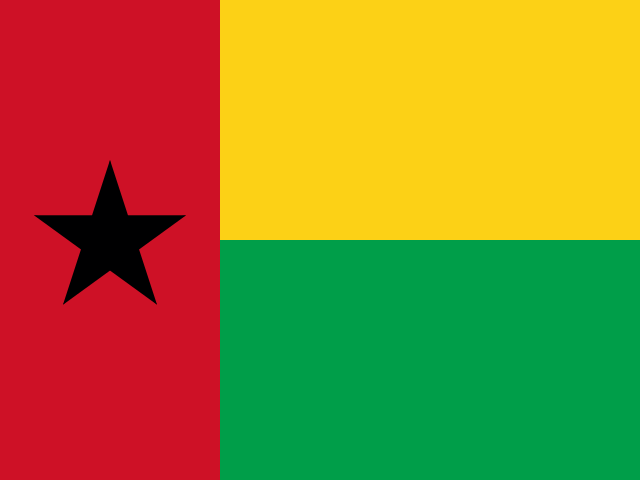
The Flag of Guinea-Bissau
Africa · Adopted 24 September 1973
Guinea-Bissau's flag was raised more than a year before Portugal itself recognized the country's independence — it was adopted on 24 September 1973 by the PAIGC (African Party for the Independence of Guinea and Cape Verde), the guerrilla movement that had been fighting Portuguese colonial rule since 1963, when it unilaterally declared the birth of the republic from territory it already controlled. Portugal did not formally recognize independence until September 1974, after the Carnation Revolution in Lisbon toppled the dictatorship that had been prosecuting Africa's colonial wars, so for roughly a year the flag flew over a state most of the world had not yet officially acknowledged.
The design was created for the PAIGC by the movement's own leadership under Amílcar Cabral, the party's founder and chief theorist of the independence struggle, who was assassinated in January 1973, just months before his movement's flag became the new nation's. The flag deliberately followed the pan-African color and symbol conventions established by Ghana in 1957 — red, yellow, green, and a black star — signaling the PAIGC's alignment with the broader continental independence movement rather than inventing an unrelated new visual language.
The black five-pointed star at the hoist is explicitly a reference to the black star on Ghana's flag, itself a tribute to the Black Star Line shipping company associated with Marcus Garvey's early-20th-century pan-Africanist movement — making Guinea-Bissau's star a symbol with roots that reach back through Ghana to a Black diaspora movement founded decades before Guinea-Bissau existed as a state. The red vertical band is understood domestically as representing the blood of those who died in the eleven-year war against Portuguese rule, one of the longest and most costly of Africa's independence conflicts. The yellow stripe stands for the sun and for the mineral and agricultural wealth of the land, and the green stands for the country's forests and hope for the future.
For nearly two decades after independence, Guinea-Bissau and Cape Verde — both born from the same PAIGC movement — used nearly identical flags, reflecting the party's original ambition to eventually unite the two territories into a single state. That plan collapsed after a 1980 coup in Guinea-Bissau soured relations between the two, and Cape Verde adopted an entirely new flag design in 1992, ending the visual link between the two former sister movements.
Guinea-Bissau's flag has not changed since 1973 despite the country's turbulent post-independence political history, which has included a civil war (1998–1999), numerous coups and attempted coups, and repeated periods of military intervention in civilian government — among the most politically unstable records in West Africa. Through all of it, the flag itself has remained a fixed point.
Because the black star, and the red-yellow-green palette, both trace back to the same Ghanaian pan-African template, Guinea-Bissau's flag is frequently mistaken at a glance for several other West and Central African flags that drew on the same visual source, even though each adopted the symbolism through its own distinct independence movement.
Amílcar Cabral himself never lived to see the flag flown over an internationally recognized state — he was assassinated in Conakry, neighboring Guinea's capital, in January 1973 by a rival PAIGC member in circumstances that remain a subject of some historical dispute over the degree of Portuguese colonial intelligence involvement — and his memory is honored across Guinea-Bissau today with his image and writings still central to the country's civic identity, giving the flag's star an additional, deeply personal layer of meaning tied to the man who never got to see it officially raised.
Guinea-Bissau remains among the poorest countries in West Africa by most economic measures, with cashew nuts making up the overwhelming majority of export earnings, a single-commodity dependence that leaves the economy — and by extension the yellow band's reference to agricultural wealth — highly exposed to global price swings in a way few other African economies are quite as narrowly tied to one crop.
The country's chronic instability has also drawn it into international drug-trafficking networks: weak institutions and porous coastlines made Guinea-Bissau a notable transit hub for South American cocaine bound for Europe through the 2000s and 2010s, a problem serious enough that some analysts and journalists at the time described the country as at risk of becoming a 'narco-state,' with several senior military officers, including a former navy chief, later sanctioned or indicted internationally on drug-trafficking charges — a grim modern chapter for a country whose flag still carries Amílcar Cabral's liberation-era symbolism.
Guinea-Bissau observes 24 September as its Independence Day, honoring the PAIGC's own 1973 unilateral declaration rather than Portugal's later September 1974 recognition — a deliberate choice that keeps the flag's founding date tied to the moment the liberation movement itself claimed statehood, not the moment the former colonial power acknowledged it, a distinction few other former Portuguese colonies draw so explicitly in their own national calendars.
Political instability has repeatedly tested the flag's continuity in the 21st century as much as it did in the 1980s and 1990s: a contested 2020 presidential election between Umaro Sissoco Embaló and Domingos Simões Pereira ended with the military installing Embaló before the country's own Supreme Court had ruled on the result, and a further attempted coup in February 2022 was put down while Embaló was in office — recent enough that the flag's continuity through instability is not only a story about the 1980s and 1990s but a still-unfolding one.
The star sits at the hoist
- Flag with a reinforced hoist edge — With the star set in a vertical band at the hoist, the design depends on which edge is fixed to the pole, and that edge is also the one that takes the load, so a reinforced header is doing two jobs here.
As an Amazon Associate we earn from qualifying purchases made through these links, at no extra cost to you.
Often confused with
- Ghana — originated the black-star-on-tricolor template that Guinea-Bissau's PAIGC deliberately borrowed, though Ghana's stripes run horizontal while Guinea-Bissau's are split between a hoist band and horizontal stripes. Compare side by side →
- Senegal — neighboring Senegal also uses green-yellow-red, though as vertical stripes with a central star rather than Guinea-Bissau's hoist-band-plus-horizontal-stripe layout, making the two easy to conflate from memory alone. Compare side by side →
Guinea-Bissau at a glance
- Capital
- Bissau
- Population
- 2.2 million (2024)
- Currency
- West African CFA Franc (XOF)
- Language(s)
- Portuguese (official); Guinea-Bissau Creole widely spoken as a lingua franca
Population figure as of 2024, source: UN World Population Prospects (2024 revision). See methodology for how facts are sourced and kept current.