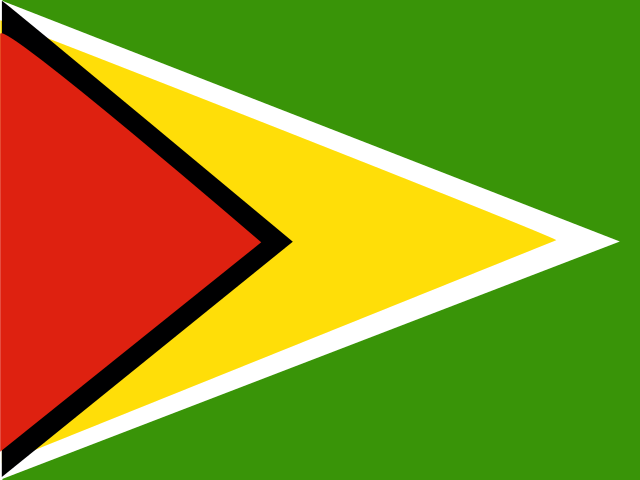
Georgetown — Capital of Guyana
Georgetown's founding is unusually tangled among South American capitals: the site was first developed under a brief French occupation in 1781–1782, when French forces seized the Dutch colonies of Demerara and Essequibo and laid out a settlement they called Longchamps. Dutch administrators regained control soon after and renamed the growing town Stabroek, a name it carried until the British took permanent control of the colony in the early 1800s.
The British renamed the settlement Georgetown in 1812, honoring King George III, and it became the administrative seat of British Guiana, the colonial territory that unified the formerly separate Dutch colonies of Demerara, Essequibo, and Berbice under one British administration. Georgetown kept that capital status straight through the colonial period and into Guyana's independence in 1966, and again when the country became a republic in 1970.
Much of Georgetown's older architecture is built from wood rather than stone or brick, a choice originally driven by the high cost of importing masonry materials into a colony with limited local stone, and the result is one of the largest collections of wooden colonial buildings anywhere in the Caribbean or South America. St. George's Cathedral, an Anglican cathedral completed in 1892 and built almost entirely of wood, is regularly cited as one of the tallest wooden religious buildings in the world.
The city itself sits below sea level along the Atlantic coast, a legacy of the Dutch engineers who first drained and settled the area using a system of canals, dams, and sea defenses modeled on techniques used in the Netherlands — infrastructure that modern Georgetown still depends on, since much of the city would flood without the seawall and drainage network the Dutch began building in the 18th century.
Georgetown's street grid still reflects its Dutch colonial layout, with canals running through several neighborhoods that were originally designed for drainage and small-boat transport rather than as decorative features, giving parts of the city a visibly different urban pattern from the Spanish-grid layouts common in most other South American capitals.
The city is also home to the Stabroek Market, a cast-iron market building imported prefabricated from the United States and completed in 1881, whose distinctive clock tower remains one of Georgetown's most recognizable landmarks and one of the few surviving reminders of the city's earlier Dutch name.
Georgetown's Botanical Gardens, laid out in 1879, hold one of the more significant colonial-era plant collections in the Caribbean and South American region, and the adjoining Georgetown Zoo, established later on the same grounds, remains one of the few zoological parks in the country.
The city has become newly significant to Guyana's economy since offshore oil discoveries beginning in 2015 transformed the country from one of South America's poorer nations into one with among the fastest-growing GDPs in the world, and Georgetown has absorbed much of the resulting construction, investment, and population growth as companies and workers arrived to service the new offshore industry.
Georgetown's colonial-era canal system, though reduced in scope compared to its 19th-century extent, still requires constant maintenance to keep the city habitable, and periodic flooding during the rainy season remains a recurring civic issue that city planners trace directly back to the below-sea-level engineering choices Dutch settlers made more than 300 years ago.
Quick facts
- Georgetown's metropolitan population is roughly 200,000 within city limits, with the greater urban area home to a larger share of Guyana's small national population of under a million.
- The city's Dutch-built sea wall stretches for miles along the Atlantic coast and remains actively maintained, since large parts of Georgetown sit below high-tide sea level.
- St. George's Cathedral, completed in 1892, stands roughly 43.5 meters (about 143 feet) tall and is frequently cited among the tallest wooden buildings used for worship anywhere in the world.
- Georgetown was the site of the founding congress of the People's Progressive Party in 1950, a pivotal moment in Guyana's independence movement led by Cheddi Jagan and Forbes Burnham.
- The city's name has never reverted to Stabroek or Longchamps despite the colony changing hands multiple times before British rule was secured — it has been Georgetown continuously since 1812.