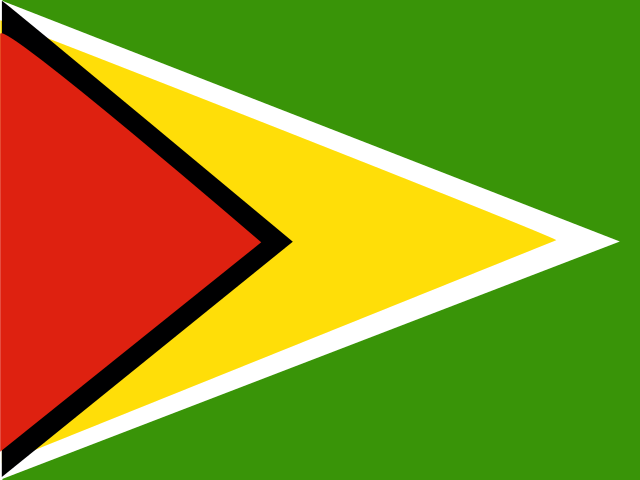
The Flag of Guyana
South America · Adopted 26 May 1966
Guyana's flag was hoisted for the first time at the exact moment the country stopped being British Guiana, on independence day, 26 May 1966, which makes it one of the relatively few national flags whose adoption date is also literally the country's birth date rather than a later formalization of an older revolutionary banner. It replaced the British Blue Ensign defaced with the colony's badge that had flown over the territory throughout the colonial period.
The design is popularly known as the Golden Arrowhead, and it wasn't drawn up by a Guyanese committee — it was commissioned from Whitney Smith, the American who coined the term 'vexillology' for the study of flags and ran a private flag research center in Massachusetts. Smith's original submission went through revisions by the College of Arms in London, which widened the black and white borders separating the main color fields before the design was finalized for independence, a detail of British institutional oversight that's easy to forget given how distinctly Guyanese the finished flag reads today.
The geometry itself is genuinely unusual among the world's flags: a green field carries a red triangle at the hoist and a longer gold arrowhead pointing toward the fly, with the arrowhead outlined first in black and then in white. Very few national flags use this triangle-within-triangle arrowhead structure, which is part of why the Golden Arrowhead is often singled out by vexillologists as one of the more distinctive designs adopted during the wave of 1960s decolonization.
Each element carries a specific reading tied to the country rather than a generic virtue. Green stands for Guyana's forests and its agricultural land, which together cover the overwhelming majority of the country's territory. The gold arrowhead represents mineral wealth, a reference to Guyana's long history of gold and, more recently, bauxite and diamond extraction. The red triangle is read as the zeal and dynamism required to build a new nation. Black stands for the endurance the country would need to sustain that effort, and the white border represents Guyana's many rivers, which have historically served as the main routes into an interior that dense rainforest otherwise makes difficult to cross by road.
Guyana's flag has not been redesigned since 1966, which stands out given how much the country's politics shifted in the following decades — it became a republic within the Commonwealth in 1970, and its economy and demographics (a population split roughly between descendants of enslaved Africans and indentured Indian laborers brought under British rule) have remained politically significant ever since, without prompting any change to the national symbol both communities fly.
As the only English-speaking country in South America — a legacy of British rather than Spanish or Portuguese colonization — Guyana's flag stands visually apart from every one of its tricolor-heavy neighbors, and its arrowhead geometry has no close match anywhere else on the continent.
The flag is flown most prominently on Republic Day, 23 February, marking the 1970 declaration of the Co-operative Republic of Guyana, and on Independence Day itself, 26 May, when it is displayed nationwide alongside events commemorating the 1763 Berbice slave rebellion led by Cuffy, now honored as a national hero.
The Golden Arrowhead has taken on renewed prominence in recent years because of Guyana's long-running border dispute with Venezuela over the Essequibo region, a resource-rich area making up roughly two-thirds of Guyana's territory that Venezuela has claimed since the 19th century and pressed more aggressively after a 2015 offshore oil discovery inside the disputed zone. Venezuela held a domestic referendum in December 2023 asserting sovereignty over Essequibo, and Guyanese officials and citizens have since flown the Golden Arrowhead more visibly across the contested territory itself as a deliberate assertion of Guyana's own claim, a dispute that remains unresolved and, as of 2026, still sits before the International Court of Justice.
Whitney Smith, the flag's designer, went on to found the Flag Research Center in Winchester, Massachusetts, and is credited with coining the English word 'vexillology' itself in 1957, nearly a decade before Guyana's independence gave him the chance to design a national flag rather than simply study other people's.
Because the Golden Arrowhead was commissioned from an outside designer rather than emerging from a homegrown competition, as several other newly independent Caribbean and Latin American nations did around the same period, some early Guyanese commentators questioned whether a foreign vexillologist should have final say over the country's founding symbol — a debate that faded quickly once the design was in wide public use, but one that's occasionally revisited in Guyanese cultural retrospectives on the independence era.
The flag's specific proportions — a 3:5 ratio, with the red triangle's point reaching exactly to the flag's horizontal center and the gold arrowhead extending nearly to the fly edge — are fixed by Guyanese law with the same degree of precision typical of flags formalized during the 1960s wave of decolonization, when many new governments used exact legal specification of national symbols as a visible marker of sovereign statehood.
Where the triangle's point lands
- Geometry-accurate flag — The red triangle reaches exactly the midpoint of the length and the gold arrowhead runs almost to the fly, so two overlapping triangles have to be cut to stated depths rather than eyeballed.
As an Amazon Associate we earn from qualifying purchases made through these links, at no extra cost to you.
Guyana at a glance
- Capital
- Georgetown
- Population
- 0.83 million (2024)
- Currency
- Guyanese Dollar (GYD)
- Language(s)
- English (official); Guyanese Creole widely spoken
Population figure as of 2024, source: UN World Population Prospects (2024 revision). See methodology for how facts are sourced and kept current.