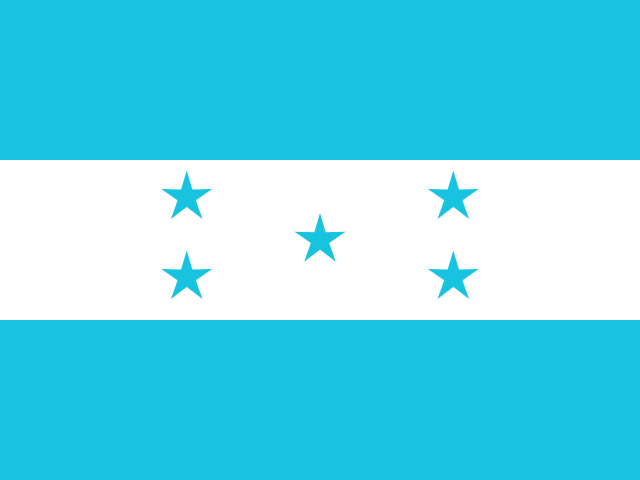
Tegucigalpa — Capital of Honduras
Tegucigalpa was founded in 1578 as a Spanish mining settlement, drawn there by silver deposits in the surrounding hills, and its name is usually traced to a Nahuatl-influenced term meaning something close to "silver hill," though the exact etymology is debated among linguists and some older sources instead connect it to an indigenous Lenca place-name that predates the Spanish town. It shared prominence with the older colonial city of Comayagua for much of the Spanish colonial period, and the rivalry between the two cities over which should serve as capital continued well into Honduras's independent history.
Tegucigalpa became Honduras's permanent capital in 1880, when President Marco Aurelio Soto formally moved the seat of government there from Comayagua, ending a back-and-forth that had seen the capital shift between the two cities multiple times earlier in the 19th century. Soto's decision is generally attributed to Tegucigalpa's mining wealth and its more defensible, centrally located position in the mountains, rather than any single dramatic event forcing the move.
In 1938, Tegucigalpa was administratively merged with the neighboring city of Comayagüela, across the Choluteca River, into a single Central District, effectively folding its old colonial rival into greater Tegucigalpa rather than continuing the two as separate urban centers — a resolution, of sorts, to the centuries-old competition between the region's cities for political primacy.
The city's mountainous, bowl-shaped setting, hemmed in by hills on most sides, has repeatedly made it vulnerable to flooding and landslides; Hurricane Mitch in 1998 caused catastrophic flooding and destruction across Tegucigalpa, killing thousands nationally and reshaping parts of the capital's informal settlements, which remain concentrated on steep, flood- and landslide-prone hillsides.
Tegucigalpa's colonial-era core, including the 18th-century Cathedral of San Miguel and a cluster of Spanish Baroque churches, survives alongside a modern government and university district, and the city functions as Honduras's political and cultural hub even though the northern city of San Pedro Sula has, at various points since the late 20th century, generated a larger share of the country's industrial and commercial output.
The city's silver mines, which drew Spanish settlers to the site in the 16th century, continued to operate on and off for centuries afterward and are part of why Tegucigalpa, rather than a coastal city, was viable as a major inland settlement at all during the colonial period, when overland transport across Honduras's rugged terrain was slow and difficult; the mining wealth that built the early town also financed much of its surviving colonial-era church architecture, commissioned by wealthy mine owners and merchants.
The city's long rivalry with Comayagua also had a religious dimension: Comayagua held status as the seat of the region's Catholic diocese for much of the colonial period, giving it an ecclesiastical prestige Tegucigalpa initially lacked even as the latter grew wealthier from mining, and the eventual shift of political primacy to Tegucigalpa in the 19th century is often described by Honduran historians as the moment the country's commercial and administrative center decisively pulled ahead of its older religious and ceremonial one.
Quick facts
- Greater Tegucigalpa's population passed 1.3 million as of 2024, spread across a metropolitan area that sprawls over some of the roughest terrain of any Central American capital, with many neighborhoods built directly onto steep, landslide-prone hillsides.
- The Basílica de Nuestra Señora de Suyapa, on the city's southeastern edge, houses Honduras's tiny patron-saint statue, the Virgin of Suyapa, and draws large pilgrimage crowds each February.
- The National Autonomous University of Honduras (UNAH), founded in 1847 and headquartered in Tegucigalpa, is the country's oldest and largest institution of higher education.
- Tegucigalpa sits at an elevation of roughly 990 meters (3,250 feet) in a mountain valley, giving it a notably cooler climate than Honduras's coastal cities.
- Toncontín International Airport, long the city's main air link, was for decades considered one of the more challenging commercial airports in the world because of its short runway hemmed in by hills — a factor in relocating most commercial traffic to the newer Palmerola airport starting in 2021.