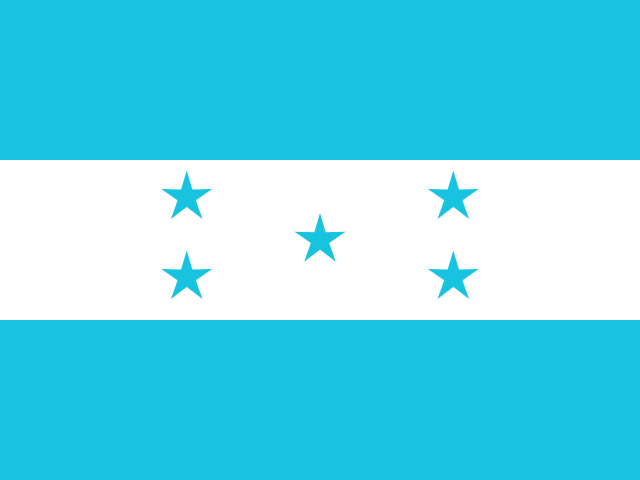
The Flag of Honduras
North America · Adopted 16 February 1866
Honduras's flag descends directly from the banner of the Federal Republic of Central America (1823–1841), a short-lived union of five newly independent Spanish-American states — Guatemala, El Salvador, Honduras, Nicaragua, and Costa Rica — that briefly tried to govern the isthmus as a single country after breaking from both Spain and, briefly, the Mexican Empire. That federal flag was a horizontal blue-white-blue tricolor, and when the Federation dissolved into five separate republics, Honduras was one of several successor states that kept the same blue-white-blue pattern rather than inventing a wholly new one, choosing continuity with the federal project over a clean break from it.
Honduras formally adopted its current flag on 16 February 1866, adding five blue five-pointed stars arranged in an X pattern across the central white stripe — a detail unique to Honduras among its blue-white-blue siblings. The five stars are explicitly interpreted as representing the five original states of the Central American Federation, making the flag itself a standing memorial to a political union that had already failed by the time this specific design became official, and an implicit statement of hope, still occasionally voiced in Honduran political rhetoric, that Central American unification might someday be revived.
The blue bands are read as representing the Pacific Ocean and Caribbean Sea that border the isthmus on its two coasts, a maritime symbolism shared, with local variation, across the former federation's other flags, while the white band stands for peace and the land between the two seas. This two-ocean framing is common to Nicaragua's and El Salvador's flags as well, since all three trace to the same federal template, but Honduras is the only one of the three that kept plain blue-white-blue stripes without adding a national coat of arms directly onto the field — the Honduran coat of arms exists and appears on some official and military versions, but the standard civil flag most Hondurans fly is the plain striped-and-starred version, unlike El Salvador's flag, which carries its coat of arms centered on the white band as standard.
Nicaragua, the third of the trio to retain the same base pattern, places its own coat of arms — a triangle with a rainbow and five volcanoes — centered on the white stripe of its flag, while Honduras instead marks its shared federal ancestry with the five stars rather than a coat of arms, a genuinely different design choice among three countries that all descend from the identical 1823 federal banner. Guatemala and Costa Rica, the other two federation successor states, broke from the blue-white-blue pattern more sharply — Guatemala went with blue-white-blue arranged vertically and later added its own quetzal-bearing coat of arms, while Costa Rica added a red band and its own coat of arms in the 1840s, moving furthest from the shared origin.
The five-star arrangement has not been redesigned since 1866, making Honduras's flag one of the more stable in the region despite the country's frequent political upheavals over the following century and a half, including repeated changes of government, periods of military rule in the 20th century, and a 2009 constitutional crisis — none of which prompted a flag change, unlike some neighboring states that redesigned their flags to mark specific new regimes.
Because Honduras, Nicaragua, and El Salvador all fly some version of a blue-white-blue horizontal tricolor, the three are commonly confused by outsiders unfamiliar with the region's shared 19th-century federal history; distinguishing them in practice usually comes down to whether a coat of arms is present in the center (El Salvador, standard use) or absent (Honduras, standard use, but marked instead with the five stars), with Nicaragua's coat of arms design being visually the most distinct of the three when present.
The Honduran coat of arms itself, reserved mainly for official and military versions of the flag rather than everyday civilian use, depicts a triangle enclosing a rainbow, a mountain landscape flanked by two watchtowers, and a chest of tools associated with mining — a set of symbols dating in earlier form to the Spanish colonial period, when silver mining around cities like Tegucigalpa was central to the region's economy, and later readapted after independence to represent the young republic's natural resources and its aspiration toward prosperity built on them.
The five stars are rendered in a fixed cross-like X arrangement specified by the 1866 decree, with the government's official material describing them as spanning the white stripe from roughly the upper hoist corner to the lower fly corner and vice versa; Honduran civic education consistently frames the arrangement as a deliberate act of remembrance for the Central American Federation rather than a purely decorative choice, and Independence Day observances on 15 September — shared as a common date across all five former federation states, since all five declared independence from Spain together in 1821 — regularly reference the flag's federal ancestry directly in official speeches.
Honduras briefly annexed itself to the short-lived Mexican Empire under Agustín de Iturbide immediately after breaking from Spain in 1821, alongside the rest of the future Central American Federation states, before that empire collapsed within two years and the isthmus's provinces regrouped into the federal republic whose flag Honduras still echoes; this early, largely forgotten Mexican interlude is part of the reason Central America's independence movements are often taught as a two-stage break — first from Spain, then from Mexico — rather than the more familiar single-step narrative found in most former Spanish colonies.
Five stars on the white band
- Placement-accurate flag — This is the one of the three related flags that carries stars rather than an emblem on the middle band, arranged in an X, so a plain white band or a neat row means the wrong flag.
As an Amazon Associate we earn from qualifying purchases made through these links, at no extra cost to you.
Often confused with
- Nicaragua — shares the identical blue-white-blue base pattern from the same 1823 Central American Federation flag, but Nicaragua centers a triangle-and-volcanoes coat of arms on the white stripe rather than Honduras's five stars. Compare side by side →
- El Salvador — also descends from the same federal blue-white-blue tricolor and, in its standard civil version, centers its own coat of arms on the white stripe — a detail Honduras's standard flag omits in favor of the five-star X pattern. Compare side by side →
Honduras at a glance
- Capital
- Tegucigalpa
- Population
- 10.6 million (2024)
- Currency
- Honduran Lempira (HNL)
- Language(s)
- Spanish (official)
Population figure as of 2024, source: UN World Population Prospects (2024 revision). See methodology for how facts are sourced and kept current.