Reykjavik — Capital of Iceland
Reykjavik holds a claim few other national capitals can make: according to Iceland's medieval Landnámabók (Book of Settlements), it was the very first permanent settlement on the island, founded around 874 CE by Ingólfur Arnarson, traditionally regarded as Iceland's first settler, who is said to have thrown his high-seat pillars overboard as he approached the coast and settled wherever they washed ashore — landing at a bay he reportedly named Reykjavik, or 'smoky bay,' after the geothermal steam rising from the ground nearby, the same geothermal activity that still heats most of the city today.
Despite that founding-era prominence, Reykjavik spent most of the following thousand years as a modest farming settlement rather than a city of any real size or political weight — Iceland had no single fixed capital through the medieval and early modern periods, with the Althing, the national assembly established around 930 CE and among the oldest parliamentary institutions in the world, meeting instead at Þingvellir, a dramatic rift-valley site roughly 45 kilometers from Reykjavik, rather than in the settlement itself.
Reykjavik's rise to genuine urban and administrative importance began in the 18th century under Danish colonial administration, when Danish authorities established trade monopoly operations and small-scale industry there in the 1750s, and it was formally granted status as Iceland's principal town later that century; by the time the Althing was reconvened as a consultative body in 1845 (having been suspended in 1800), it met in Reykjavik rather than Þingvellir, cementing the city's role as Iceland's administrative center even while the country remained under the Danish crown.
Reykjavik became capital of a fully sovereign Iceland in stages that track the country's own gradual path to independence: seat of home rule government from 1904, capital of the separate Kingdom of Iceland (still in personal union with Denmark) from 1918, and finally capital of the fully independent Republic of Iceland when it was declared at Þingvellir — not in Reykjavik itself — on 17 June 1944, even though the republic's actual government and institutions were and remain based in the city.
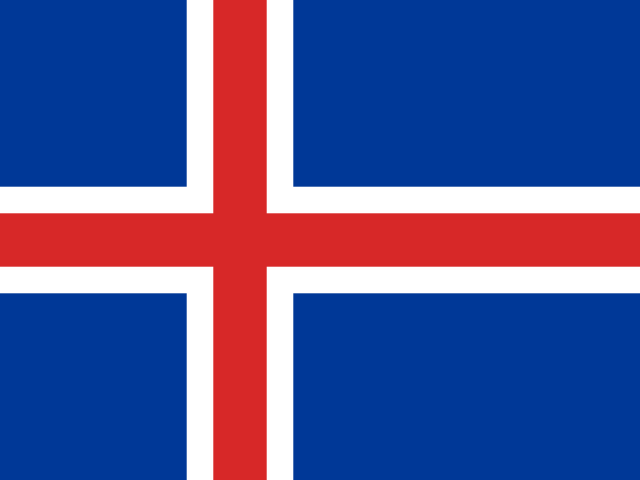
As one of the world's northernmost national capitals, Reykjavik's identity is closely tied to the same geothermal and volcanic geology that supplies much of its heating and electricity — a resource that also, more dramatically, produces the occasional nearby volcanic eruptions on the Reykjanes Peninsula that have drawn global attention in the 2020s, underscoring how directly the city's daily life and Iceland's own flag symbolism (fire beneath ice) both trace back to the same volcanic landscape.
The city's Hallgrímskirkja church, completed in 1986 after more than 40 years of intermittent construction, was designed to echo the basalt lava columns found in Iceland's landscape, and its tower remains one of the tallest structures in the country and a landmark visible from most of central Reykjavik.
Reykjavik grew only modestly for most of its early history, and it was Danish colonial trade policy more than any organic urban development that first pushed it toward town status in the mid-1700s; the city did not receive formal municipal charter status until 1786, meaning Reykjavik has held official town rights for only a little over two centuries despite the settlement's own origin story reaching back over a thousand years.
The Second World War transformed Reykjavik almost overnight: British forces occupied neutral Iceland in May 1940 to preempt a feared German invasion, followed by American troops from 1941 under a bilateral defense agreement, and the resulting military construction — roads, an airport, harbor facilities — and wartime employment boom accelerated Reykjavik's growth and modernization far faster than peacetime development likely would have.
Iceland's population was so overwhelmingly rural for so long that Reykjavik did not become home to a genuine majority of the national population until well into the 20th century, a comparatively late and rapid urbanization that gives the capital's growth history a notably different shape from most long-established European capitals, which typically urbanized far more gradually over centuries.
Quick facts
- Reykjavik's city population is around 140,000 as of 2024, but the capital region holds roughly two-thirds of Iceland's entire national population of under 400,000.
- Reykjavik is generally cited as the northernmost capital of a sovereign state in the world, sitting just south of the Arctic Circle.
- Nearly all of the city's heating comes from geothermal energy, piped in from nearby hot springs and geothermal fields — a system that has supplied Reykjavik's district heating network since the 1930s.
- The Althing, Iceland's parliament, is one of the oldest continuously operating national assemblies in the world, tracing its founding to roughly 930 CE at Þingvellir, though it has met in Reykjavik since the 19th century.
- Reykjavik hosted the 1986 Reagan-Gorbachev summit, a Cold War superpower meeting widely credited with laying groundwork for later nuclear arms reduction agreements.