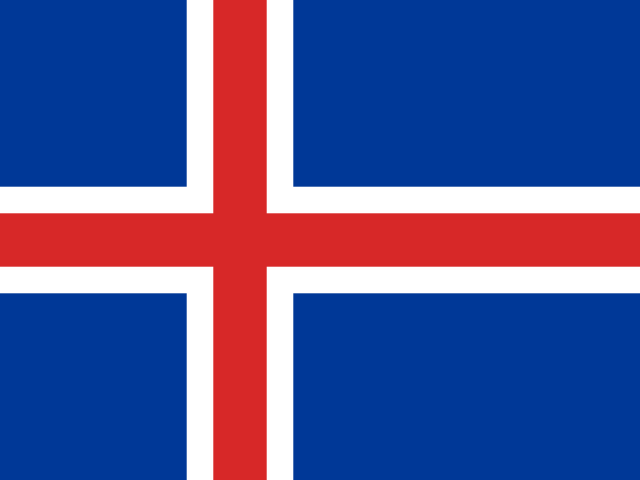
The Flag of Iceland
Europe · Adopted 19 June 1915 (as national flag); 17 June 1944 (as flag of the fully independent Republic)
Iceland's flag design was the personal proposal of Matthías Þórðarson, a young Icelandic scholar who in 1906 suggested a blue field with a white-fringed red cross to a student society in Reykjavik, at a time when Iceland was still a dependency of Denmark and had no distinct national flag of its own to fly — Icelanders at the time were legally required to use the Danish flag, the Dannebrog, on Icelandic soil, a point of considerable resentment among the nationalist movement pressing for greater self-rule.
Þórðarson's design deliberately followed the Scandinavian cross pattern already shared by Denmark, Norway, and Sweden — a visual statement that Iceland belonged to the same Nordic family of nations even while asserting a distinct identity within it — but distinguished itself with a specific color combination unlike any of its Nordic neighbors: a sky-blue field, a white cross, and a fiery red cross centered within the white. Icelandic tradition holds that the three colors were chosen to represent the island's own landscape directly: blue for the surrounding ocean and the mountains seen from a distance, white for glacial ice and snow, and red for the volcanic fire beneath the island's surface — an origin story genuinely distinct from most European cross flags, whose colors typically trace to a royal house or a religious symbol rather than a description of the country's own geology.
Denmark granted Iceland the right to fly its own civil and merchant flag in 1915, formalizing Þórðarson's design as Iceland's official flag under the terms of Iceland's status as a separate kingdom in personal union with the Danish crown — a step short of full independence but the first time Icelanders were legally permitted to fly a flag other than the Dannebrog on Icelandic soil and Icelandic-registered ships.
Full Icelandic independence came on 17 June 1944, chosen deliberately during the Second World War while Denmark itself was under Nazi German occupation and unable to object or intervene — Icelanders voted overwhelmingly in a referendum to dissolve the remaining union with the Danish crown and establish the Republic of Iceland, and the same 1915 flag design, unchanged, became the flag of the fully sovereign republic that day, a date still celebrated annually as Iceland's national day.
The exact shade of blue was formally darkened in 1944 at the point of full independence — the original 1915 version used a lighter sky-blue closer to the Norwegian and other Nordic cross flags' shades, while the 1944 law specified a deeper ultramarine blue, giving Iceland's flag a visually distinct tone from its Nordic neighbors' generally paler or differently balanced blues.
Iceland's flag has not been redesigned since 1944, and Icelandic law fixes both the exact proportions of the cross's offset (shifted toward the hoist, in the standard Scandinavian cross style shared with Denmark, Norway, Sweden, and Finland) and the precise legal shades of blue, white, and red, treating unauthorized alteration of the flag's design as a matter regulated by national flag law.
Despite sharing the Scandinavian cross format with four other Nordic flags, Iceland's specific blue-white-red combination is distinctive enough within that family that it is rarely confused at a glance with Norway's near-identical red-white-blue cross — the two flags use the same three colors but reverse which color forms the cross and which forms the field, a genuine and sometimes cited point of visual confusion between the two.
Iceland has no armed forces of its own beyond a small coast guard, which gives the flag a somewhat different everyday civic role than in many nations — it is flown mainly at government buildings, schools, and private homes on national holidays rather than being closely tied to military ceremony or regiments, and Icelandic flag etiquette (regulated by the 1944 law and subsequent guidance) focuses mainly on correct display alongside other Nordic flags at joint Nordic Council events, where Iceland's flag sits alongside those of Denmark, Norway, Sweden, and Finland as a formally recognized peer despite Iceland's tiny population relative to its neighbors.
Þórðarson, the flag's original designer, did not live to see his 1906 sketch reach full legal recognition as the flag of a fully sovereign state — he died in 1961, seventeen years after the 1944 declaration of the Republic, but well after having watched his student-society proposal move from an informal nationalist gesture to Iceland's permanent national symbol across nearly four decades.
Iceland's 1944 independence referendum produced an overwhelming result, with more than 97 percent of voters supporting full separation from Denmark — a margin reflecting both genuine national sentiment and the practical reality that wartime conditions made any real Danish objection impossible, since Denmark itself was under German occupation and its own king, Christian X, was in no position to intervene in a vote taking place thousands of kilometers away in the North Atlantic.
A white border around the red cross
- Geometry-accurate flag — The red cross sits inside a wider white one, so the design depends on the white border staying an even width all the way round; a cross drawn too wide swallows it at the arms.
As an Amazon Associate we earn from qualifying purchases made through these links, at no extra cost to you.
Often confused with
- Norway — uses the identical Scandinavian cross layout with the same three colors — red, white, and blue — but reverses the arrangement: Norway's flag is a red field with a blue-and-white cross, while Iceland's is a blue field with a red-and-white cross. Compare side by side →
- Denmark — the country Iceland's flag was created in direct contrast to; both use the Scandinavian cross format, but Denmark's Dannebrog is a plain red field with a white cross, sharing no color overlap at all with Iceland's blue-white-red beyond the shared cross shape. Compare side by side →
Iceland at a glance
- Capital
- Reykjavik
- Population
- 395,000 (2024)
- Currency
- Icelandic Krona (ISK)
- Language(s)
- Icelandic (official)
Population figure as of 2024, source: UN World Population Prospects (2024 revision). See methodology for how facts are sourced and kept current.