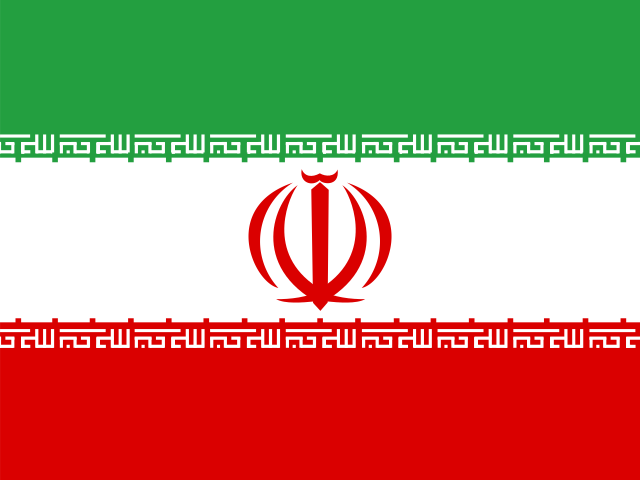
Tehran — Capital of Iran
Tehran became Iran's capital in 1786, when Agha Mohammad Khan, founder of the Qajar dynasty, chose it as his seat of power — a comparatively young capital by the standards of Iranian history, given that Persia's various empires and dynasties had previously ruled from cities such as Isfahan, Shiraz, and, in antiquity, Persepolis, all of which carry far older imperial associations than Tehran does.
Agha Mohammad Khan's choice was partly strategic: Tehran sat closer to the Qajar tribal power base in northern Iran and to the Caspian region than the Safavid dynasty's former capital of Isfahan did, and it also offered easier access for controlling both the northern and central parts of the country than more southern cities could.
The city grew relatively slowly through the 19th century compared to the scale it would later reach, but expanded dramatically during the 20th century under the Pahlavi dynasty (1925–1979), which pursued aggressive modernization and Westernization programs that reshaped Tehran with wide boulevards, government buildings, and new residential districts, transforming it from a mid-sized Qajar-era city into a sprawling modern metropolis.
Tehran sits at the foot of the Alborz mountain range, whose peaks, including Mount Damavand — Iran's highest point and one of the tallest volcanoes in Asia — are visible from much of the city on clear days, giving Tehran a dramatic northern backdrop unusual among major Middle Eastern capitals built primarily on flat terrain.
The city was the site of major protests during the 1979 Islamic Revolution that ended Pahlavi rule and established the Islamic Republic, and it has remained the political and administrative center of Iran throughout the decades since, hosting the country's parliament, supreme leader's office, and most national government ministries.
Tehran's Grand Bazaar, one of the largest and oldest covered marketplaces in the Middle East, predates the city's status as capital and has functioned continuously as a commercial hub through the Qajar, Pahlavi, and Islamic Republic periods, historically serving as a center of political organizing as well as trade — bazaar merchants played a notable role in both the 1906 Constitutional Revolution and the 1979 uprising.
The city sits close to several active geological fault lines and has a documented history of destructive earthquakes affecting the wider region, a risk that has periodically prompted Iranian officials to discuss relocating some government functions away from Tehran, though no such relocation has been carried out; the city's rapid, dense 20th-century growth has left much of its housing stock built before modern seismic building codes were widely enforced.
The Azadi Tower, a marble monument in western Tehran completed in 1971 to mark the 2,500th anniversary of the Persian Empire under the Pahlavi monarchy, was later renamed 'Freedom Tower' after the 1979 revolution and became a central gathering point during the mass protests that year, giving one of Tehran's most recognizable modern landmarks a symbolic role in both the monarchy it was built to celebrate and the revolution that overthrew it.
Tehran's dense urban core is bisected by a network of north-south avenues climbing gradually toward the foothills, and wealthier, cooler neighborhoods have historically clustered in the city's north closer to the mountains, while more industrial and lower-income districts sit further south — a north-south economic gradient shaped substantially by elevation and the resulting difference in summer temperatures across the sprawling city.
Quick facts
- Tehran's metropolitan area is home to more than 9 million people within the city proper and well over 13 million across the wider metropolitan region.
- Tehran replaced Isfahan as Iran's capital in 1786, ending Isfahan's roughly two-century run as the seat of the Safavid dynasty.
- Mount Damavand, visible from Tehran on clear days, is the highest peak in Iran and the highest volcano in Asia.
- Tehran's severe air pollution, driven by traffic and its mountain-basin geography that traps smog, has periodically forced school and business closures in recent years.
- The city hosts the Golestan Palace, a Qajar-era royal complex and UNESCO World Heritage Site dating to the dynasty that first made Tehran the capital.