The Flag of Iran
Asia · Adopted 29 July 1980
Iran's current flag was formally adopted on 29 July 1980, about eighteen months after the 1979 Islamic Revolution overthrew the Pahlavi monarchy, and it keeps the green-white-red horizontal tricolor that Iran had already been using in one form or another since the 1906 Constitutional Revolution — the new government changed what sits on top of those colors, not the colors themselves.
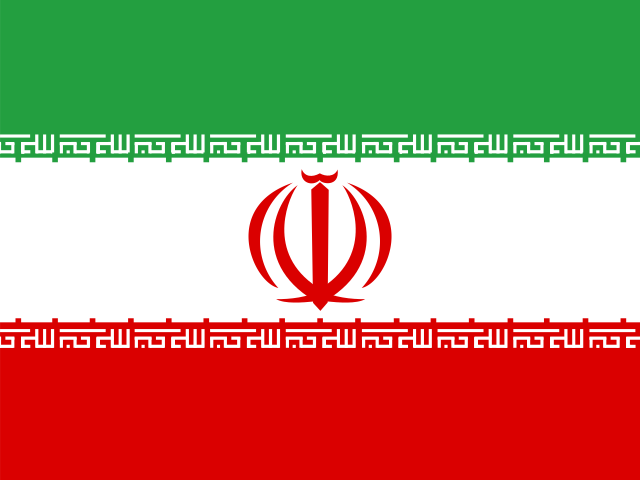
The most visible change was the removal of the Pahlavi-era emblem, a lion holding a sword in front of a rising sun, which had represented the monarchy and Persian royal tradition, and its replacement with a stylized red emblem in the center of the white band. That emblem is a compressed, geometric rendering of the word 'Allah' along with elements read as a tulip shape — tulips being a traditional Persian symbol of martyrdom, particularly resonant given the flag's redesign came so soon after the deaths of protesters during the revolution.
The flag's most distinctive and least widely known feature outside Iran is the Takbir — the phrase 'Allahu Akbar,' God is greatest — written in white Kufic-style Arabic script eleven times along the top edge of the green band and eleven times along the bottom edge of the red band, for 22 repetitions in total. The number 22 is not arbitrary: it refers to the 22nd day of Bahman, the eleventh month of the Iranian solar calendar, which corresponds to 11 February — the date in 1979 the revolution is officially considered to have succeeded, when Ayatollah Khomeini's supporters took control of Tehran.
Green, white, and red as a set predate the Islamic Republic by more than seven decades; the tricolor was formalized during Iran's constitutional movement in the early 20th century and has been read since then as representing, respectively, growth and Islam, peace, and the martyrdom and courage of Iranians who died defending the country — a reading the post-1979 government kept and simply layered new religious symbolism onto rather than discarding.
Iran's flag has gone through several emblem changes across the 20th century as its government changed — imperial versions carried the lion-and-sun for decades under the Qajar and Pahlavi dynasties — but the 1980 version has now been in continuous use longer than any of its 20th-century predecessors, and Iranian law treats both the emblem and the Takbir inscriptions as fixed, non-optional elements whenever the flag is officially reproduced.
The old lion-and-sun emblem has not disappeared from Iranian political life; it is still used informally by some opposition and monarchist groups abroad as a symbol of pre-1979 Iran, which makes the emblem itself, rather than the underlying tricolor, the main point of visual and political contrast between supporters and opponents of the current Iranian government when either group displays a version of the flag.
Because the green-white-red tricolor pattern is shared, in different orders and with different emblems, by several other nations' flags in the region and beyond, Iran's flag is occasionally confused at a glance with others using the same three colors, though the Takbir script running along both color boundaries is unique to Iran and is usually the fastest way to identify it correctly even from a distance.
The flag's official construction ratio is 4:7, noticeably squarer than the 2:3 ratio common to many national flags, and government specifications set exact proportions for the width of each colored band, the size of the central emblem, and the spacing of the repeated Takbir inscriptions, leaving little room for informal variation in officially produced flags.
The flag itself has become a visible point of political contest during recent unrest inside Iran: during the widespread protests that followed the September 2022 death of Mahsa Amini in police custody, some demonstrators displayed flags with the current central emblem removed or replaced with the pre-1979 lion-and-sun symbol, using the substitution as a pointed rejection of the Islamic Republic's imagery rather than of the underlying green-white-red tricolor itself, which both supporters and many opponents of the government continue to treat as representing Iran rather than any one political era.
The current flag's adoption date, July 1980, fell only months before Iraq invaded Iran in September that year, launching the eight-year Iran-Iraq War; the newly finalized flag and its added religious symbolism circulated widely on wartime propaganda, military banners, and martyrs' memorials throughout that conflict, tying the redesigned flag closely to Iran's wartime national identity from almost its first year in use.
The tricolor's original 1906 meanings, fixed during Iran's Constitutional Revolution, were framed in more secular nationalist terms than the post-1979 government's religious reading, which is one reason some Iranian historians describe the flag's story as two distinct symbolic layers stacked on the same three colors — an early-20th-century constitutional-nationalist layer and a later Islamic Republic layer — rather than one continuous, unchanging meaning.
Iranian embassies and consulates abroad are required to display the flag with the same precise emblem and script specifications used domestically, and Iranian civil aviation and shipping registries also carry versions of the flag under separate regulations, meaning the 1980 design's exact geometry has to be reproduced consistently across a wide range of official contexts well beyond government buildings inside Iran itself.
Often confused with
- Hungary — uses the same three colors as a plain horizontal tricolor with no emblem at all, so confusion is mostly limited to a first glance at the color palette rather than the full design, since Iran's flag carries both a central emblem and the Takbir script Hungary's lacks. Compare side by side →
Iran at a glance
- Capital
- Tehran
- Population
- 89.2 million (2024)
- Currency
- Iranian Rial (IRR)
- Language(s)
- Persian (Farsi, official); Azerbaijani, Kurdish, and other regional languages widely spoken
Population figure as of 2024, source: UN World Population Prospects (2024 revision). See methodology for how facts are sourced and kept current.