Dublin — Capital of Ireland
Dublin's origins as an urban settlement are Viking rather than Gaelic: Norse raiders established a fortified trading base at the mouth of the River Liffey around 841 CE, taking advantage of a dark tidal pool (the 'dubh linn' the city's name derives from) that made a natural harbor, and the settlement grew into one of the most important Viking trading towns in the North Atlantic world, with links stretching to Scandinavia, Britain, and beyond, long before it had any connection to a unified Irish state that did not yet exist.
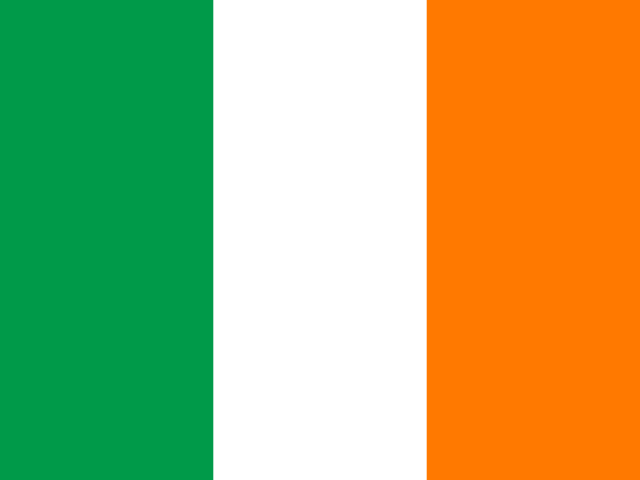
The city's role as a center of English, and later British, colonial administration in Ireland began after the Anglo-Norman invasion of 1169-71, and Dublin Castle, built from 1204 under King John, served for over seven centuries as the seat of English and then British rule over Ireland — making Dublin, somewhat paradoxically, the administrative capital of colonial Ireland for far longer than it has been capital of an independent one, a history the tricolor flag flown from the same castle since 1922 was specifically raised to supersede.
Dublin transformed into a genuinely elegant Georgian city through the 18th century, with the Anglo-Irish ascendancy building the wide streets, garden squares (like Merrion Square and St Stephen's Green), and grand townhouses that still define much of the city's architectural character, even as the same period's Penal Laws severely restricted the rights of the Catholic majority who made up most of the population outside that ascendancy class.
Dublin was the site of the 1916 Easter Rising, when rebels seized the General Post Office and other key buildings and proclaimed an Irish Republic — a rising crushed within a week by British forces, but one whose leaders' subsequent executions turned Irish public opinion decisively toward full independence, achieved after the 1919-21 War of Independence fought substantially, though not exclusively, in and around the capital.
Since independence, Dublin has been capital of the Irish Free State (1922) and then the Republic of Ireland, growing rapidly from the 1990s onward during the 'Celtic Tiger' economic boom, which drew major multinational technology and pharmaceutical companies to establish European headquarters in the city, transforming Dublin's economy and skyline within a generation.
The Great Famine of the 1840s, while its worst effects were felt in rural Ireland, also drove huge numbers of the rural poor into Dublin's tenements seeking work or emigration passage, and the city's tenement housing crisis that followed persisted well into the 20th century, culminating in a series of building collapses in 1913 that killed several residents and helped spur the housing reform movements of the following decades.
Dublin's Georgian squares survived a serious threat of demolition in the mid-20th century, when several were torn down for office development before public outcry, particularly around the 1960s destruction of a row of Georgian houses on Fitzwilliam Street, led to stronger architectural conservation protections for the city's remaining 18th-century streetscapes.
Dublin's port has been central to the city's economy since Viking times, and the modern Dublin Docklands area, once a declining industrial waterfront, was extensively redeveloped from the 1990s onward into a hub for technology and financial services firms, a transformation that paralleled Ireland's broader Celtic Tiger-era economic shift and gave the capital a second, newer commercial center distinct from its historic Georgian core.
The General Post Office on O'Connell Street, seized and held by rebels during the 1916 Easter Rising, was extensively damaged by British artillery fire during the fighting and was not fully reconstructed and reopened until 1929, and it remains a working post office today as well as one of the most visited historical sites connected to the independence movement.
Quick facts
- Dublin's city population is roughly 600,000, but the greater Dublin metropolitan area holds around 1.5 million people as of 2024 estimates — close to a third of Ireland's total population.
- Dublin Castle, seat of British rule in Ireland for over 700 years, was formally handed over to the new Irish Free State government in January 1922, a ceremony marking the practical end of direct British administration.
- Trinity College Dublin, founded in 1592 under Elizabeth I, is Ireland's oldest university and home to the Book of Kells, an illuminated medieval manuscript gospel dating to around 800 CE.
- The River Liffey divides the city into the Northside and Southside, a divide that has long carried informal class and cultural associations among Dubliners themselves.
- Dublin has become a major European base for large technology and pharmaceutical multinationals since the 1990s, drawn partly by Ireland's low corporate tax regime — a shift that reshaped the capital's economy within a single generation.