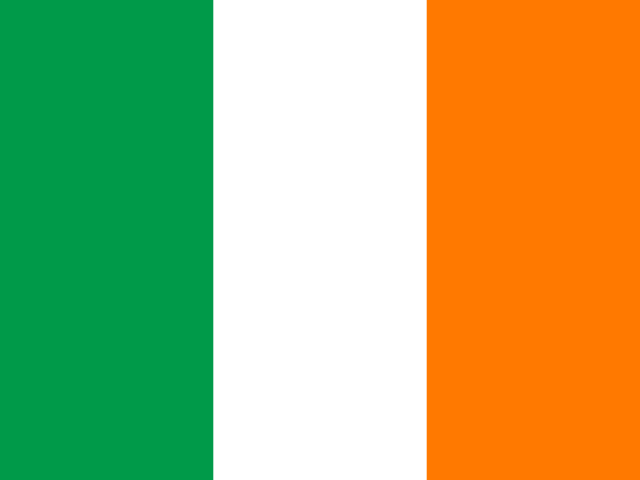
The Flag of Ireland
Europe · Adopted 21 January 1919 (formally proclaimed by the First Dáil); constitutionally confirmed 1937
Ireland's green-white-orange tricolor is generally traced to 1848, when Thomas Francis Meagher, a Young Irelander revolutionary, presented it publicly in Dublin — reportedly a gift from French republican women sympathetic to the Irish nationalist cause, itself modeled on France's own tricolor and the wider European tradition of tricolor flags as symbols of republican revolution. Meagher's own explanation of the colors, quoted for generations of Irish schoolchildren since, was explicit: green for the older Gaelic and Catholic Irish tradition, orange for the Protestant supporters of William of Orange and the Ulster/unionist tradition descended from the 17th-century plantations, and the white center stripe standing for a lasting truce and peace between the two.
That 1848 flag did not become a widely recognized national symbol immediately — for decades afterward, the harp on a green field remained the more commonly flown Irish nationalist banner, and the tricolor only rose to real prominence during the 1916 Easter Rising, when it was raised over the General Post Office in Dublin by rebels proclaiming an independent Irish Republic, an event whose brutal suppression by British forces (and the subsequent execution of its leaders) transformed Irish public opinion and made the tricolor the flag most closely associated with the revolutionary generation that followed.
The First Dáil, the revolutionary Irish parliament that convened in January 1919 amid the Irish War of Independence, formally adopted the tricolor as the national flag, and it continued as the flag of the Irish Free State after the 1921 Anglo-Irish Treaty and, later, of the fully sovereign Republic of Ireland; the 1937 Constitution (Bunreacht na hÉireann) gave the tricolor explicit constitutional status in Article 7, one of relatively few countries to name its flag directly within its founding constitutional text rather than leaving the design to ordinary statute.
The specific meaning of the orange stripe has made Ireland's flag genuinely unusual among national tricolors: rather than representing a generic value like liberty or hope, it names a specific religious-political community — Ulster Protestants tracing loyalty to William of Orange — directly on the flag of a state whose relationship with that community, and with the six counties of Northern Ireland that remained part of the United Kingdom after partition in 1921, has been a live and often painful political question for over a century since. The tricolor's aspiration toward peace between the two traditions has, as a result, often been read as much as an unfulfilled goal as an achieved one, particularly during the sectarian violence of the Troubles (roughly 1968–1998).
Ireland's flag has never been redesigned since its 1919 adoption, and its ratio and colors are specified by government convention rather than a highly detailed statutory color code of the kind some other European states use — a comparatively light-touch legal treatment for a flag with such heavily loaded political symbolism.
One of the most persistent points of confusion involving Ireland's flag is entirely unrelated to any shared history: Ivory Coast's flag uses the identical three colors — green, white, and orange — but in reversed order (orange at the hoist, green at the fly), an entirely coincidental resemblance rooted in each country's own separate 19th- and 20th-century symbolism rather than any historical connection between the two nations, and one that trips up quiz-takers and casual observers more than almost any other flag pairing in the world.
The tricolor is flown daily at Irish government buildings and is treated with particular ceremony around Easter, marking the anniversary of the 1916 Rising that first brought the flag to national prominence, alongside Saint Patrick's Day on 17 March.
During the Troubles in Northern Ireland, the tricolor itself became a genuinely contested symbol north of the border: its public display was restricted under British and Northern Irish law for periods during the conflict, and flying it in unionist-majority areas could provoke serious confrontation, while its display in nationalist and republican neighborhoods of Belfast and Derry was, and often still is, a marker of political identity — a live illustration of how the flag Meagher designed to represent peace between two traditions instead became, for decades, a flashpoint between them in the very part of the island partition had separated from the state that flew it officially.
Ireland's national flag protocol treats the tricolor with formal respect but comparatively modest legal severity relative to some other states: unlike several countries where flag desecration is criminalized outright, Irish flag etiquette is governed mainly by a non-statutory code of conduct issued by the Department of the Taoiseach, covering correct hoisting, folding, and display order rather than imposing criminal penalties for misuse.
Meagher himself never saw an independent Ireland: he was convicted of sedition for his role in the failed 1848 rising, transported to Van Diemen's Land (Tasmania), later escaped to the United States, and went on to serve as a Union Army general during the American Civil War before dying in 1867 in a drowning accident on the Missouri River — meaning the man most associated with designing Ireland's flag spent the final two decades of his life entirely outside Ireland, a detail Irish history classes note as one of the more striking footnotes of the flag's origin story.
A true orange, not a yellow
- Colourfast outdoor flag — The page notes the colours rest on convention rather than a detailed statutory code, which leaves more room than usual for a maker to drift; orange is also the band that fades toward yellow fastest outdoors.
As an Amazon Associate we earn from qualifying purchases made through these links, at no extra cost to you.
Often confused with
- Ivory Coast (Côte d'Ivoire) — adopted its tricolor at 1959 independence with an entirely different reading — orange for the northern savannah, white for peace and the country's rivers, green for the southern coastal forests — the two flags' most commonly confused pair worldwide. Compare side by side →
- Italy — shares green and white with Ireland's flag but replaces orange with red, and the resemblance is limited mainly to the shared green-and-white portion of each design rather than a full match. Compare side by side →
Ireland at a glance
- Capital
- Dublin
- Population
- 5.2 million (2024)
- Currency
- Euro (EUR)
- Language(s)
- Irish and English (both official)
Population figure as of 2024, source: UN World Population Prospects (2024 revision). See methodology for how facts are sourced and kept current.