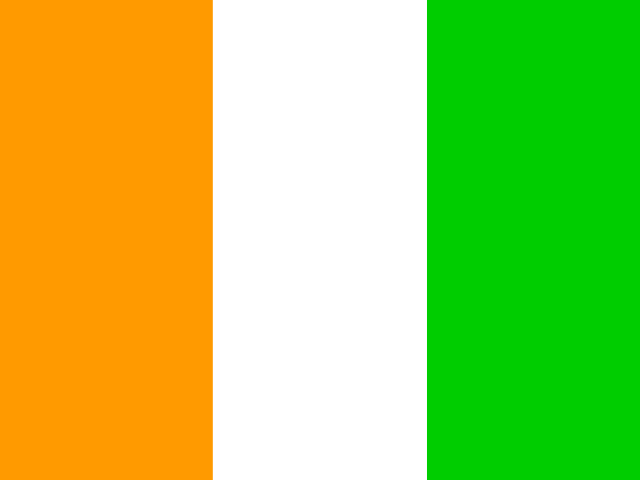
Yamoussoukro — Capital of Ivory Coast
Yamoussoukro was a modest village, historically linked to the Akouè branch of the Baoulé people, before it became one of the more unusual capital stories in Africa: it was the hometown of Félix Houphouët-Boigny, Ivory Coast's first president, who steadily redirected national investment toward the town of his birth throughout his 33-year rule, and formally designated it the country's political capital in 1983, moving the role away from the coastal city of Abidjan.
The transfer was never fully completed in practice. Most foreign embassies, international organizations, and much of the actual machinery of government have remained in Abidjan, which continues to function as the country's economic capital and largest city by a wide margin, leaving Yamoussoukro with the formal title but only a partial share of the governing apparatus — a split arrangement that persists decades after the official 1983 designation.
The town's most famous landmark, the Basilica of Our Lady of Peace, was commissioned by Houphouët-Boigny and completed in 1989 at a reported cost of several hundred million dollars, deliberately built to exceed the dimensions of St. Peter's Basilica in Rome in overall size (though not in dome height), making it one of the largest churches in the world in a country where Christians are a minority alongside a large Muslim population and traditional faiths — a project that drew both admiration for its scale and criticism over its cost in a developing country.
Houphouët-Boigny's vision for Yamoussoukro extended to wide, multi-lane boulevards, a presidential palace complex with a moat stocked with sacred crocodiles, and a golf course and international-standard hotel, all built to a scale that vastly outstripped the town's modest population — infrastructure that today sits comparatively underused relative to what was built for it.
Since Houphouët-Boigny's death in 1993, Yamoussoukro has remained the constitutional capital in name, hosting Ivory Coast's National Assembly building among other government functions, but the persistent concentration of real political and economic activity in Abidjan means Yamoussoukro's status as capital is often treated as more symbolic than functional in everyday governance.
Yamoussoukro's outsized international airport, built with capacity far beyond what the town's actual air traffic has ever required, has long been cited alongside its underused six-lane boulevards as a symbol of the mismatch between the infrastructure built for a planned political capital and the more modest demand a town of its size actually generates.
Despite the shortfall in day-to-day government functions, Yamoussoukro carried genuine diplomatic weight during Liberia's civil war, hosting a series of peace negotiations known as the Yamoussoukro Accords, signed in several rounds between 1991, that brought together Liberia's warring factions under West African mediation — a reminder that the town's symbolic prestige as Houphouët-Boigny's showcase capital gave it real convening power in regional diplomacy even while its own domestic governing role stayed limited.
The Institut National Polytechnique Félix Houphouët-Boigny (INP-HB), formed in 1996 through the merger of several existing technical and engineering schools, is based in Yamoussoukro and remains one of Ivory Coast's leading institutions for engineering, agronomy, and technical education, giving the town at least one substantial national institution beyond government offices and the basilica.
Houphouët-Boigny's presidential residence complex in Yamoussoukro includes an artificial lake stocked with sacred Nile crocodiles that were traditionally fed live chickens by staff as a daily public spectacle for decades — a practice tied to Baoulé beliefs linking crocodiles to Houphouët-Boigny's own lineage, and one that continued, on a reduced scale, into the 21st century after his death.
Quick facts
- Recent estimates put Yamoussoukro's population somewhere between 280,000 and 355,000, a small fraction of Abidjan's several million and one of the widest capital-to-largest-city population gaps found anywhere.
- UNESCO added the basilica to its World Heritage List in 2023, more than three decades after the building's 1989 completion.
- Yamoussoukro is named for Yamousso, a Baoulé queen and ancestor of Félix Houphouët-Boigny, with 'kro' meaning 'town' in the Baoulé language.
- Pope John Paul II personally consecrated the church in September 1990, a year after completion, giving it recognized status as a Catholic pilgrimage site even though Ivorian Christians remain a minority nationally alongside Muslims and followers of traditional faiths.
- Yamoussoukro's oversized airport sees only limited scheduled traffic; most travelers still fly into Abidjan and make the roughly 240-kilometer road trip north to reach the political capital.