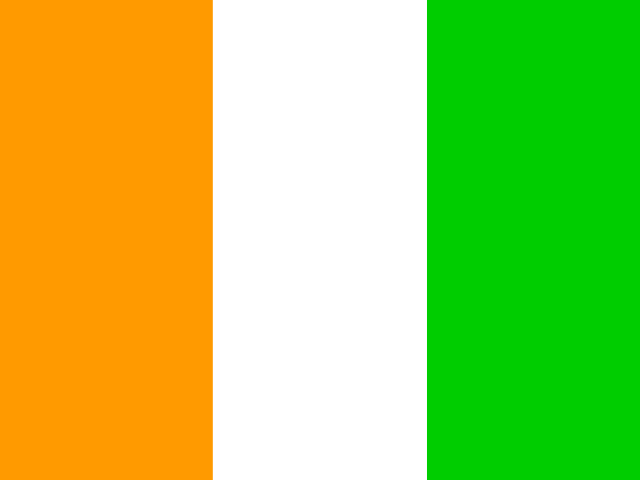
The Flag of Ivory Coast
Africa · Adopted 3 December 1959
Ivory Coast's orange-white-green vertical tricolor was adopted on 3 December 1959, several months before the country's formal independence from France on 7 August 1960, as part of the constitutional groundwork laid by Félix Houphouët-Boigny's government-in-waiting under the short-lived Mali Federation and then as an autonomous republic within the French Community. Choosing a flag ahead of full independence was itself a signal: Houphouët-Boigny, who would go on to lead the country for over three decades as its first president, favored a gradual, negotiated transition from France rather than a sharp break, and the flag's early adoption fit that cautious, orderly approach.
The design is famous — and occasionally mocked in trivia circles — for being a near-mirror of Ireland's flag: both are vertical tricolors of orange, white, and green, but Ivory Coast's orange band sits at the hoist while Ireland's green does, meaning the two flags are literal reverses of each other. The resemblance is coincidental rather than historical; the two countries' flags were designed roughly 45 years apart, for entirely unrelated political movements, on opposite sides of the planet, and any confusion between them stems purely from having landed on the same three colors in reversed order, not from any shared design lineage.
Within Ivory Coast the colors carry their own distinct meaning, unrelated to Ireland's very different green-white-orange symbolism of Catholic and Protestant unity. Orange represents the northern savanna lands and, more broadly, the fertility of the soil and the country's economic ambition; white stands for peace and the unity the young nation sought among its many ethnic groups; and green represents the dense forest of the south and, by extension, hope for the future — a north-south, savanna-to-forest geography genuinely reflected in the flag's two color fields with white unity between them.
Ivory Coast's economy at independence, and for decades after, was built overwhelmingly on cocoa and coffee exports, and the country became the world's largest cocoa producer under Houphouët-Boigny's market-friendly economic policies — a status it still holds today, producing roughly 40% of the world's cocoa supply, a share it has held into 2026. The orange stripe's association with fertile land connects directly to that agricultural identity.
The flag has not been redesigned since 1959, surviving Houphouët-Boigny's 33-year rule, the political crisis and civil conflict that followed his 1993 death, the 2002–2007 civil war that split the country between a rebel-held north and government-held south, and the further post-election violence of 2010–2011 — periods when the flag itself remained the one point of visual continuity across a deeply fractured national politics.
The country's official English name remains 'Ivory Coast' in most everyday usage internationally, though the government has requested since 1985 that all countries use the French name 'Côte d'Ivoire' untranslated in every language, a request tied to national pride that most international bodies now honor even in English-language contexts, while general usage still varies.
Houphouët-Boigny's economic model, sometimes called the 'Ivorian miracle' in its first two decades, made Ivory Coast one of postcolonial Africa's genuine economic success stories through the 1960s and 1970s, built on close ties with France, generous terms for foreign investors, and heavy reliance on cocoa and coffee revenue — a model that began to unravel as global cocoa prices fell in the 1980s, feeding directly into the political instability of the following two decades that the flag itself, unlike the economy, weathered without change.
Since the 2011 resolution of the post-election crisis, under presidents Alassane Ouattara and a restored period of relative stability, the flag has flown over a period of renewed economic growth, with Ivory Coast regularly posting some of the fastest GDP growth rates in West Africa through the 2010s and into the 2020s, even as the country continues to navigate the ethnic and regional tensions that the 2002-2011 conflicts exposed.
The 2010-2011 crisis itself was triggered when incumbent president Laurent Gbagbo refused to concede defeat to Ouattara after a presidential election that international observers and the UN certified Ouattara had won, leading to months of violence, an economic blockade, and eventually French and UN military intervention that captured Gbagbo from his presidential residence in April 2011; Gbagbo was later tried at the International Criminal Court and ultimately acquitted in 2019 of charges relating to the violence, a verdict that remains a point of ongoing political sensitivity within the country.
Unlike many former French colonies in West Africa, Ivory Coast's plain tricolor carries no coat of arms or emblem of any kind, a deliberate simplicity distinct from the country's separate national coat of arms, which does feature an elephant's head, a rising sun, and two oil palm branches and appears on official seals, currency, and government letterhead — a division between an unadorned civil flag and a more symbol-laden coat of arms that mirrors the French tradition Ivory Coast's own flag design was drawn from at independence.
In shape the flag matches France's own 2:3 tricolor proportions rather than the narrower ratios some neighboring Anglophone West African states use, a detail that quietly reflects how closely Ivory Coast's early state institutions, administrative practice, and even its flag proportions were modeled on those of its former colonial power even as its actual color choice and symbolism moved in an entirely different, locally rooted direction. Yamoussoukro formally became the constitutional capital in 1983, honoring Houphouët-Boigny's birthplace, but Abidjan has remained the country's commercial hub and the seat of most foreign embassies, a split between legal and functional capital that the flag itself, flown over both cities, does not distinguish between.
Which edge goes against the pole
- Flag with a canvas header — The page points out this design and Ireland's are the same three colours in opposite order, so hanging it from the wrong edge turns one flag into the other. The header is what settles the hoist.
As an Amazon Associate we earn from qualifying purchases made through these links, at no extra cost to you.
Often confused with
- Ireland — the two flags use the identical three colors — orange, white, green — in the identical vertical layout, but with the order fully reversed: Ivory Coast runs orange-white-green from the hoist, Ireland runs green-white-orange, a coincidence of color choice rather than any shared history. Compare side by side →
Ivory Coast at a glance
- Capital
- Yamoussoukro
- Population
- 31.9 million (2024)
- Currency
- West African CFA Franc (XOF)
- Language(s)
- French (official); Dioula and dozens of local languages widely spoken
Population figure as of 2024, source: UN World Population Prospects (2024 revision). See methodology for how facts are sourced and kept current.