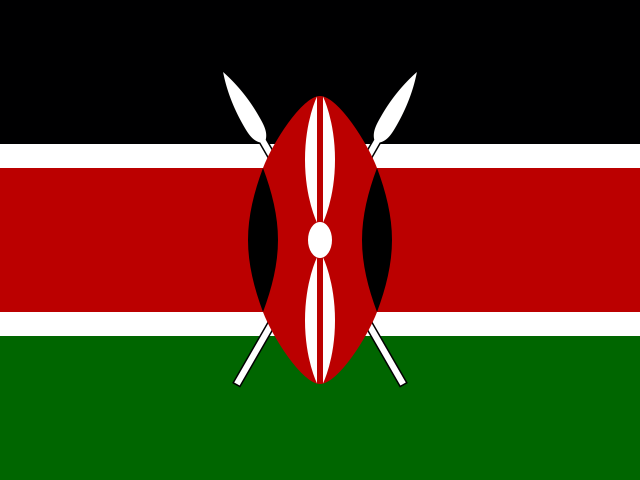
Nairobi — Capital of Kenya
Nairobi did not exist as a settlement until 1899, when it was established almost by accident as a railway depot and supply point along the Uganda Railway, chosen for a swampy site that happened to sit roughly midway between Mombasa on the coast and Kampala inland, with a name derived from the Maasai phrase 'Enkare Nyirobi,' meaning 'place of cool waters,' after a nearby stream.
The site's swampy, malaria-prone ground made it a questionable choice from the start, and colonial administrators considered relocating the town more than once in its early years, but by 1907 Nairobi had already replaced Mombasa as the capital of British East Africa, largely because of its rail-hub position and its higher, cooler elevation, which colonial settlers found more agreeable for permanent residence than the humid coast.
Nairobi retained its role as capital when Kenya gained independence in 1963, and it grew rapidly in the following decades into East Africa's largest and most economically significant city, home to the regional headquarters of numerous multinational corporations and to the United Nations Environment Programme (UNEP) and UN-Habitat, making it one of a small number of cities worldwide to host a UN headquarters agency outside of New York, Geneva, or Vienna.
The city is unusual among major capitals for its adjacency to genuine wilderness: Nairobi National Park, established in 1946, sits just a few kilometers from the downtown skyline and remains home to lions, giraffes, rhinos, and other large wildlife, offering a juxtaposition of skyscrapers and savanna that is virtually unique among world capitals.
Nairobi has also become East Africa's leading technology and startup hub in the 21st century, sometimes nicknamed 'Silicon Savannah' for its concentration of mobile-money and tech firms, a role that traces back in part to Kenya's pioneering M-Pesa mobile payment system, launched in 2007, which reshaped everyday finance across much of East Africa and drew global attention to Nairobi's tech sector.
Colonial-era Nairobi was administered under strict racial residential segregation, with Europeans, Asians, and Africans confined to separate designated zones of the city — a pattern whose legacy is still visible in Nairobi's uneven distribution of infrastructure and housing quality between formerly 'European' neighborhoods like Karen and Muthaiga and dense informal settlements such as Kibera, one of the largest informal settlements in Africa, which grew rapidly after independence as rural migrants arrived faster than formal housing could be built.
The city was the target of the August 1998 US Embassy bombing, a coordinated al-Qaeda attack that also struck the embassy in Dar es Salaam the same day, killing over 200 people in Nairobi alone and marking one of the deadliest terrorist attacks in Kenya's history; the site of the destroyed embassy in downtown Nairobi is now a memorial park.
Nairobi's matatu minibuses, privately owned and often elaborately decorated with graffiti art, LED lighting, and sound systems, form the backbone of the city's public transport system in the absence of a large-scale formal metro or bus network, and matatu culture has become its own recognized strand of Kenyan popular art and youth culture, studied and exhibited well beyond Nairobi itself.
The Nairobi Railway Museum, next to the still-active main railway station, preserves rolling stock and artifacts from the Uganda Railway era that founded the city, including a carriage associated with a notorious 1898 lion attack on railway workers near Tsavo — an episode from the line's construction period that later inspired books and films and remains tied in popular memory to the railway's difficult early years.
Quick facts
- As of 2024, Greater Nairobi's metropolitan area holds an estimated 5.2 million people — close to a tenth of Kenya's entire population concentrated in a single urban region, and the largest metro population anywhere in East Africa.
- The city's name comes from the Maasai phrase for 'cool waters,' referring to the Nairobi River that originally ran through the railway camp site.
- Karura Forest, a large protected woodland within city limits, became a flashpoint of environmental activism in the late 1990s when Nobel laureate Wangari Maathai led protests against attempts to sell off and develop parts of it.
- Nairobi National Park, adjoining the city's southern edge, is one of the only national parks in the world located within a capital city's boundaries.
- Jomo Kenyatta International Airport, which opened in 1958 as Embakasi Airport and was renamed in 1978 for Kenya's first president, is East Africa's busiest aviation hub.
- Nairobi sits at an elevation of roughly 1,795 meters (5,889 feet) above sea level, giving it a notably cooler, milder climate year-round than many other cities close to the equator.