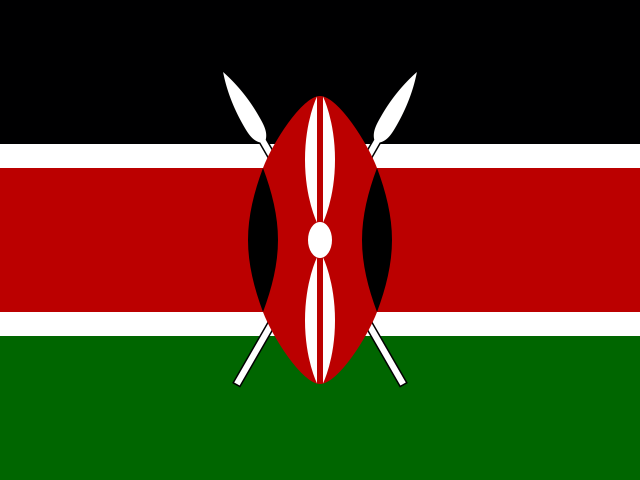
The Flag of Kenya
Africa · Adopted 12 December 1963
Kenya's flag was raised for the first time at midnight on 12 December 1963, the moment the country became independent from Britain, and it was based directly on the flag of the Kenya African National Union (KANU), the political party that led the independence movement under Jomo Kenyatta. Adopting a ruling party's banner as the national flag was a deliberate statement of continuity between the liberation struggle and the new state, rather than a neutral symbol designed from scratch by a committee.
The black, red, and green horizontal bands, separated by narrow white fimbriations, carry meanings tied specifically to Kenya's independence struggle: black represents the Kenyan people, red represents the blood shed in the fight for independence — most directly a reference to the Mau Mau uprising of the 1950s, a sustained armed rebellion against British colonial rule that the British responded to with mass detention and violent suppression — and green represents the country's fertile land and agriculture. White was added to the KANU original specifically to symbolize peace and unity, distinguishing the national flag from the party banner it was drawn from.
The Maasai shield and two crossed spears at the center are the flag's most visually distinctive element among African flags and were chosen to represent the defense of freedom, drawing on Maasai warrior tradition as an emblem of the country readiness to defend its independence rather than referencing any single ethnic group's exclusive claim to the new nation — though the Maasai people themselves are one of dozens of ethnic groups within Kenya, and the shield's specific cultural borrowing has occasionally been a point of discussion regarding how evenly Kenya's diverse ethnic groups are represented in national symbols.
Kenya's flag has never been formally redesigned since 1963, though the precise rendering of the shield and spears was refined over the decades for consistency in official use. The flag survived the transition from Kenyatta's presidency to Daniel arap Moi's single-party rule in the late 1970s through the 1980s, the return to multiparty democracy in the early 1990s, and the sweeping 2010 constitutional overhaul that restructured much of Kenyan government — none of which touched the flag design itself.
Because the black-red-green combination echoes the pan-African palette used elsewhere on the continent, Kenya's flag is sometimes grouped casually with other East and Central African flags in trivia contexts, but the specific addition of the central Maasai shield-and-spears emblem makes it visually distinct from any flag using plain stripes, and no other national flag uses that particular device.
The flag is flown prominently each year on Jamhuri Day (12 December), which commemorates both the 1963 independence and the 1964 declaration of Kenya as a republic, making the flag's anniversary and the country's founding day the same date.
The Mau Mau uprising the red band references was a genuinely brutal chapter of the independence struggle: British colonial forces detained an estimated 150,000 to over a million Kenyans (estimates vary widely by source) in camps during the 1952-1960 State of Emergency, and Britain formally apologized and paid compensation to thousands of elderly Mau Mau veterans in a 2013 settlement, decades after the events the flag's red band is popularly understood to commemorate.
Kenya's own constitutional structure was also reshaped substantially by the 2010 constitution, which introduced a devolved system of 47 county governments — a major institutional change to how the country is governed that nonetheless left the national flag flying overhead exactly as it had since 1963, illustrating how the flag has functioned as a fixed symbol across genuinely significant shifts in how the country is actually run.
Kenya's flag also flew over one of East Africa's most closely watched and, at times, most contested democratic transitions of the 21st century: the disputed 2007 presidential election triggered weeks of ethnic-tinged post-election violence that killed over 1,000 people and displaced hundreds of thousands, a crisis eventually resolved through a power-sharing agreement mediated by former UN Secretary-General Kofi Annan — a genuinely dark episode in the country's democratic history that the flag's independence-era symbolism of unity and shared struggle did not prevent, but that Kenya's subsequent, comparatively smoother 2013, 2017, and 2022 elections have gradually moved past.
At the midnight independence ceremony itself in Nairobi's Uhuru ('Freedom') Stadium, the outgoing Union Jack was lowered and the new Kenyan flag raised in front of Prince Philip, Duke of Edinburgh, who attended as the official representative of Queen Elizabeth II, alongside Jomo Kenyatta, who would be sworn in as prime minister that night and become the country's first president when Kenya was declared a republic almost exactly a year later, on 12 December 1964. The flag's shield is modeled on the traditional oxhide Maasai war shield, painted with distinctive geometric patterns, and the two spears crossing behind it are rendered in a stylized, uniform way for official reproduction rather than copying any single historical Maasai spear design.
Kenya's National Flag, Emblems and Names Act sets out detailed legal rules for correct display, prohibits commercial misuse of the design, and specifies the flag's construction ratio at 2:3 with exact color placement for the black, red, white, and green elements. The flag has also flown at half-mast on several nationally mourned occasions in the post-independence era, including after the 1998 al-Qaeda bombing of the US Embassy in Nairobi, which killed over 200 people, and the 2013 Westgate Mall and 2015 Garissa University College terrorist attacks, moments when the flag's function as a shared symbol of collective grief has stood apart from its founding independence-era symbolism.
A shield with fine detail
- Double-sided flag — The shield carries patterned segments and two crossed shafts overlaid on the stripes; printed through one layer the pattern reverses behind, which is visible on a flag this detailed.
As an Amazon Associate we earn from qualifying purchases made through these links, at no extra cost to you.
Often confused with
- South Africa — no direct color overlap in layout, but Kenya's flag is occasionally confused in casual quizzes with other black-red-green pan-African tricolors from the same independence era, despite Kenya's unique central shield making it visually distinct up close. Compare side by side →
Kenya at a glance
- Capital
- Nairobi
- Population
- 56.4 million (2024)
- Currency
- Kenyan Shilling (KES)
- Language(s)
- Swahili and English (both official)
Population figure as of 2024, source: UN World Population Prospects (2024 revision). See methodology for how facts are sourced and kept current.