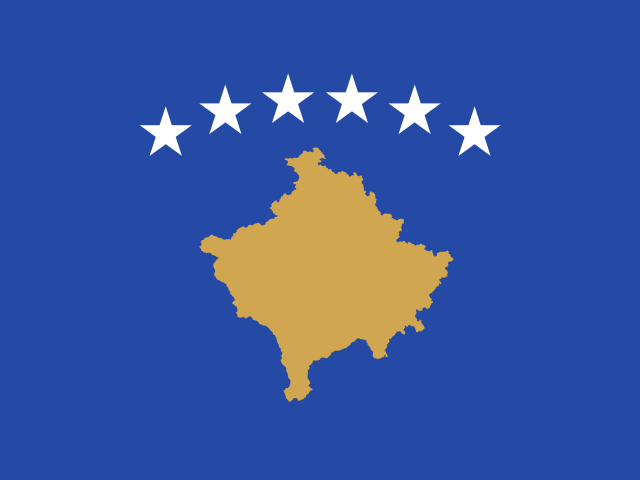
Pristina — Capital of Kosovo
Pristina's history stretches back to Roman and earlier settlement in the surrounding region, but it rose to real prominence in the medieval period under Serbian rule, becoming an important trading and administrative town within the Serbian Kingdom and later Empire in the 13th and 14th centuries — a period Serbian national memory ties closely to the region as a whole, since the pivotal 1389 Battle of Kosovo against Ottoman forces, one of the most mythologized events in Serbian history, was fought at Kosovo Polje just outside the city.
Ottoman forces controlled the wider Kosovo region, including Pristina, for roughly five centuries following that battle, leaving a substantial architectural and cultural imprint still visible in the city's older quarters, including mosques and a bazaar district dating to the Ottoman period, before Kosovo passed to Serbian and then Yugoslav control in the early 20th century after the Balkan Wars of 1912-13.
Pristina's modern significance as an administrative center grew substantially under socialist Yugoslavia, when it was designated capital of the Socialist Autonomous Province of Kosovo within Serbia in 1974, a status that granted the province considerable self-government until Serbian leader Slobodan Milošević stripped that autonomy in 1989 — a move widely regarded as a major precipitating factor in the ethnic tensions that culminated a decade later in the 1998-99 Kosovo War.
Following NATO's 1999 intervention and the establishment of UN administration (UNMIK) over Kosovo, Pristina became the seat of the UN-run interim government and, after Kosovo's 2008 declaration of independence, the capital of the new state — inheriting, in the process, both the 1974-era provincial government infrastructure and the far more difficult task of building a functioning national capital for a young, still only partially recognized state.
The city today shows the visible layering of that turbulent recent history: Yugoslav-era socialist architecture, an Ottoman old town, war-damaged and rapidly reconstructed neighborhoods from the immediate post-1999 period, and — a genuinely distinctive local landmark — a large statue of Bill Clinton on a boulevard named after him, erected in gratitude for the US role in the 1999 NATO intervention that ended the war, a rare instance of a foreign leader honored so prominently in a national capital's public space.
During the 1990s, when Serbian authorities under Milošević stripped Kosovo's autonomy, ethnic Albanians in Pristina organized a parallel, unofficial education and healthcare system — including an underground Albanian-language university — operating alongside official Serbian institutions, a period of quiet civil resistance that preceded the outright armed conflict of 1998-99.
Pristina's Mother Teresa Boulevard, the city's main pedestrian street, is named for the Nobel Peace Prize-winning nun, who was of ethnic Albanian descent, and the boulevard remains the city's principal gathering point for public celebrations, protests, and commemorations of major national moments, including the 2008 independence declaration itself.
Pristina's population grew rapidly and largely without formal planning both during the socialist-era Yugoslav period and again in the years immediately following the 1998-99 war, as displaced rural residents and returning refugees settled in and around the capital, leaving the city with a somewhat improvised, densely built urban fabric that contrasts with the more deliberately planned socialist-era boulevards and government buildings at its center.
The newer National Library of Kosovo building, completed in 1982 under Yugoslav rule and instantly recognizable for its unusual lattice of 99 domes and metal-mesh exterior, remains one of Pristina's most architecturally distinctive and most debated buildings, admired by some as bold modernist design and criticized by others as an awkward fit for the city around it.
Quick facts
- Pristina's population is estimated at roughly 220,000 within the city proper as of 2024, with a wider metropolitan area population somewhat higher.
- Pristina became capital of an autonomous, self-governing Kosovo province within Yugoslavia in 1974, decades before it became capital of an independent state in 2008.
- The city's Bill Clinton Boulevard and accompanying statue, unveiled in 2009, commemorate the US-led NATO intervention that ended the 1998-99 war.
- Pristina is not internationally universally recognized as a national capital in the same way as, say, Paris or Rome, given that Kosovo's statehood itself is not recognized by all UN member states as of 2024.
- The University of Pristina, founded in 1969, is the largest and oldest public university in Kosovo and has played a significant role in the region's Albanian-language higher education.