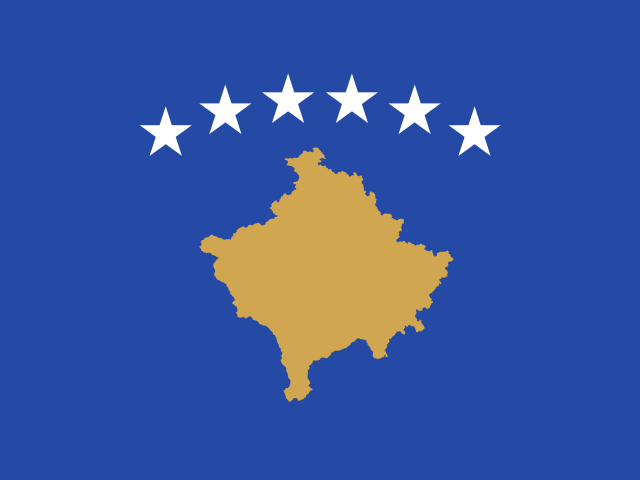
The Flag of Kosovo
Europe · Adopted 17 February 2008
Kosovo declared independence from Serbia on 17 February 2008, and its flag was adopted the same day — an unusually fast, deliberately engineered process compared with most national flags, which tend to accumulate meaning and design changes over years or decades. The design itself was the product of an international competition and negotiation process overseen partly by the UN and EU-facilitated status talks that preceded independence, reflecting the reality that Kosovo's statehood was, and remains, disputed: as of 2024, Kosovo is recognized by roughly 100 UN member states but not by Serbia, Russia, China, or five EU members, and the flag had to be built to function within that contested diplomatic landscape rather than simply express one ethnic community's symbolism.
That diplomatic sensitivity shaped the design directly. Kosovo's population is majority ethnic Albanian, and the most obvious 'Albanian' national symbol — the black double-headed eagle on red, used by both Albania and by Kosovo Albanians historically — was deliberately avoided for the state flag specifically because it would have alienated Kosovo's Serb minority and undercut the new state's claim to represent all of its citizens rather than one ethnic group. Instead, the flag uses a blue field, echoing the blue found on the flags of the European Union and the United Nations, both of which had overseen Kosovo's path to statehood and administered it directly for years beforehand (the UN from 1999 under UNMIK, the EU-led EULEX mission from 2008).
Centered on the blue field is a gold silhouette map of Kosovo itself — an outline of the territory's actual borders — beneath a horizontal arc of six white five-pointed stars, one representing each of the country's six major ethnic groups as recognized in Kosovo's constitution: Albanians, Serbs, Turks, Gorani, Roma, and Bosniaks. This deliberately inclusive, multi-ethnic symbolism, built into the flag from its first day rather than added later, was a direct response to the ethnic violence and division of the 1998-99 Kosovo War and its aftermath, and was intended to signal a civic rather than ethnic basis for the new state.
The gold map on Kosovo's flag makes it one of only two national flags in the world to depict an actual geographic outline of the country's own borders — the other being Cyprus, whose flag similarly uses a copper-colored silhouette map of the island beneath olive branches, adopted in 1960 for closely parallel reasons: like Kosovo, Cyprus's design was built to avoid favoring either of its two main ethnic communities (Greek and Turkish Cypriots) by deliberately excluding both the Greek and Turkish national colors and symbols.
Despite the flag's careful multi-ethnic design, it has not been universally embraced within Kosovo itself: many ethnic Albanians in Kosovo, who form the large majority of the population, continue to fly the red-and-black Albanian eagle flag informally and with considerable enthusiasm at everyday events, sporting occasions, and celebrations, treating the officially adopted blue-and-gold flag as more of a formal state symbol used at government buildings and international settings than as the flag of everyday popular identity — a genuine gap between official and popular symbolism that is unusually pronounced compared with most countries.
Kosovo's flag has not been redesigned since its 2008 adoption, and its exact proportions, the specific gold and blue shades, and the precise geographic rendering of the map are fixed by the same 2008 law establishing Kosovo's state symbols alongside the coat of arms and national anthem — all created together as part of a single, coordinated post-independence symbol-design package rather than accumulated separately over time the way most older states' symbols were.
Kosovo's national anthem, adopted alongside the flag in 2008, is a wordless instrumental piece for the same underlying reason the flag avoids ethnic Albanian iconography — any lyrics in Albanian or Serbian risked being read as favoring one community over the other, so the anthem, titled 'Europe,' was composed without lyrics at all, making the flag and anthem's shared design logic (neutral symbolism engineered for a divided post-conflict population) unusually explicit and coordinated compared with most countries' national symbols.
Kosovo's flag is displayed at government buildings and, since 2008, at the country's diplomatic missions abroad in the roughly 100 states that recognize it, though it is notably absent or contested in some international settings — Kosovo is not a UN member state as of 2024 because of a Russian and Chinese Security Council veto threat, meaning its flag does not fly outside UN headquarters in New York the way the flags of fully recognized member states do.
At international sporting events, Kosovo has competed under its own flag and anthem since the International Olympic Committee granted it recognition in late 2014, first appearing at the 2016 Rio Olympics — where judoka Majlinda Kelmendi won Kosovo's first-ever Olympic gold medal, giving the young flag one of its most widely celebrated public moments on the international stage barely eight years after its 2008 adoption.
Often confused with
- Cyprus — the only other national flag depicting an actual map silhouette of the country's own territory, and for a closely related reason — both flags were deliberately designed to avoid favoring either of the country's main ethnic/religious communities by using a neutral map rather than either group's traditional colors or symbols. Compare side by side →
- Albania — the flag Kosovo's ethnic-Albanian majority often flies informally instead of the official state flag — Albania's red field and black double-headed eagle were deliberately left off Kosovo's own state design to keep it neutral for the country's Serb and other minorities. Compare side by side →
Kosovo at a glance
- Capital
- Pristina
- Population
- 1.6 million (2024)
- Currency
- Euro (EUR, used unilaterally; Kosovo is not an EU or eurozone member)
- Language(s)
- Albanian and Serbian (both official)
Population figure as of 2024, source: Kosovo Agency of Statistics / UN estimates (2024). See methodology for how facts are sourced and kept current.