Beirut — Capital of Lebanon
Excavations in downtown Beirut have uncovered layers of settlement stretching back more than 5,000 years, evidence of a site occupied through wave after wave of regional powers; the city flourished as a Phoenician port in antiquity and was later prized under Roman rule for its law school, one of the most renowned centers of legal education in the Roman Empire, until an earthquake and tsunami devastated it in 551 CE.
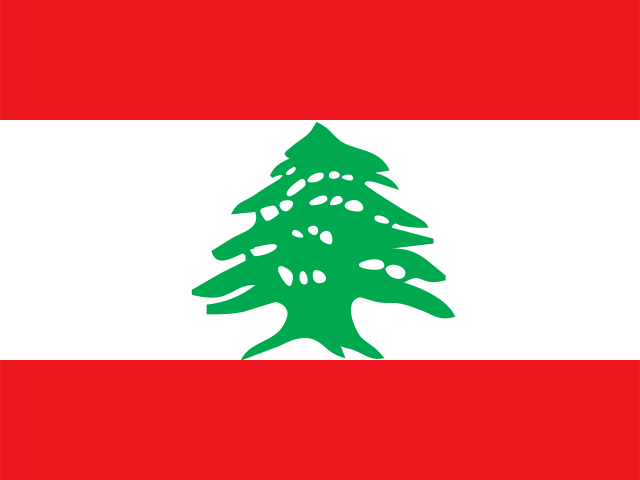
The city passed through Byzantine, Arab, Crusader, Mamluk, and Ottoman control over the following centuries, developing as a trading port throughout, before becoming the capital of the French Mandate for Lebanon after World War I and then the capital of independent Lebanon when the country declared independence in 1943 — the same year Lebanon adopted its cedar-bearing flag.
Beirut earned a reputation through the mid-20th century as a cosmopolitan financial and cultural hub often nicknamed 'the Paris of the Middle East,' a period of prosperity and relative openness that was shattered by the Lebanese Civil War, which raged from 1975 to 1990 and left much of central Beirut, including its historic downtown, in ruins, with the city's infamous 'Green Line' dividing it into hostile eastern and western sectors for much of the conflict.
Beirut has faced repeated large-scale destruction even after the civil war ended: the city was heavily damaged again during the 2006 Israel-Hezbollah conflict, and on 4 August 2020 a massive explosion at the city's port, caused by improperly stored ammonium nitrate, killed over 200 people, injured thousands, and devastated large parts of the city's downtown and residential districts — one of the largest non-nuclear explosions in recorded history and a disaster still shaping Beirut's reconstruction and politics years later.
Despite this repeated cycle of destruction and rebuilding, Beirut remains the seat of Lebanon's parliament and most national institutions, and it retains a resilient cultural and nightlife scene that Beirutis and outside observers alike have often cited as evidence of the city's capacity to rebuild after crisis.
Beirut's downtown core was extensively rebuilt after the civil war under a large private development company, Solidere, established in 1994, which reconstructed much of the historic city center's streetscape; the project drew both praise for restoring a devastated area and criticism from some residents and preservationists over the displacement of former property owners and tenants during the process.
Investigations into the 2020 port explosion have continued for years without a completed judicial outcome, repeatedly stalled by political interference according to rights groups monitoring the case, and the damaged port silos and surrounding blast site remain a visible, unrepaired scar in the city's skyline years after the disaster, a point of continued public frustration in Lebanon.
The American University of Beirut, founded in 1866 as the Syrian Protestant College, is one of the oldest American-founded universities outside the United States and has educated generations of political and business leaders across the wider Arab world, giving Beirut an outsized regional role in higher education relative to the city's modest physical size.
Beirut's Corniche, a long seafront promenade running along the Mediterranean coast, remains one of the city's most consistently used public spaces across different eras of prosperity and crisis, drawing residents for daily walks and gatherings even during periods when much of the rest of the city has been affected by political or economic instability.
Quick facts
- Beirut's metropolitan population is estimated at around 2.4 million, making it by far Lebanon's largest urban area.
- Investigators traced the 2020 blast to a shipment of ammonium nitrate that had sat unsecured in a portside warehouse since 2013, after the cargo ship carrying it was impounded over unpaid fees.
- Beirut's banking sector, long protected by strict secrecy laws modeled partly on Switzerland's, made the city a major regional financial hub until the sector's near-total collapse during Lebanon's currency crisis beginning in 2019.
- The 2005 assassination of former prime minister Rafic Hariri by a seafront car bomb triggered mass protests known as the Cedar Revolution, which helped force the withdrawal of Syrian troops stationed in Lebanon since the civil war.
- During the civil war, curators at the National Museum of Beirut encased many ancient artifacts in protective concrete to shield them from shelling, an improvisation credited with saving much of the collection before restoration work began after 1990.