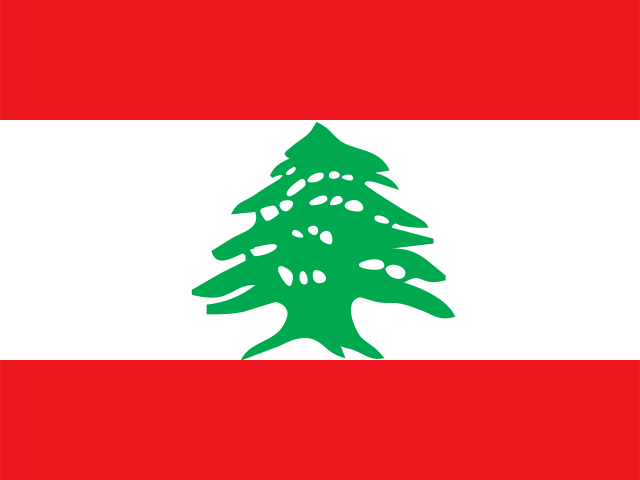
The Flag of Lebanon
Asia · Adopted 7 December 1943
Lebanon's flag was adopted on 7 December 1943, in the middle of the country's push for independence from the French Mandate, at a special session of the newly elected Lebanese parliament that also amended the constitution to strip out mandate-era provisions — the flag change and the broader independence declaration happened as a single, deliberate political act rather than as separate events.
Accounts from that parliamentary session describe the design being finalized in the room itself: a cedar branch, cut from an actual tree, was reportedly used as reference and sketched directly into the center of a red-white-red horizontal triband, a pattern that itself echoed flags used earlier under the French Mandate period and, before that, by the semi-autonomous Mutasarrifate of Mount Lebanon in the late Ottoman era.
The cedar tree at the center is the flag's defining symbol and predates any Lebanese state institution — the Cedars of God grove in the Lebanon mountain range has religious and cultural significance stretching back thousands of years, referenced repeatedly in the Hebrew Bible as a symbol of strength, holiness, and permanence, and Lebanon's mountainous cedar forests were prized and heavily logged by ancient civilizations including the Phoenicians, Egyptians, and Assyrians for shipbuilding and construction.
That long harvesting history is also why the cedar carries a note of loss alongside pride: Lebanon's once-extensive cedar forests have been reduced to a small fraction of their historical range, and the surviving Cedars of God grove is a UNESCO World Heritage Site actively protected and replanted rather than a stand-in for forests that still cover the country broadly — the flag commemorates a tree that is now genuinely scarce in Lebanon rather than commonplace.
The white band, twice the height of each red band, is generally read as representing peace and the snow that covers Lebanon's mountains, while the red bands stand for the blood shed by Lebanese who fought for the country's independence and liberty — a reading that Lebanese civic education presents consistently, even though, as with many mid-20th-century flags, the exact original wording of the symbolism wasn't written into a single authoritative government document at the time of adoption.
Lebanon's flag has not been redesigned since 1943, remaining unchanged through the 1975–1990 civil war, the country's various periods of foreign military presence, and its ongoing political crises — a rare point of stability for a national symbol in a country whose government and territorial control have shifted repeatedly over the same period.
The cedar appears widely beyond the flag itself, on Lebanese currency, the country's national airline livery, and as informal shorthand for Lebanese identity among the large Lebanese diaspora communities abroad, making it one of the more instantly recognizable national tree symbols of any country's flag worldwide.
During the mass protests that began in October 2019 against government corruption and economic collapse, demonstrators from across Lebanon's many religious and political factions carried the plain national flag, cedar and all, in enormous numbers as a deliberately unifying symbol — organizers and participants frequently noted at the time that displaying the state flag rather than any single party or sect's banner was itself a pointed statement against Lebanon's fractured, sectarian political system.
Lebanon's remaining old-growth cedar groves, including the UNESCO-listed Cedars of God, are actively protected under Lebanese and international conservation programs, with ongoing replanting efforts aimed at expanding cedar forest cover that has been reduced to a small remnant of what once covered much larger portions of the country's mountain ranges in antiquity.
The specific tree species, Cedrus libani, was prized across the ancient Near East for its size, durability, and resistance to rot, and historical texts describe Egyptian pharaohs importing Lebanese cedar for boatbuilding and ceremonial uses, Phoenician shipbuilders relying on it for their trading and naval fleets that dominated the Mediterranean in antiquity, and the Hebrew Bible describing cedar imported from Lebanon for the construction of Solomon's Temple in Jerusalem — a trade history that predates any Lebanese state by roughly three thousand years.
Because the cedar had already functioned as an emblem of the region for so many centuries before 1943, some earlier Lebanese political and religious institutions under Ottoman and French administration had also used cedar imagery on local seals and banners, meaning the 1943 flag's designers were formalizing an already well-established regional symbol into a new state emblem rather than introducing the tree as national iconography for the first time.
Lebanon marks its Independence Day on 22 November, commemorating the 1943 release of political leaders imprisoned by French authorities during the crisis that led directly to full sovereignty, an event distinct from but closely connected to the flag's adoption that same year, and flag displays across Beirut and other Lebanese cities are traditionally at their heaviest around that November anniversary.
Middle East Airlines carries the cedar in its own branding, and Lebanese cultural, sporting, and diaspora organizations worldwide have long used a standalone cedar silhouette, without the surrounding red-white-red bands, as a compact stand-in for Lebanese identity in settings where a full tricolor flag would be impractical.
Because Lebanon's political system since 1943 has been built around a confessional power-sharing arrangement distributing top offices among different religious communities, the plain, symbol-light cedar flag is often described by Lebanese commentators as one of the few national symbols genuinely shared without direct confessional coding, unlike many other emblems and even some public holidays in Lebanese civic life, which explains part of why it was carried so widely during the 2019 protests.
A tree with distinguishable branches
- High-resolution printed flag — The cedar is drawn as layered horizontal branches rather than a generic conifer outline, and a coarse print collapses those layers into a green triangle.
As an Amazon Associate we earn from qualifying purchases made through these links, at no extra cost to you.
Lebanon at a glance
- Capital
- Beirut
- Population
- 5.5 million (2024)
- Currency
- Lebanese Pound (LBP)
- Language(s)
- Arabic (official); French and English widely used
Population figure as of 2024, source: UN World Population Prospects (2024 revision). See methodology for how facts are sourced and kept current.