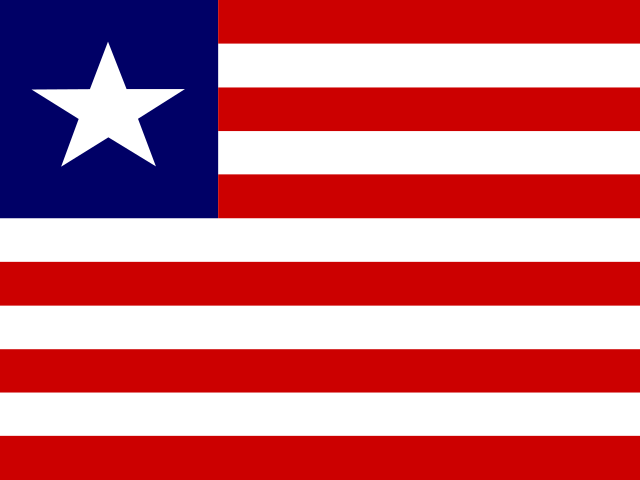
Monrovia — Capital of Liberia
Monrovia was founded in 1822 on Cape Mesurado by agents of the American Colonization Society, an organization of white American abolitionists and slaveholders alike whose motives ranged from genuine anti-slavery conviction to a desire to remove free Black Americans from US soil, and the settlement was named directly after US President James Monroe, who had supported federal funding for the colonization project — making Monrovia one of the very few world capitals named after a sitting foreign head of state.
The first settlers, freed and formerly enslaved African Americans along with some Afro-Caribbean migrants, faced brutal early conditions: disease, conflict with local Indigenous groups whose land the settlement encroached on, and severe shortages, and a substantial share of the earliest arrivals died within the settlement's first years — a costly founding that nonetheless established what would become, in 1847, the capital of Africa's first independent republic.
Monrovia's political history has been dominated by the same Americo-Liberian settler-descendant elite for over a century after founding, a group that maintained disproportionate power over the indigenous majority population until the 1980 coup led by Master Sergeant Samuel Doe overthrew President William Tolbert, ending 133 years of unbroken Americo-Liberian political control centered in the capital.
The city suffered severe destruction during Liberia's two civil wars (1989–1997 and 1999–2003), including brutal urban combat during the 2003 siege of Monrovia, when rebel forces attacked the government-held capital and tens of thousands of displaced civilians sheltered in the grounds of the US Embassy compound — a crisis that drew international attention and contributed to the deployment of a peacekeeping force and Charles Taylor's eventual exile later that year.
Since the wars ended, Monrovia has been rebuilding under a series of governments, including that of Ellen Johnson Sirleaf, elected in 2005 as Africa's first female elected head of state, and the city remains Liberia's overwhelmingly dominant urban, political, and economic center, home to the country's main port and the great majority of its formal-sector economy.
The original 1822 settlement was established on Providence Island, a small islet at the mouth of the Mesurado River that today sits within Monrovia proper and is preserved as a historic site marking the exact landing point of the first Society-sponsored settlers, distinguishing it from the many other African capitals with no single, identifiable founding location.
West Point, a densely packed peninsula slum in Monrovia housing tens of thousands of residents with minimal formal infrastructure, became internationally known during the 2014-2015 West African Ebola epidemic, when it was placed under a highly controversial military quarantine for several days in August 2014 after riots broke out over the measure — an episode that drew global attention to how poorly the capital's informal settlements were equipped to handle a major public health emergency.
Monrovia's downtown skyline is still dominated by the shell of the Ducor Palace Hotel, a once-luxury property opened in 1960 that was looted and gutted during the civil wars and has stood as an abandoned, graffiti-covered ruin on a hill overlooking the city ever since, widely used by residents and visitors alike as an unofficial symbol of the gap between Monrovia's mid-century aspirations and its wartime devastation.
The city's Waterside Market, sprawling along the Mesurado River near the old commercial district, remains one of West Africa's larger informal trading hubs, and its ongoing redevelopment has been a recurring political issue for successive Monrovia city governments seeking to formalize and modernize the market without displacing the traders who depend on it.
Quick facts
- Monrovia's population has roughly quadrupled since the end of the civil war in 2003, reaching an estimated 1.5 to 2 million residents by 2024 as returning refugees and rural migrants settled in and around the capital — enough that close to a third of all Liberians now live there.
- Monrovia ranks among the rainiest capitals on Earth, averaging roughly 4,500 millimeters (about 180 inches) of rain a year, most of it packed into an intense May-to-October monsoon season.
- The city has served as Liberia's capital continuously since the republic's 1847 founding, never relocated or replaced.
- The 2003 Second Battle of Monrovia, fought as rebel forces besieged the capital, was a decisive turning point that led to President Charles Taylor's exile and the end of the Second Liberian Civil War.
- Monrovia's deep-water port, developed with US assistance after World War II, remains central to Liberia's trade in rubber, timber, and iron ore.