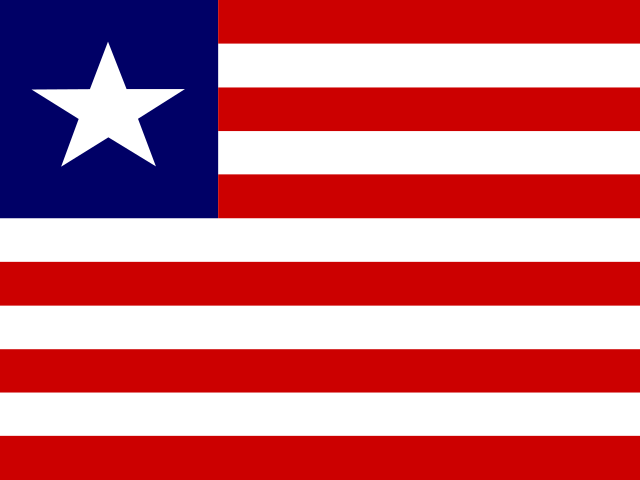
The Flag of Liberia
Africa · Adopted 26 July 1847
Liberia's flag was adopted on 26 July 1847, the day the country declared independence, and it was designed by a committee of women associated with the American Colonization Society settlement that had been founded on this stretch of West African coast in 1822 to resettle freed and formerly enslaved African Americans. The eleven red and white horizontal stripes and the single white star on a blue canton were modeled directly and deliberately on the flag of the United States, making Liberia's flag one of the most explicit national homages to another country's flag anywhere in the world.
The resemblance is not accidental symbolism read in after the fact — it is the documented intent of the founders themselves. Liberia was established specifically as a homeland for freed African Americans, many of them former slaves, and the settlers who built the new republic consciously modeled its constitution, its capital's name (Monrovia, after US President James Monroe, a supporter of the colonization project), and its flag on American models, seeing themselves as carrying American republican and Christian ideals to Africa even as they were building an independent nation distinct from the United States.
The eleven stripes represent the eleven signatories of Liberia's Declaration of Independence, a specifically Liberian detail that departs from the American original's fifty-state, thirteen-stripe logic — where the US flag's stripes commemorate the original thirteen colonies, Liberia's eleven stripes commemorate the individual signers of its own founding document, a different and Liberia-specific counting logic behind a very similar-looking device.
The single white star, rather than the US flag's field of many stars, is often explained as symbolizing Liberia's status as the first independent republic on the African continent (predating most other African nations' independence by well over a century), though some historical accounts also connect it to the star's simpler role as a beacon of liberty for formerly enslaved people. The blue canton is described in Liberian tradition as representing the African continent itself, distinguishing this element's meaning from the US flag's fifty-state symbolism even though the visual placement is nearly identical.
Liberia's origins as a state built by resettled African Americans created a lasting internal divide between the Americo-Liberian settler minority, who dominated politics for over a century, and the indigenous ethnic groups who made up the vast majority of the population — a tension that culminated in the 1980 coup led by Samuel Doe, the country's first head of state from an indigenous background, and later contributed to the brutal civil wars of 1989–1997 and 1999–2003 that devastated the country. The flag itself remained unchanged through all of this upheaval.
Liberia's flag has never been formally redesigned since 1847, making it one of the oldest continuously used national flag designs in Africa, predating the independence of every other African nation on the continent by well over a century.
The flag's committee of designers is traditionally named as seven women — among them Susannah Lewis, Matilda Newport, and Sarah Dripper — who are credited in Liberian national memory with sewing the first version by hand, a founding story schoolchildren in Liberia are still taught today alongside the broader account of the country's settlement by freed African Americans.
The civil wars of 1989-2003, which killed an estimated 250,000 people and displaced much of the population, never prompted any change to the flag itself; if anything, the flag's survival through the fighting and Liberia's subsequent Truth and Reconciliation process became, for many Liberians, a symbol of national continuity through a period when almost every other national institution had been shattered or compromised.
Charles Taylor, the warlord-turned-president whose rule (1997-2003) presided over much of the second war and fueled the brutal conflict in neighboring Sierra Leone through arms-for-diamonds dealing, was eventually tried not in Liberia but before a UN-backed special court sitting in The Hague, where he was convicted in 2012 of war crimes and crimes against humanity and sentenced to 50 years — a prosecution that unfolded entirely apart from Liberia's own institutions, including the flag that continued flying over Monrovia throughout the proceedings.
Liberia's flag proportions were set at 10:19, the same distinctive ratio the US flag itself uses rather than the 2:3 ratio common on most other national flags — a construction detail that makes the American homage even more literal than the color scheme and star-and-stripes layout alone suggest. Liberia observes Flag Day on 24 August each year, commemorating the flag's 1847 adoption specifically and separately from Independence Day on 26 July, with a presidential proclamation and public ceremonies in Monrovia typically marking the occasion.
The American Colonization Society project that founded Liberia was itself deeply controversial within the US abolitionist movement of the 1820s–1840s: prominent abolitionists including Frederick Douglass and William Lloyd Garrison opposed colonization schemes, arguing that resettling free Black Americans in Africa let slaveholding interests avoid confronting slavery at home and implied that Black Americans could never be full citizens of the United States itself, rather than genuinely serving the interests of the freed people involved. That domestic American controversy shadowed Liberia's founding even as the settlers who actually made the voyage built a new republic whose flag borrowed directly and deliberately from the country many of them had been forced or persuaded to leave.
The 10:19 proportion
- Flag cut to 10:19 — This is one of the few flags outside the United States cut to 10:19, which is longer and shallower than almost every stock size; a flag sold simply as 3x5 is not the shape the page describes.
As an Amazon Associate we earn from qualifying purchases made through these links, at no extra cost to you.
Often confused with
- United States — the resemblance is deliberate, not coincidental — Liberia's founders explicitly modeled the striped design and star-on-blue canton on the American flag, differing mainly in stripe count (11 vs 13) and star count (1 vs 50). Compare side by side →
Liberia at a glance
- Capital
- Monrovia
- Population
- 5.5 million (2024)
- Currency
- Liberian Dollar (LRD), with the US Dollar also widely used in circulation
- Language(s)
- English (official); over two dozen indigenous languages spoken
Population figure as of 2024, source: UN World Population Prospects (2024 revision). See methodology for how facts are sourced and kept current.