Vaduz — Capital of Liechtenstein
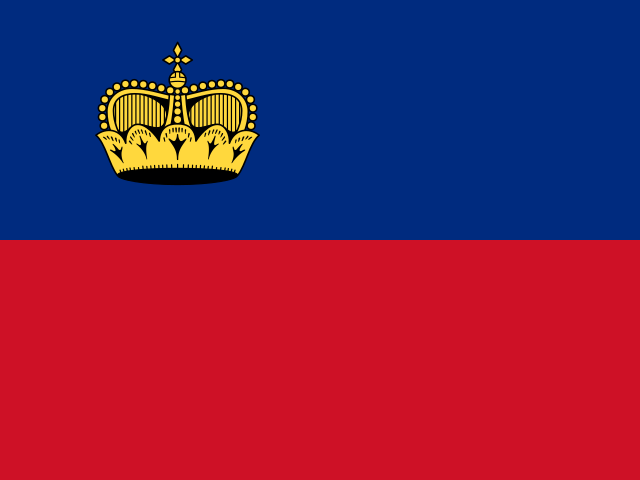
See the flag of Liechtenstein →
Vaduz takes its name from Vaduz Castle, first documented in the 12th century and built by the local Counts of Werdenberg-Sargans on a rocky hill above the Rhine valley, long before the modern principality of Liechtenstein existed as a distinct political entity — the castle predates the country's own founding by roughly six centuries and remains, unusually for a national capital, the actual private residence of the reigning prince rather than a museum or ceremonial building alone.
The town became capital by inheritance rather than any deliberate founding decision: the Princely House of Liechtenstein, an Austrian noble family that had held vast estates across the Holy Roman Empire for centuries but, notably, no territory that gave them a seat in the Imperial Diet, purchased the County of Vaduz in 1712 and the neighboring Lordship of Schellenberg in 1699, consolidating the two into a single territory that Emperor Charles VI elevated to the status of an Imperial Principality in 1719 — named Liechtenstein after the ruling family itself, a genuinely unusual case of a country being named after its rulers' dynasty rather than any geographic or ethnic term.
Despite ruling the principality from 1719, members of the House of Liechtenstein rarely visited or resided in Vaduz itself for most of the 18th and 19th centuries, preferring their much grander estates and palaces in Vienna; the ruling princes did not take up permanent residence in Vaduz Castle until Prince Franz Josef II moved the family seat there in 1938, a full 219 years after the principality's founding — meaning Vaduz functioned as capital in name and administration for far longer than it did as the prince's actual home.
Liechtenstein itself narrowly avoided being absorbed into its larger neighbors on several occasions through its history, maintaining independence through careful diplomacy during the Napoleonic Wars, the dissolution of the Holy Roman Empire in 1806, and the collapse of the German Confederation in 1866, and Vaduz's status as capital of a fully sovereign micro-state has never actually been displaced or contested since the principality's founding, a rare case of unbroken capital continuity for a European state.
Modern Vaduz functions as a small but genuinely wealthy administrative and financial center, reflecting Liechtenstein's status as a long-established international banking and low-tax business hub — a role the country built up substantially over the 20th century that gives its tiny capital an outsized concentration of financial-sector employment relative to its modest population.
Vaduz's small size has produced an unusual civic quirk: the town has no railway station of its own on the main line (Liechtenstein's rail service runs through nearby Schaan instead), making it, along with a handful of other micro-capitals, one of relatively few European national capitals not directly served by its country's principal rail line.
Vaduz has no airport of its own either, and Liechtenstein as a whole has no national airline; travelers reach the capital overland from Switzerland's Zurich Airport or Austria's Altenrhein, a practical consequence of the country's tiny size that shapes how Vaduz functions day-to-day as a capital far more modestly resourced, in terms of transport infrastructure, than almost any other in Europe.
Liechtenstein's 1923 customs union with Switzerland, entered into after an earlier and less successful customs arrangement with Austria-Hungary collapsed with that empire's dissolution in 1918, tied Vaduz's economic life closely to its larger neighbor and remains the foundation of the country's continued use of the Swiss franc and close economic integration with Switzerland today.
The country held a set of significant constitutional referendums in 2003 that substantially expanded the reigning prince's formal powers, including the right to veto legislation and dissolve parliament — changes approved by Liechtenstein's citizens directly and administered from Vaduz, making the small capital the seat of one of the more monarch-empowered constitutional systems anywhere in Western Europe today.
Quick facts
- Vaduz has a population of roughly 5,700 as of 2024, making it one of the smallest national capitals in the world by population.
- Vaduz Castle, the private residence of the reigning Prince of Liechtenstein, is not generally open to public tours, though the surrounding town and its views of the castle draw significant tourism.
- The ruling family did not permanently move into Vaduz Castle until 1938, under Prince Franz Josef II — nearly two and a quarter centuries after the principality's 1719 founding.
- Liechtenstein has no standing military, having abolished its small army in 1868 for cost reasons, making Vaduz one of relatively few national capitals with no domestic armed forces to defend it.
- Liechtenstein has used the Swiss franc as its official currency since 1921, reflecting its close economic integration with neighboring Switzerland, of which Vaduz's own institutions remain a visible reminder.