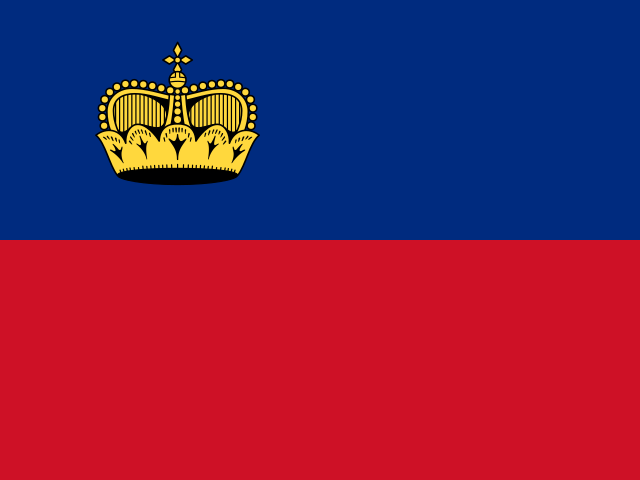
The Flag of Liechtenstein
Europe · Adopted 18 September 1982 (as currently proportioned); blue-red field since 1921, crown added 1937
Liechtenstein's flag began simply, as a horizontal bicolor of blue over red, formally adopted in 1921 the same year the country's constitution was enacted — blue was said to represent the sky and the red the evening fires lit in the hearths of the principality's homes, a modest, domestic pair of meanings for a country whose flag would go on to have one of the more embarrassing near-misses in modern vexillological history.
That embarrassing moment came at the 1936 Berlin Summer Olympics, where Liechtenstein's small delegation discovered, on arrival, that their national flag — plain blue over red — was visually identical to Haiti's flag, which used the same two colors in the same horizontal arrangement. The two countries' teams reportedly found themselves marching under indistinguishable flags at the same Games, a genuinely awkward coincidence for two nations with no historical connection to each other whatsoever, and one that made international news at the time as an oddity of the event.
Liechtenstein's government moved quickly: the following year, in 1937, it added a gold princely crown to the upper hoist corner of the blue stripe, a addition rooted directly in the country's status as a principality still ruled by the House of Liechtenstein — the crown representing the unity of the princely family and the people, and, not incidentally, permanently distinguishing the flag from Haiti's plain bicolor going forward. The change is one of the clearest documented cases of a national flag being altered specifically to resolve an Olympic-level identity mix-up rather than for any deeper political or independence-related reason.
Liechtenstein's principality status is itself unusual among European states: it remains a hereditary constitutional monarchy ruled by the House of Liechtenstein, a dynasty that has held the territory (through purchase and consolidation of the counties of Vaduz and Schellenberg) since the early 18th century, and the reigning prince retains real, not merely ceremonial, political powers under the 2003-amended constitution, including the ability to veto legislation and dissolve parliament — a level of active monarchical authority unusual among Western European states by the 21st century, and one the flag's crown symbolizes directly rather than as pure heraldic decoration.
The flag's exact proportions were most recently fixed by a 1982 law establishing the current 3:5 ratio and the precise positioning of the crown, a minor technical adjustment rather than a substantive redesign; the underlying blue-red-and-crown design established in 1937 has remained visually unchanged since.
Liechtenstein is one of the smallest UN member states by both area and population, and its flag's story — a near-miss with Haiti at a single Olympic Games directly prompting a permanent design change — is one of the most frequently retold anecdotes in popular flag trivia precisely because it is so unusual: most flag redesigns trace to revolutions, independence, or political upheaval, not an awkward coincidence noticed at a sporting event.
Since 1937, Liechtenstein's flag has not been confused with Haiti's at any subsequent Olympics or international gathering, and the crown remains the flag's single most distinguishing feature relative to other blue-and-red national bicolors used elsewhere in the world.
Liechtenstein has taken part in the Olympics regularly since the 1936 mix-up, and the country holds a genuinely unusual distinction in Olympic history: it is the most populous nation, per its own small population, never to have won a Summer Olympics medal, even while its athletes have won several Winter Olympics medals in Alpine skiing — a small footnote that keeps the flag's most famous anecdote tied, decades later, to the same Games where the original Haiti mix-up occurred.
The crown added in 1937 is not a generic decorative device but a specific rendering associated with the princely house's own heraldic tradition, and Liechtenstein's government has, in subsequent decades, issued formal specifications for its exact size, color (gold), and placement relative to the blue stripe, treating the emblem with the same legal precision applied to the flag's base colors and proportions.
Liechtenstein's 1719 elevation to Imperial Principality was itself motivated substantially by the ruling family's ambition to secure a seat in the Imperial Diet of the Holy Roman Empire, something their existing scattered estates elsewhere had not provided — meaning the very territory the flag now represents was originally acquired less for its own sake than as a qualifying property to unlock a political privilege, a genuinely unusual founding motive that still shapes how historians describe the country's 18th-century origins.
Liechtenstein's flag law also specifies a separate state flag, adding the national coat of arms (a shield quartering the arms of several historic territories the House of Liechtenstein once held or claimed, including the Duchy of Troppau and the County of Rietberg) to the plain blue-red-and-crown civil flag, a formal governmental version used at official buildings and by the reigning prince distinct from the simpler flag flown by ordinary citizens and businesses.
The crown in the upper hoist
- Flag with the crown — Without the crown this design is identical to Haiti's, so the crown is not decoration; check it is present and set in the upper hoist rather than centred.
As an Amazon Associate we earn from qualifying purchases made through these links, at no extra cost to you.
Often confused with
- Haiti — the flag Liechtenstein's design was mistaken for at the 1936 Berlin Olympics before the 1937 crown addition — Haiti's flag remains a plain blue-over-red horizontal bicolor (with a central coat of arms on official versions) with no crown, still visually close to what Liechtenstein's own flag looked like before the fix. Compare side by side →
Liechtenstein at a glance
- Capital
- Vaduz
- Population
- 40,000 (2024)
- Currency
- Swiss Franc (CHF)
- Language(s)
- German (official)
Population figure as of 2024, source: Liechtenstein Office of Statistics / UN estimates (2024). See methodology for how facts are sourced and kept current.