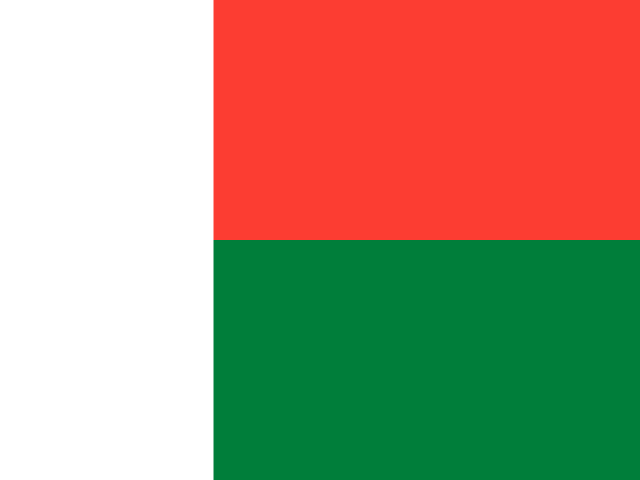
Antananarivo — Capital of Madagascar
Antananarivo was founded around 1610 by Andrianjaka, a Merina king, on a ridge of hills in the island's central highlands, chosen for its defensible high ground rather than for coastal trade access — a strikingly different founding logic than most African colonial-era capitals, since the city predates French colonization by nearly three centuries and was built as the seat of a genuinely indigenous Malagasy kingdom.
The city's name means roughly 'city of the thousand' in Malagasy, traditionally explained as a reference to the thousand soldiers Andrianjaka is said to have stationed there to guard the settlement, and it grew over the following two centuries into the capital of the unified Kingdom of Madagascar under the Merina dynasty, which by the early 19th century under King Radama I and later Queen Ranavalona I controlled most of the island.
The Rova of Antananarivo, the royal palace complex on the city's highest hill, served as the residence of the Merina monarchs for roughly two centuries before French colonization in 1896 dissolved the monarchy and exiled the last queen, Ranavalona III, to Algeria; the palace complex, though badly damaged by a 1995 fire, remains one of the most historically significant sites on the island and a monument to the pre-colonial Malagasy state that French rule ended.
French colonial administrators kept Antananarivo as the colony's capital after 1896, building a new lower town in the valley below the historic hilltop core, and the city retained its role automatically at independence in 1960 — one of relatively few African capitals to have functioned continuously as the seat of political power for both a pre-colonial indigenous kingdom and the modern independent state.
Today Antananarivo remains Madagascar's political, economic, and cultural center, its hillside layout of red-brick houses and narrow winding streets giving it a distinctive skyline shaped by the highland terrain the Merina kings originally chose for defense rather than convenience.
Lake Anosy, an artificial lake created by French colonial engineers in the early 20th century in a low-lying part of the city, is now ringed by jacaranda trees and overlooked by a memorial to Malagasy soldiers who died fighting for France in the First World War, making it one of the more visited public spaces in the capital and a physical marker of the colonial-era city planning layered over the older hilltop kingdom above it.
The Andafiavaratra Palace, built in the 1870s as the residence of Rainilaiarivony, the powerful prime minister who effectively ran the Merina kingdom's government for over 30 years under three successive queens, sits below the main Rova complex and today functions as a museum holding royal artifacts that survived the 1995 fire, offering a more intact counterpart to the still-recovering Rova itself.
Zebu cattle, a long-horned, humped breed central to Malagasy rural economy and ritual life, are traded in large numbers at markets on the capital's outskirts, and the presence of cattle markets within reach of the highland capital reflects how closely Antananarivo's urban economy remains tied to the pastoral traditions of the surrounding countryside, even as the city itself has grown into a metropolis of several million people.
Quick facts
- Antananarivo's population runs to roughly 1.4-1.6 million within city limits and over 3 million across the wider metropolitan area, per 2024 estimates.
- Under French colonial rule the city was known by the Frenchified spelling Tananarive, a name officially dropped in favor of the original Malagasy Antananarivo after independence in 1960.
- Antananarivo's Rova hill, known locally as Analamanga, is counted among the traditional 'twelve sacred hills of Imerina,' the ceremonial hilltops tied to the historic Merina monarchy.
- The Rova palace complex, seat of the Merina monarchy, was severely damaged by fire in 1995 and has been under long-term restoration since.
- Madagascar's highland central location for its capital is unusual among Indian Ocean island nations, most of which built their capitals directly on the coast.
- Queen Ranavalona I, who ruled from Antananarivo from 1828 to 1861, is remembered for decades of persecution of Christian converts, including executions at Ambohipotsy hill within the city, now marked by a memorial church.
- Terraced rice paddies still occupy the low ground between Antananarivo's hills, a visible, still-farmed legacy of the intensive irrigated rice cultivation the Merina kingdom's economy was built on.