The Flag of Madagascar
Africa · Adopted 14 October 1958
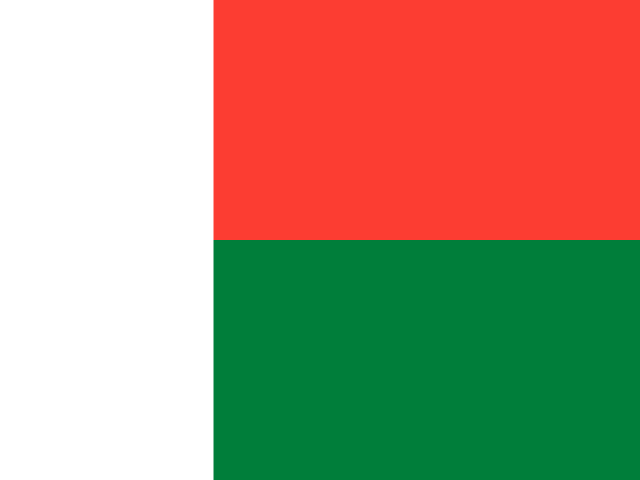
Madagascar's flag was adopted on 14 October 1958, during the two-year interim period when the island held self-governing status short of full sovereignty inside the French Community, ahead of independence being formally completed in June 1960. The white-red-green tricolor, with a vertical white band at the hoist and horizontal red-over-green bands filling the rest, was a new design created specifically for the coming republic rather than an inherited colonial or resistance-movement banner.
The white and red colors are widely understood to reference the historic Kingdom of Merina, the Malagasy monarchy that unified much of the island under Queen Ranavalona and her predecessors in the 18th and 19th centuries before French colonization in 1896 — white and red had long been used in Merina royal symbolism, and their inclusion in the 1958 flag was a way of connecting the new republic to a genuinely pre-colonial Malagasy political tradition rather than inventing a wholly new set of national colors.
The green band is a departure from that older Merina palette and is generally explained as representing the Hova, historically a free commoner class within Merina society, and more broadly the coastal peoples of Madagascar outside the highland Merina heartland — making the flag's three colors a genuine attempt to represent both the historic highland monarchy and the island's coastal populations within a single design, in a country where highland-coastal political and cultural distinctions have mattered for centuries.
Madagascar's distinct layout — a vertical band at the hoist paired with horizontal bands filling the rest — is unusual among African flags, most of which use either purely horizontal or purely vertical stripes; this hybrid format sets Madagascar visually apart from most of its regional neighbors despite sharing the general red-white-green palette common in the pan-African context.
The flag itself has never been redesigned since 1958, a stability that stands out against a genuinely eventful run of governments since: a socialist one-party period under Didier Ratsiraka beginning in the 1970s, a return to multiparty democracy in the 1990s, and a disputed 2009 political crisis in which Ratsiraka's eventual successor, Marc Ravalomanana, was forced from office by Andry Rajoelina in a transition several international bodies at the time characterized as unconstitutional — none of which prompted any change to the national flag itself.
Because Madagascar's economy and ecology are so closely tied to its status as an island separated from mainland Africa for roughly 88 million years, with a large share of its plant and animal species found nowhere else on Earth, the flag is sometimes discussed alongside the island's broader reputation for uniqueness — a flag whose hybrid vertical-and-horizontal layout is itself something of a design outlier, much like the island's biology.
Madagascar's own ethnic composition complicates any simple reading of the flag as purely a highland-versus-coast balance: the island's population traces its ancestry to a genuinely unusual mix of Southeast Asian (primarily Austronesian, related to peoples of Borneo) and East African migrants who settled the island at different points over roughly two millennia, a dual heritage visible in the Malagasy language itself, which is Austronesian in origin despite the island sitting just off Africa's coast — a genetic and linguistic history the flag's designers were working within, even though the flag's colors reference political rather than ethnic history specifically.
Madagascar's government has periodically reasserted the flag's continuity as a point of national stability: even during the especially fraught 2009 transition, when Andry Rajoelina took power with military backing and much of the international community suspended recognition and aid to the country for several years, the flag itself was never contested by any political faction, remaining one of the only genuinely uncontested national symbols throughout the crisis.
Rajoelina himself eventually returned to power through the ballot box, winning presidential elections in 2018 and again in 2023, though the 2023 vote was marred by an opposition boycott and disputes over his eligibility to run given questions about his French citizenship acquired during his years out of office — a controversy that again played out entirely apart from the national flag, which has now flown continuously through four distinct Malagasy republics since 1958 without a single redesign.
Madagascar marks two separate dates tied to its road to statehood, and only one of them is the flag's own anniversary: 14 October 1958, when the flag was adopted alongside the proclamation of the self-governing Malagasy Republic within the French Community, and 26 June 1960, celebrated today as Independence Day, when full sovereignty from France was completed. The nearly two-year gap between the two dates reflects the broader pattern across French West and Central African territories in this period, most of which moved through an autonomous-republic stage inside the French Community before a separate, later declaration of full independence.
Madagascar's flag law fixes the ratio at 2:3 and specifies the white hoist band at exactly one third of the flag's total length, with the red and green horizontal bands splitting the remaining two-thirds evenly — a construction detail that distinguishes it at a glance from flags using a plain three-band vertical or horizontal layout even before a viewer registers the color choices themselves. The socialist-era Democratic Republic of Madagascar (1975–1992) added its own red five-pointed-star party emblem to Ratsiraka's ruling AREMA party materials and state seals during that period, but that emblem was never incorporated into the national flag itself, which stayed the plain 1958 tricolor throughout the socialist period.
A hoist band of exactly one third
- Sewn-panel flag — The white band is specified at a third of the total length, which is a proportion you can check by eye on delivery and the first thing a loosely cut flag gets wrong.
As an Amazon Associate we earn from qualifying purchases made through these links, at no extra cost to you.
Madagascar at a glance
- Capital
- Antananarivo
- Population
- 31.0 million (2024)
- Currency
- Malagasy Ariary (MGA)
- Language(s)
- Malagasy and French (both official)
Population figure as of 2024, source: UN World Population Prospects (2024 revision). See methodology for how facts are sourced and kept current.