Kuala Lumpur — Capital of Malaysia
Kuala Lumpur's name translates literally to 'muddy confluence,' a description of the actual geography where the city began: it was founded in 1857 at the meeting point of the Klang and Gombak rivers by a group of Chinese tin miners who established a trading post to supply the tin mining operations rapidly developing in the surrounding Klang Valley.
The settlement grew quickly as tin mining boomed through the late 19th century, and it became the administrative capital of the state of Selangor under British colonial influence in 1880, then the capital of the Federated Malay States in 1896 — a step that set it on the path to becoming the eventual national capital, well ahead of Malaysia's independence.
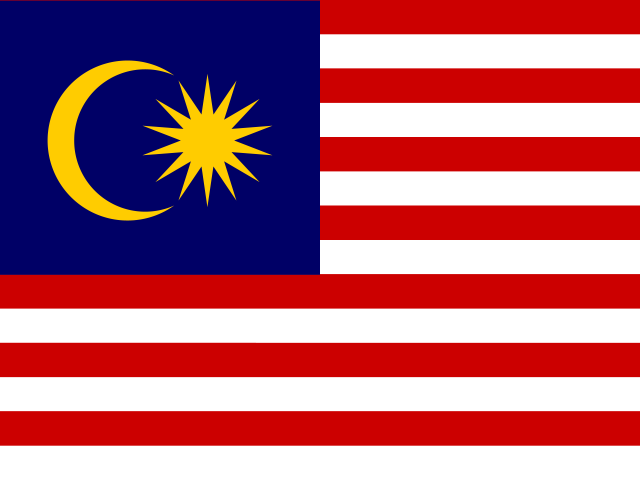
Kuala Lumpur became the capital of the independent Federation of Malaya in 1957, and it retained that status when the expanded state of Malaysia formed in 1963, the same year the country's flag grew from eleven stripes to fourteen to reflect the newly enlarged federation.
Since 1999, Kuala Lumpur has shared its capital functions with Putrajaya, a purpose-built administrative city about 25 kilometers south, to which most federal government ministries relocated in a deliberate effort to relieve congestion in Kuala Lumpur's dense urban core; Kuala Lumpur nonetheless remains Malaysia's official capital and continues to house the national parliament and the monarchy's official residence.
The city's skyline is dominated by the Petronas Twin Towers, completed in 1998 and, for several years afterward, the tallest buildings in the world — a landmark so closely tied to Malaysia's rapid economic development through the late 20th century that its twin spires now function as a shorthand for the entire city on postcards and in film backdrops across the region.
Batu Caves, a limestone hill complex a short distance north of the city center containing Hindu shrines and a towering golden statue of the deity Murugan, predates the city's modern growth as a religious site and has become one of Kuala Lumpur's most visited attractions, drawing especially large crowds during the annual Thaipusam festival.
Kuala Lumpur's public transit network, including its light rail, monorail, and MRT lines developed from the 1990s onward, was built substantially to address the traffic congestion that came with the city's rapid late-20th-century growth, and continued expansion of the system has remained a recurring feature of the city's infrastructure planning into the 2020s.
Kuala Lumpur's status as a majority Malay-Muslim city sitting alongside large, historically established Chinese and Indian communities has made it one of Southeast Asia's most religiously and ethnically layered capitals, visible in the close proximity of the city's central mosque, historic Chinese temples in areas like Petaling Street, and Hindu temples such as Sri Mahamariamman, several of which sit within walking distance of one another in the older parts of downtown.
Kuala Lumpur's Merdeka Square, the former colonial-era cricket field where Malaya's independence was formally proclaimed at midnight on 31 August 1957, remains the traditional site of the country's annual Merdeka Day flag-raising ceremony, giving the flag's most significant yearly public display a direct physical connection to the exact location of the 1957 independence proclamation.
Kuala Lumpur's Chinatown, centered on Petaling Street, developed alongside the city's earliest tin-mining-era Chinese community and remains a dense hub of shophouses, markets, and food stalls that traces its roots directly back to the same 1857 founding period that produced the city itself, giving it one of the longest continuous commercial histories of any single district in the capital.
Quick facts
- Kuala Lumpur's metropolitan area (Greater KL / Klang Valley) has a population of roughly 8 million, though the city proper is considerably smaller.
- Kuala Lumpur is one of Malaysia's three federal territories, administered directly by the federal government rather than by a state government, a status it shares with Putrajaya and Labuan.
- The KLCC Park surrounding the Petronas Twin Towers was built on the site of the former Selangor Turf Club racecourse, which relocated in the early 1990s to make way for the development.
- The Kuala Lumpur Tower (Menara KL), completed in 1996 on a hill above the city center, is one of the tallest telecommunications towers in the world and predates the Petronas Twin Towers by two years.
- Merdeka 118, completed in central Kuala Lumpur in 2023, became the world's second-tallest building and Malaysia's tallest structure, surpassing the Petronas Twin Towers.