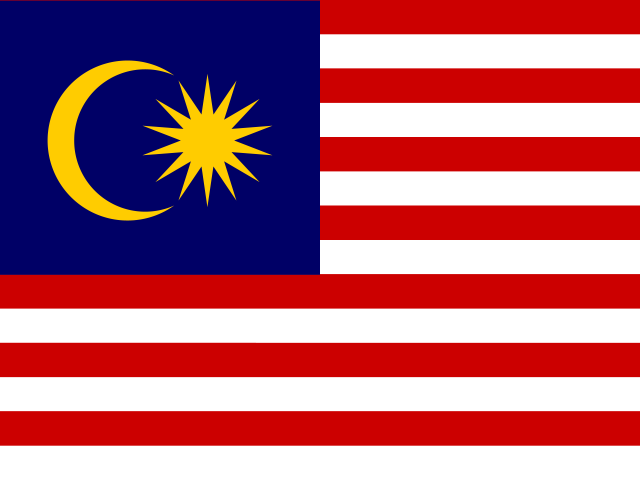
The Flag of Malaysia
Asia · Adopted 16 September 1963
Malaysia's flag, known officially as the Jalur Gemilang — 'Stripes of Glory' — reached its current 14-stripe form on 16 September 1963, the day the Federation of Malaya merged with Singapore, Sabah, and Sarawak to form the expanded state of Malaysia, though the underlying design is older still, having started life as the flag of the Federation of Malaya at its 1957 independence from Britain.
That 1957 original had eleven red-and-white horizontal stripes and an eleven-pointed star in its blue canton, one point and one stripe for each of the eleven states that made up the Federation of Malaya at the time. When Malaysia formed in 1963, the design was expanded rather than replaced — three more stripes and three more star points were added, bringing the total to fourteen, matching the new count of constituent states and territories in the enlarged federation.
Singapore's departure from Malaysia in 1965, less than two years later, could have forced another redesign back down to thirteen, but Malaysia instead kept the number fourteen and simply reassigned its meaning: the fourteenth stripe and point are now understood to represent the federal government and Malaysia's federal territories collectively, rather than any single one of the country's thirteen states, preserving the flag's design without needing a formal reduction.
The canton's yellow crescent and fourteen-point star carry meanings specific to Malaysia's constitutional makeup: yellow is the traditional color of the Malay rulers, the hereditary sultans who still hold ceremonial and some constitutional authority in most Malaysian states, while the crescent represents Islam, the country's official religion, and the star's points stand for the unity of the states with the federal government, the same reassigned meaning carried over from the post-1965 reinterpretation.
Because the flag's basic composition — horizontal red-and-white stripes with a starred blue canton in the upper hoist corner — closely echoes the general layout of the United States flag, Malaysia's flag is frequently compared to it in casual observation, though the resemblance is generally treated as a structural coincidence shared through a common colonial-era 'stripes and canton' design grammar rather than a direct borrowing; the star shape, crescent, and specific color meanings are unrelated to and independently derived from American symbolism.
Malaysia's flag law prescribes an exact 1:2 ratio and precise specifications for the stripe widths, canton size, and star geometry, and Malaysian schools and government campaigns have periodically promoted correct-display education, partly in response to recurring cases of the flag being printed or displayed with the wrong number of stripes or a misshapen star — errors common enough in commercial and even some official printings that flag-accuracy has become a recurring minor public issue.
The flag is flown especially prominently around Malaysia's Merdeka (Independence) Day on 31 August and Malaysia Day on 16 September, the latter specifically marking the 1963 federation that gave the flag its current fourteen-stripe form, and it flies over Putrajaya, the purpose-built administrative capital that now houses most federal government offices even though Kuala Lumpur remains Malaysia's official capital and the seat of parliament and the monarchy.
A 1997 amendment to Malaysia's flag regulations formally set out the modern name Jalur Gemilang and launched a sustained government campaign encouraging citizens to fly the flag from private homes and vehicles, a push credited with substantially increasing everyday public display of the flag beyond government buildings and official events compared to earlier decades.
Correct display of the flag has occasionally become a minor point of public controversy in Malaysia, including recurring cases of commercially printed flags with an incorrect stripe count or a misshapen crescent and star, and past incidents of the flag being inadvertently printed or displayed upside down at public events, which have periodically prompted government reminders about the legally specified proportions and orientation.
Sabah and Sarawak, the two states on the island of Borneo that joined Malaysia in 1963 alongside the former Federation of Malaya and briefly Singapore, are each represented within the fourteen-point star and fourteen-stripe count on equal footing with the peninsular states, even though both retain certain distinct constitutional autonomies within the Malaysian federation — including their own immigration controls — that set them apart administratively from the eleven peninsular states the original 1957 flag was designed around.
Because Brunei, a nearby Bornean sultanate that also uses yellow prominently in its own flag as a mark of royal authority, shares a broadly similar Islamic-monarchy symbolic vocabulary with Malaysia despite never joining the federation itself, the two countries' flags are occasionally mentioned together in regional design discussions even though their actual layouts — Brunei's featuring a diagonal design rather than stripes — are quite different in practice.
Malaysia's flag law fixes the official ratio at 1:2 and specifies the canton's size as covering the upper-left quarter of the flag's length, with fourteen stripes of equal width running the remaining length — precise proportional rules that, combined with the periodic printing errors noted above, have made correct-reproduction guidance a recurring theme of Malaysian government public messaging around national holidays.
The Jalur Gemilang has become closely tied to sustained government-backed patriotic campaigns since the late 1990s aimed at boosting everyday civilian flag ownership and display well beyond the government buildings and schools where flag flying had traditionally been concentrated.
Because Malaysia's fourteen-stripe count has stayed fixed since 1963 despite Singapore's 1965 departure, some Malaysian schoolchildren are taught the flag's stripe count as a reminder of the country's founding federation rather than its exact current composition of states, a small but genuine gap between the flag's literal design history and Malaysia's present-day thirteen-state structure.
Fourteen stripes at 1:2
- Flag cut to 1:2 — Fourteen alternating stripes only fit cleanly in the specified height, and a shorter cut is where a maker quietly drops one or lets the canton overlap the wrong number of them.
As an Amazon Associate we earn from qualifying purchases made through these links, at no extra cost to you.
Often confused with
- United States — shares the same general layout of horizontal stripes with a starred canton in the upper hoist corner, though the resemblance is a structural coincidence — Malaysia's stripes are red-and-white in a different count, and its canton carries a crescent-and-star rather than the fifty individual stars used on the American flag. Compare side by side →
Malaysia at a glance
- Capital
- Kuala Lumpur
- Population
- 35.6 million (2024)
- Currency
- Malaysian Ringgit (MYR)
- Language(s)
- Malay (official); English, Mandarin, and Tamil widely spoken
Population figure as of 2024, source: UN World Population Prospects (2024 revision). See methodology for how facts are sourced and kept current.