Valletta — Capital of Malta
Valletta exists because of a siege. After the Knights of St. John withstood the Great Siege of Malta in 1565 — a months-long Ottoman assault that the vastly outnumbered defenders survived largely thanks to the fortifications on the Sciberras peninsula — the Order's Grand Master, Jean Parisot de Valette, decided the peninsula needed a permanent fortified city rather than makeshift defenses. Construction began in 1566, the city was named after him, and it became the Order's new capital, replacing the older settlements of Birgu and Mdina as the center of Maltese administration.
The city was laid out on a strict grid by the Italian military engineer Francesco Laparelli, a deliberate departure from the winding medieval street plans typical of the era, and built almost entirely within a few decades using limestone quarried from the island itself — the same soft, warm-colored stone that still gives Valletta's buildings their distinctive uniform tone today. UNESCO placed the entire city on its World Heritage list in 1980, calling it one of the most concentrated historic areas in the world for its size.
At roughly 0.8 square kilometers, Valletta is among the smallest national capitals in the European Union by land area, small enough to walk end to end in under half an hour, yet it packs in St. John's Co-Cathedral — built by the Knights between 1573 and 1578 and home to two Caravaggio paintings, including 'The Beheading of Saint John the Baptist,' the only work the artist is known to have signed — alongside the Grand Master's Palace and a dense network of Baroque churches and auberges built to house the Knights organized by their national langues, or tongues.
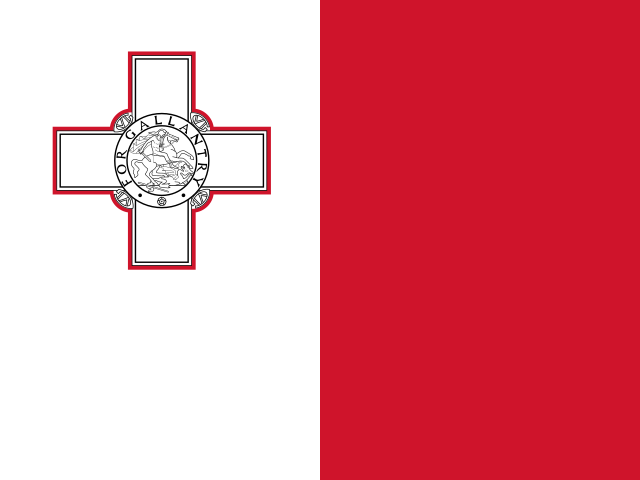
Valletta remained the seat of government through British colonial rule from 1800 to 1964 and continued as capital after independence and again after the 1974 shift to a republic, without ever being displaced or relocated the way many newer capitals have been. It absorbed heavy bombing during the Second World War siege that later earned the whole island the George Cross, and portions of the city had to be rebuilt afterward, though much of the Knights-era core survived.
Today Valletta functions primarily as Malta's administrative and cultural center — home to the Maltese Parliament, the president's official residence, and national courts — while much of the surrounding population and everyday commercial life is concentrated in the wider Grand Harbour region and towns like Birgu and Sliema across the water, a division of political capital and lived-in urban center that shapes how compact Valletta itself actually feels day to day.
Valletta's fortifications, built by the Knights across the late 16th and 17th centuries, remain some of the best-preserved examples of star-fort military architecture from the era in the Mediterranean, layered defenses designed specifically in response to the near-disaster of the 1565 siege, when the Order came close to losing the islands entirely before Ottoman forces eventually withdrew.
The Grandmaster's Palace, once the seat of the Order's rulers and now home to Malta's presidential offices and House of Representatives, holds an armoury of several thousand pieces of weaponry and armor assembled by the Knights over more than two centuries — one of the largest such collections still displayed in its original historic setting anywhere in Europe.
The Knights organized themselves into eight langues, or linguistic divisions — including Provence, Auvergne, France, Italy, Aragon, Castile, Germany, and England — each housed in its own auberge scattered through the city; the Auberge de Castille, rebuilt in Baroque style in the 1740s, now houses the office of Malta's prime minister, while the Auberge d'Italie has been converted into MUŻA, the national museum of fine arts.
The Manoel Theatre, built in 1731 under Grand Master António Manoel de Vilhena, remains in regular use and ranks among the oldest working theatres in Europe, its small horseshoe-shaped auditorium still staging opera and drama seasons nearly three centuries after it first opened.
From the terraced Upper Barrakka Gardens above the Grand Harbour fortifications, a saluting battery installed by the British in the 19th century still fires a cannon shot at noon each day, a ceremonial tradition that has outlasted both the colonial administration that started it and the Knights' fortifications it now overlooks.
Quick facts
- Valletta's population within its own small city boundary is only a few thousand residents, even though it anchors a much larger metropolitan region around the Grand Harbour.
- Grand Master Jean Parisot de Valette, whom the city is named for, was already in his seventies when he ordered its construction in 1566 and died the following year, before the fortified capital he commissioned was finished.
- St. John's Co-Cathedral also houses a second Caravaggio painting, 'Saint Jerome Writing,' displayed in the same oratory as his larger, signed 'Beheading of Saint John the Baptist.'
- Valletta's 1980 UNESCO listing covers the entire walled city rather than a single monument or district, an unusually broad designation reflecting how densely its historic fabric survives within such a small footprint.
- Valletta served as European Capital of Culture in 2018, an occasion Malta used to fund restoration projects across the old city's fortifications and public spaces.