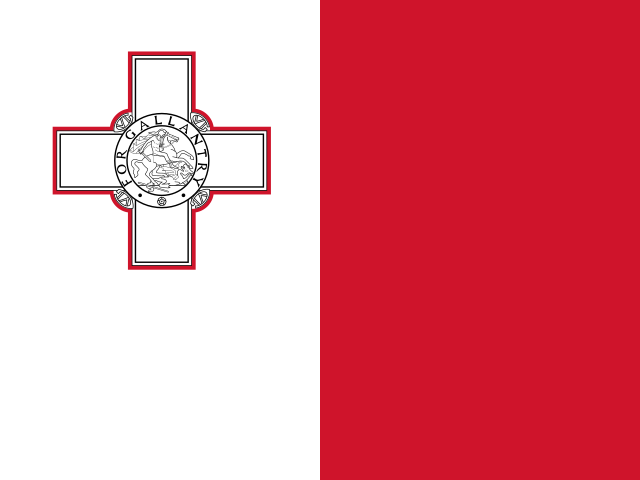
The Flag of Malta
Europe · Adopted 21 September 1964
Malta's flag became official on 21 September 1964, the day Britain granted the island independence after more than a century and a half of colonial rule. The design is a vertical bicolor, white in the hoist and red in the fly, with a small image of the George Cross edged in red set inside a blue-bordered white canton in the upper hoist corner. Nothing else on the flag needs a legend or a key — the George Cross is a specific, named British military decoration, and its presence records a specific historical episode rather than a generic virtue.
That episode was the siege of Malta during the Second World War. Between 1940 and 1942 the island endured sustained Axis aerial bombardment aimed at knocking out its use as an Allied naval and air base in the central Mediterranean; food and fuel shortages became severe enough that convoys had to run the gauntlet of German and Italian attacks just to keep the population fed. In April 1942, King George VI awarded the George Cross collectively to 'the island fortress of Malta' in recognition of that endurance — the only time in the medal's history it has been given to an entire population rather than an individual. Malta had already begun flying a red flag bearing the cross in one corner shortly afterward, well before independence made it part of the national flag proper.
The white and red halves predate the George Cross by centuries and are wrapped in a story Maltese schoolchildren are still taught, even though historians treat it as legend rather than documented fact: that Count Roger I of Sicily, a Norman ruler who took Malta from Arab control in 1091, tore a corner from his own red-and-white checkered banner and gave it to the Maltese as their colors. No contemporary 11th-century source confirms this, but white and red had certainly become associated with Malta well before the 20th century, independent of whatever the true origin turns out to be.
A more traceable thread runs through the Order of St. John, the crusading order also known as the Knights of Malta, which ruled the islands from 1530 to 1798. The Order's own banner was a white cross on a red field — the reverse color arrangement of the plain white-and-red flag Malta used before 1964 — and some of that visual association persisted through British colonial rule, when Malta flew British ensigns rather than a flag of its own.
Before 1964, the closest thing to a distinct Maltese flag under British administration was the plain white-red split without any badge, used informally and on some civic occasions. The 1943 wartime flag added the George Cross inside a small canton on a red field; when full statehood arrived in 1964, framers of the new national flag kept the George Cross exactly where wartime usage had put it, but restored the older white-and-red halves as the field, merging the two symbolic layers — medieval-legend colors and a 20th-century war decoration — into a single design rather than choosing between them.
Malta's constitution has not altered the flag's design since 1964, though the country's status changed twice afterward: it became a republic in 1974, replacing the British monarch as head of state with a president, and joined the European Union in 2004. Neither change touched the flag itself, which is unusual — many countries that shift from monarchy to republic redesign at least the details of their national symbols, but Malta's George Cross flag has stayed constitutionally fixed through both transitions.
Because red-and-white pairings are common among European flags, Malta's is sometimes mentally grouped with Poland's, Monaco's, or Indonesia's in casual conversation, even though all three of those are horizontal bicolors with no canton badge at all — Malta's vertical split and its small blue-bordered white square carrying the George Cross make it visually distinct the moment anyone looks closely. A closer visual relative is the flag of the Order of St. John itself, whose white-cross-on-red is the color-reversed ancestor of the plain pre-1964 Maltese flag, though the two are flown by entirely different institutions today — the Order continues as a Rome-based charitable and diplomatic body, unconnected to the modern Maltese state.
The flag is flown daily at government buildings and is especially prominent around Independence Day on 21 September and Republic Day on 13 December, and the George Cross itself still appears separately on Maltese euro coins and in the Order of the Islands of Malta honors system, a reminder that the wartime medal has outgrown the flag and become a broader national emblem in its own right.
The flag also has an unusually large commercial footprint for such a small country, because Malta operates one of the largest ship registries in the world — vessels owned anywhere on earth can be registered under the Maltese flag, making it one of the most common 'flags of convenience' in international shipping, alongside Panama and Liberia. That means the George Cross flag flies on a huge volume of merchant tonnage that has no other connection to Malta beyond the registration paperwork, a genuinely different kind of flag presence than the ceremonial and governmental use the design was originally created for in 1964.
The Sovereign Military Order of Malta, the modern descendant of the medieval Knights of St. John who once ruled the islands, still exists today as a Rome-headquartered entity with UN observer status and its own separate flag, the white-cross-on-red banner distinct from the national Maltese flag — the two are sometimes confused by people who assume the historic Knights and the modern Republic of Malta are the same institution, when in fact the Order lost sovereignty over the islands in 1798 and has operated independently of Maltese statehood ever since.
A cross inside a bordered canton
- High-resolution printed flag — The canton holds a cross with its own red edging inside a blue border, three elements nested in a corner patch, and that is a lot of structure for a print to hold at flag size.
As an Amazon Associate we earn from qualifying purchases made through these links, at no extra cost to you.
Often confused with
- Monaco — also a red-and-white flag, but Monaco's is a plain horizontal bicolor with no canton or badge of any kind, while Malta's is a vertical split carrying the small George Cross emblem. Compare side by side →
- Poland — pairs the same two colors, but Poland's flag is a horizontal white-over-red bicolor with no emblem, unlike Malta's vertical split and George Cross canton. Compare side by side →
Malta at a glance
- Capital
- Valletta
- Population
- 545,000 (2024)
- Currency
- Euro (EUR)
- Language(s)
- Maltese and English (both official)
Population figure as of 2024, source: UN World Population Prospects (2024 revision). See methodology for how facts are sourced and kept current.