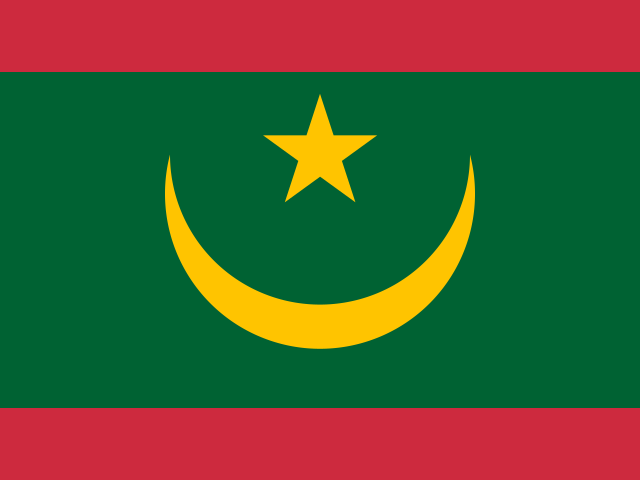
Nouakchott — Capital of Mauritania
Nouakchott is a genuinely purpose-built capital: before independence it was little more than a small fort and a modest coastal village, chosen deliberately by French colonial planners and the incoming Mauritanian government in the late 1950s specifically because it sat roughly midway between the country's northern desert regions and its southern Senegal River communities, avoiding favoritism toward any single existing regional center in a vast and ethnically diverse territory.
The city was constructed essentially from scratch starting in 1958, designed initially for a population of around 15,000 people, and became the official capital when Mauritania gained independence from France in 1960 — a modest planned town that has since grown far beyond anything its original designers anticipated.
Nouakchott's growth was dramatically accelerated by the Sahel droughts of the 1970s and 1980s, which devastated traditional nomadic and agricultural livelihoods across the region and drove massive rural-to-urban migration into the capital, transforming it from a small planned settlement into one of the fastest-growing cities in West Africa within a few decades — a growth trajectory driven almost entirely by climate-linked displacement rather than planned urban expansion.
The city sits directly on the Atlantic coast yet remains deeply shaped by the Sahara that surrounds it on the other three sides, and encroaching sand dunes have posed a persistent, ongoing challenge for city planners and residents, with wind-blown sand a routine feature of daily life and infrastructure maintenance in a way few other national capitals contend with.
As Mauritania's only large city, Nouakchott now concentrates the overwhelming majority of the country's government functions, formal-sector jobs, and modern infrastructure, including the port facilities and fishing industry that make up one of the country's most significant economic sectors, drawing on the rich fishing waters off Mauritania's Atlantic coast.
The King Fahd Mosque, funded by Saudi Arabia and completed in the early 1990s with a pair of tall minarets that remain among the tallest structures on the capital's skyline, reflects both Mauritania's overwhelmingly Muslim population and the Gulf-state funding that has shaped a number of the city's major public buildings since the 1980s.
Nouakchott's beach fish market, where wooden pirogues land their catch directly onto the sand each morning and traders haul it straight into the adjoining market stalls, remains one of the most distinctive features of daily life in the capital and a visible, informal counterpart to the more industrial fishing operations based further north at Nouadhibou.
Mauritania holds the unusual distinction of being the last country in the world to formally abolish slavery, criminalizing it only in 2007 after an earlier 1981 decree had outlawed the practice without providing means of enforcement; the debate over how thoroughly that legacy has actually ended remains an active and often contentious subject of political life centered in Nouakchott, where national rights organizations and government ministries alike are based.
Quick facts
- By 2024 UN estimates, Nouakchott's population had swelled to somewhere between 1.3 and 1.5 million — roughly a hundredfold increase from the 15,000 residents the city was originally designed to house at independence in 1960.
- The city's name is generally translated from Berber as 'place of the winds,' a fitting description given its exposure to Saharan wind and drifting sand.
- Nouakchott was purpose-built as Mauritania's capital starting in 1958, with no prior history as a major settlement before that construction began.
- The 1970s-80s Sahel droughts drove mass rural migration into Nouakchott, causing the city's population to grow far beyond its original planned scale within a few decades.
- Mauritania's fishing industry, much of it channeled through Nouakchott's port, is one of the richest fishing zones in West Africa and a major national export earner.
- The Saudi-funded King Fahd Mosque, completed in the early 1990s, remains one of the tallest and most prominent structures on Nouakchott's skyline.
- The Université de Nouakchott Al Aasriya, established in 1981 as the country's first university, remains Mauritania's largest institution of higher education and one of the few in the country offering graduate-level programs.