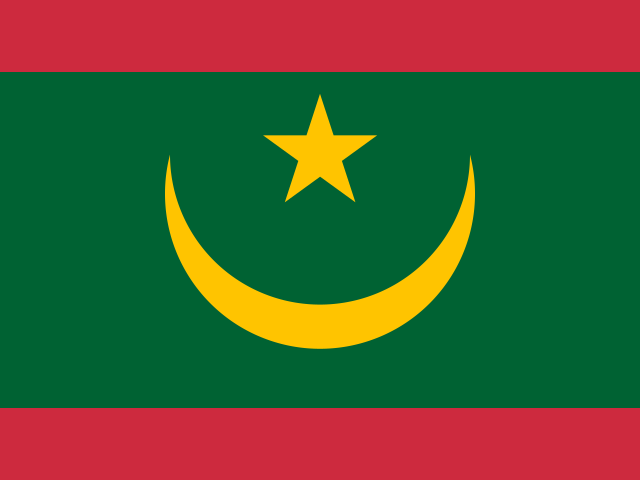
The Flag of Mauritania
Africa · Adopted 28 November 1959 (redesigned 15 April 2017)
Mauritania's original flag was adopted on 28 November 1959, roughly a year before independence from France on 28 November 1960, and for its first 58 years consisted simply of a gold crescent and five-pointed star centered on a plain green field — a design so minimal it was one of the simplest national flags in Africa, communicating Mauritania's Islamic identity (the crescent and star) and its arid, largely desert landscape (the green, aspirational for a country that is over 90% Sahara and Sahel terrain) without any additional bands or emblems.
That original design was replaced on 15 April 2017, following a national referendum held that year on a package of constitutional changes under President Mohamed Ould Abdel Aziz. The government added a narrow red stripe at both the top and bottom edges of the flag, framing the existing green field and gold crescent-and-star, without altering the central emblem itself.
Officials explained the added red stripes as representing the blood shed by Mauritanians in defense of the homeland, particularly in resisting French colonization and defending the country's territorial integrity in the decades since independence, including the Western Sahara conflict Mauritania was drawn into in the 1970s before withdrawing its claim in 1979. The change was bundled into a broader 2017 constitutional referendum that also addressed the country's Senate and regional governance structures, making the flag redesign one piece of a larger package of reforms rather than a standalone symbolic decision.
The referendum and the flag change were not without controversy domestically: opposition figures at the time criticized the process as insufficiently consultative, and Mauritania's National Assembly had earlier rejected the same reform package in March 2017, prompting the government to bypass parliament and put the changes directly to a public referendum instead — meaning the flag Mauritanians fly today emerged from a genuinely contested political process, not a uncontroversial consensus update.
Mauritania is one of relatively few African nations to have made any change at all to its original independence-era flag in the 21st century, and the addition of the red stripes gives the current design a fundamentally different visual signature from its 1959-2017 predecessor, even though the crescent-and-star emblem that has represented the country since before independence remains untouched at the center.
The crescent and star combination places Mauritania's flag in the same broad Islamic-symbol family as Algeria's, Tunisia's, and several other North African and Middle Eastern flags, though Mauritania's is distinguished by its solid green field (rather than green-and-white, as in Algeria) and, since 2017, by the red border stripes unique to its own design.
Mauritania was the last country in the world to formally abolish slavery in law, doing so only in 1981, and to criminalize it, which did not happen until 2007 — a genuinely uncomfortable historical fact that human-rights organizations have continued to highlight given credible reports that slavery-like practices persist informally in parts of the country even after legal abolition, a history that sits uneasily alongside the 2017 flag's added red stripes, officially framed as honoring sacrifice and struggle for the homeland.
President Mohamed Ould Abdel Aziz, who oversaw the 2017 flag change, had himself first come to power in a 2008 military coup before being elected president in 2009 and again in 2014, giving the flag redesign a backdrop of a leader consolidating and reshaping national symbols during a decade in which he also faced periodic accusations of authoritarian governance from domestic opposition figures and international observers.
Mauritania straddles a genuine cultural and geographic fault line between Arab North Africa and Sub-Saharan Africa, with a population divided between Bidhan (Arab-Berber Moor) and several Sub-Saharan African ethnic groups including the Halpulaar, Soninke, and Wolof, a divide that has periodically produced serious ethnic tension, including a violent 1989-1991 crisis with Senegal and internal expulsions — tensions the plain, ethnically unmarked green field and Islamic crescent-and-star of the flag were arguably designed to rise above rather than directly reference.
The country's vast Sahara interior, which the flag's green is meant to counterbalance symbolically as a promise of fertile land rather than a description of most of the territory, contains one of the world's richest known iron-ore deposits at Zouérat, linked to the port at Nouadhibou by a roughly 700-kilometer railway that carries some of the longest freight trains in the world — an economically vital but visually stark landscape of desert and rail line that stands in real contrast to the lush green the flag's field is named for.
The crescent's posture on Mauritania's flag is a genuine visual signature worth pausing on: its horns point upward, cradling the five-pointed star above rather than beside or below it, an 'open bowl' orientation distinct from the sideways-facing crescent used on Turkey's and Pakistan's flags or the more tightly curved crescent on Algeria's. Government specifications describe the crescent and star in a warm gold rather than plain yellow, set against a green the 2017 flag law identifies distinctly from the lighter shades used on some other Sahel-region flags.
Mauritania observes 28 November as both Independence Day and the anniversary of the original 1959 flag's adoption, a coincidence of dates that means the country's two founding civic occasions — statehood and national symbol — are marked with a single combined ceremony each year rather than on separate calendar dates, unlike most nations where a flag's adoption and the country's independence fall on different days.
The 2017 border stripes
- Current-design flag — Older stock still shows the pre-2017 plain green field without the two red edge bands, so the thing to check in a listing is whether the red stripes at the top and bottom are actually there.
As an Amazon Associate we earn from qualifying purchases made through these links, at no extra cost to you.
Often confused with
- Algeria — shares the green field and a gold-on-green crescent-and-star family resemblance in spirit, though Algeria's flag splits its field between green and white with a red crescent and star, a genuinely different color arrangement from Mauritania's solid green with gold emblem and red border stripes. Compare side by side →
Mauritania at a glance
- Capital
- Nouakchott
- Population
- 4.9 million (2024)
- Currency
- Mauritanian Ouguiya (MRU)
- Language(s)
- Arabic (official); Pulaar, Soninke, and Wolof recognized as national languages
Population figure as of 2024, source: UN World Population Prospects (2024 revision). See methodology for how facts are sourced and kept current.