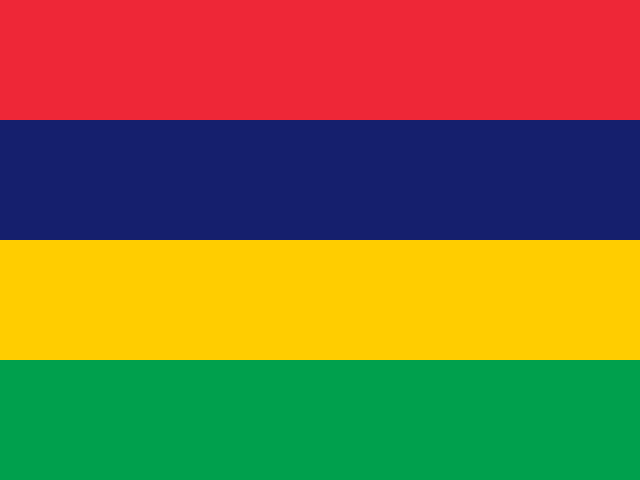
Port Louis — Capital of Mauritius
Port Louis was founded in 1735 by French governor Bertrand-François Mahé de La Bourdonnais, who developed its natural harbor into a major naval and shipbuilding base for French operations across the Indian Ocean, and named it in honor of King Louis XV — making the city, like several other former French colonial capitals, a namesake of the French monarch under whom it was established.
The harbor's strategic value made Port Louis a contested prize: Britain captured the island in 1810 during the Napoleonic Wars, ending over a century of French control, but notably allowed the French-descended population to retain their language, Napoleonic-derived civil law, and Catholic religious practice under the terms of surrender — a rare colonial arrangement that left a lasting French cultural imprint on the island that persists in Port Louis today despite over 150 years of subsequent British rule.
Under British administration, Port Louis became a key hub in the 19th-century indentured labor system, receiving hundreds of thousands of laborers primarily from India who were brought to work the island's sugarcane plantations after the 1830s abolition of slavery — a migration so large and formative that it fundamentally reshaped the island's population and remains central to Mauritian identity and Port Louis's own demographic makeup today.
Port Louis retained its role as capital when Mauritius gained independence from Britain in 1968 and again when the country became a republic in 1992, having functioned continuously as the island's principal port and administrative seat since the French colonial period — a rare case of uninterrupted capital status spanning French rule, British rule, and full independence.
The city today anchors Mauritius's status as a significant offshore financial center and free port, alongside its historic role in sugar export, and its Champ de Mars racecourse, built in 1812, is the oldest horse-racing track in the Southern Hemisphere, reflecting the city's long British colonial-era leisure culture layered atop its earlier French foundations.
Port Louis sits in a natural bowl ringed by mountains, including the distinctive jagged peak of Le Pouce just outside the city, and that enclosed geography traps heat and humidity so effectively that residents have long nicknamed the capital 'the cauldron,' a climate that has historically pushed much of the island's residential growth toward cooler highland towns like Curepipe even as commerce and government stayed concentrated in the capital.
The Caudan Waterfront, a redevelopment of the old port-adjacent commercial district completed in the 1990s, transformed a stretch of disused harbor infrastructure into shopping, dining, and casino space and is now one of the more visible symbols of Mauritius's post-independence pivot toward tourism and services alongside its older sugar and, more recently, financial-services economy.
The Jummah Mosque, completed in 1852 in the heart of Port Louis's Chinatown-adjacent commercial district, is among the oldest mosques in the Indian Ocean region and reflects the Muslim Indian merchant community that settled in the city alongside the larger wave of Hindu indentured laborers, part of the layered South Asian, Chinese, African, and European heritage that gives Port Louis one of the most religiously and ethnically diverse populations of any capital in the region.
Quick facts
- The 2024 municipal count puts Port Louis's population at roughly 148,000, a figure that has actually edged downward in recent decades as residents move to cooler suburban towns while still commuting into the capital for work.
- The city is named after King Louis XV of France, whose reign coincided with its 1735 founding by French colonial governor Mahé de La Bourdonnais.
- Fort Adelaide, a British citadel completed in 1840 on a hill above the harbor, was built less to guard against foreign invasion than to give colonial authorities a defensible position overlooking the city below.
- UNESCO recognized the Aapravasi Ghat — the harborside depot where the first indentured laborers landed in 1834 — in 2006, citing its role documenting a system that brought roughly half a million Indian workers through Port Louis over the following decades.
- Port Louis's Chinatown, established by Hakka Chinese merchants and laborers arriving from the mid-19th century onward, is among the oldest in the Indian Ocean region and still centers on Royal Street's shopfronts and clan association halls.
- The Natural History Museum in Port Louis holds one of the world's few reconstructed dodo skeletons, a fitting home given that Mauritius is the only place the flightless bird is known to have lived before its extinction in the late 17th century.
- The Jardin de la Compagnie, a shaded public garden of towering royal palms in central Port Louis, traces its origins to a vegetable garden planted by the French East India Company in the early 18th century.