The Flag of Mauritius
Africa · Adopted 12 March 1968
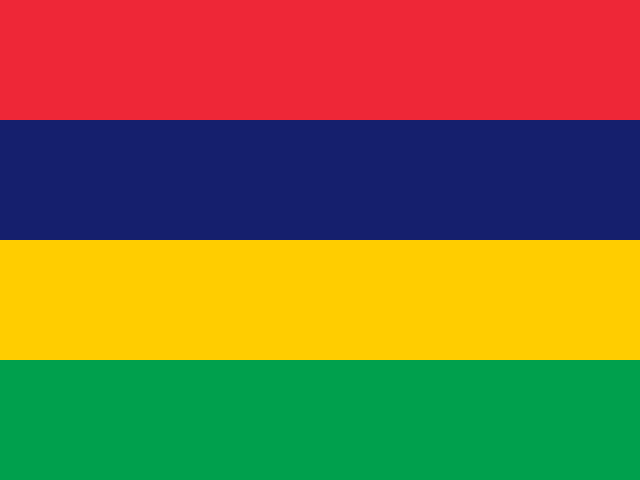
Mauritius's flag was adopted on 12 March 1968, the day the island became independent from Britain, and it is one of very few national flags in the world made up of four horizontal bands of equal width, a design choice that immediately sets it apart from the large majority of flags, which use two or three stripes. The four colors — red, blue, yellow, and green from top to bottom — were selected specifically to avoid duplicating the color schemes of other nations' flags in the region and to give the newly independent island a visually distinct identity of its own.
The four colors are understood locally to represent, in order: red for the sacrifice endured in the long fight against slavery and, later, indentured servitude, both of which shaped the island's population profoundly; blue for the Indian Ocean surrounding the island; yellow for the light of independence and new freedom; and green for the island's agriculture, historically dominated by sugarcane, and its year-round vegetation. Some accounts also connect the colors to the island's Dodo bird — extinct since the late 17th century and unique to Mauritius — though the government's own official symbolism centers on the freedom, ocean, and agriculture reading.
Mauritius's population and culture reflect one of the most layered demographic histories of any Indian Ocean nation: the island was uninhabited when first settled by the Dutch in the early 17th century, passed to French control in 1715, and then British control after 1810, and its population today descends overwhelmingly from Indian indentured laborers brought after the 1830s abolition of slavery to work the sugarcane plantations, alongside descendants of enslaved Africans and Malagasy people, French settlers, and Chinese traders — a demographic mix genuinely without close parallel elsewhere in Africa, which is part of why the flag's designers were determined to create a wholly original visual identity rather than draw on either pan-African or South Asian design conventions.
The flag has never been redesigned since 1968, remaining unchanged through the political transition from a Westminster-style constitutional monarchy under Queen Elizabeth II (Mauritius's head of state until 1992) to a republic within the Commonwealth, a transition that altered the country's constitutional status without prompting any change to the national flag.
The choice of four equal horizontal bands was itself a deliberate break from convention: most flags of the era settled by decolonization used two or three stripes, and Mauritian officials at independence were explicit that a four-band layout would make the flag instantly distinguishable at a glance from any comparably colored neighbor, an intentional design decision rather than an incidental one.
Mauritius is geographically grouped with the African continent for diplomatic and organizational purposes, including African Union membership, despite lying roughly 2,000 kilometers off the African mainland in the Indian Ocean, a distance and cultural distinctiveness that make its flag and national identity meaningfully different in character from most of the continental African flags it is often listed alongside.
The island's economy has diversified dramatically since independence, moving from near-total dependence on sugar exports in 1968 to a modern mix of textiles, tourism, and offshore financial services by the 2020s — a transformation UN and World Bank reports have repeatedly cited as one of Africa's clearer development success stories, and one the flag's green band, originally tied almost solely to sugarcane, has effectively outgrown in real economic terms even as its symbolism remains unchanged.
A long-running territorial dispute shadows the flag's story of a distinct, self-determined island identity: the Chagos Archipelago, including Diego Garcia, was detached from Mauritius by Britain just before independence in 1965 and its population was forcibly removed to make way for a US military base, a decision the International Court of Justice ruled unlawful in 2019. In 2024, the UK and Mauritius reached an agreement for sovereignty over the Chagos Islands to transfer to Mauritius while the Diego Garcia base continues to operate under a long-term lease — a resolution that arrived more than half a century after the territory was first separated from the country now reclaiming it.
Mauritius's 2011 census, the most recent to record religious and ethnic affiliation in detail, found the population roughly 48% Hindu, around a quarter Christian (chiefly Roman Catholic, reflecting French and Creole heritage), and about 17% Muslim, with the remainder split among Buddhist, other faiths, and those declining to state one — a religious mix genuinely without a close parallel among African or Indian Ocean states, and part of the practical reasoning behind a flag whose four colors were deliberately built around ocean, land, sacrifice, and freedom rather than any single community's iconography.
Government specification sets the flag at a 2:3 proportion and requires the four bands to be of exactly equal width — a detail that matters because a number of early unofficial reproductions in the 1960s used uneven stripe widths before that standard was locked in. Mauritius marks both Independence Day and Republic Day on 12 March, since the country became a republic within the Commonwealth on the same calendar date in 1992 that it had gained independence 24 years earlier, giving the flag two overlapping anniversaries on a single day each year.
Four bands of equal width
- Sewn four-band flag — The page records that early unofficial copies got the band widths uneven, which is still the fault to look for: the four horizontals are equal, and a flag whose blue looks deeper than its yellow is wrong.
As an Amazon Associate we earn from qualifying purchases made through these links, at no extra cost to you.
Mauritius at a glance
- Capital
- Port Louis
- Population
- 1.3 million (2024)
- Currency
- Mauritian Rupee (MUR)
- Language(s)
- English (official for government/legislative use); French and Mauritian Creole widely spoken in daily life
Population figure as of 2024, source: UN World Population Prospects (2024 revision). See methodology for how facts are sourced and kept current.