Mexico City — Capital of Mexico
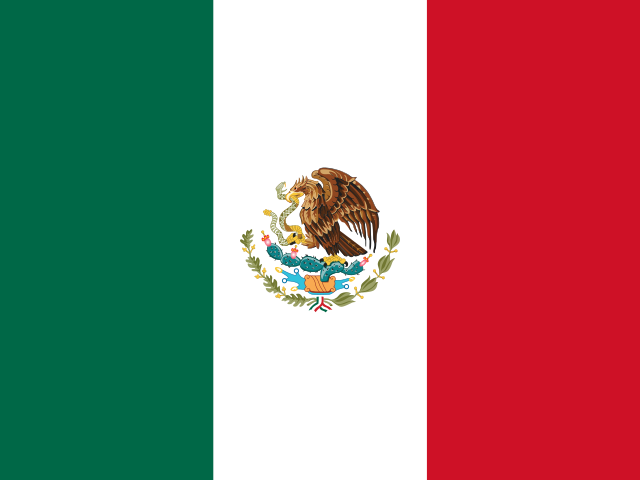
Mexico City sits directly atop the ruins of Tenochtitlan, the Aztec (Mexica) capital founded around 1325 on an island in Lake Texcoco — the very city whose legendary founding — a divine sign of an eagle atop a nopal cactus with a serpent in its grip — supplies the central emblem on Mexico's flag today. Tenochtitlan grew into one of the largest cities in the world by the early 16th century before Spanish forces under Hernán Cortés, allied with rival indigenous groups, besieged and destroyed it in 1521, then built the new colonial capital directly over its ruins rather than founding a separate site.
Lake Texcoco, on which Tenochtitlan had been built using an elaborate system of causeways and chinampas (artificial floating agricultural islands), was progressively drained by Spanish colonial engineers over the following centuries — a process that solved some flooding problems of the era but left modern Mexico City built on unstable former lakebed sediment, which is the primary reason the city has experienced significant, uneven ground subsidence and is unusually vulnerable to earthquake damage, most catastrophically demonstrated by the 1985 earthquake that killed thousands and by continuing sinking that in some districts exceeds 30 centimeters a year.
As the seat of the Viceroyalty of New Spain from the 16th century onward, Mexico City was the administrative center of Spanish colonial rule across a territory that at its peak stretched from California to Central America, giving it an outsized political and religious role — including as the site of the Metropolitan Cathedral, built over more than two centuries starting in 1573 atop the remains of the Aztec sacred precinct — that carried directly into its status as capital of independent Mexico after 1821.
Mexico City has remained the country's capital continuously since the colonial period, but its formal legal status changed in 2016, when it was converted from a special federal district into a fully constituted state-like entity, Ciudad de México, with expanded local self-government — a modernization of a governing structure that had, until then, given the capital's residents comparatively limited local political representation.
Today Mexico City is one of the largest metropolitan areas in the world, and its Zócalo, the vast central plaza built over the former ceremonial heart of Tenochtitlan, remains the site of the country's largest public ceremonies, including the annual Grito de Dolores independence commemoration each September and the raising of a giant national flag that has flown over the plaza since a 1990s-era program placed monumental flags in symbolically significant cities across Mexico.
The Templo Mayor, the main Aztec temple pyramid dedicated jointly to the war god Huitzilopochtli and the rain god Tlaloc, was deliberately buried under colonial-era construction after the conquest and was rediscovered only in 1978, when utility workers digging near the Zócalo struck a massive carved stone disc depicting the dismembered Aztec moon goddess Coyolxauhqui; the resulting excavation, still ongoing in parts, has made central Mexico City one of the few national capitals anywhere with a major pre-Columbian archaeological site actively being unearthed within blocks of its seat of government.
Quick facts
- By 2024 UN estimates, Greater Mexico City's metropolitan population had reached roughly 22 million, one of the largest urban concentrations anywhere in the Western Hemisphere.
- The city is built on the drained bed of former Lake Texcoco, causing significant ground subsidence that in some areas exceeds 30 cm per year, a major ongoing infrastructure challenge.
- Mexico City was reorganized from a federal district into the constitutionally autonomous entity Ciudad de México in 2016, granting it expanded local self-government.
- The Templo Mayor, the primary Aztec temple complex of Tenochtitlan, was rediscovered beneath the modern city center in 1978 and is now an open archaeological site next to the Metropolitan Cathedral.
- The city's Zócalo is one of the largest public squares in the world and hosts a monumental national flag raised as part of a 1990s program placing giant flags at historically significant sites nationwide.