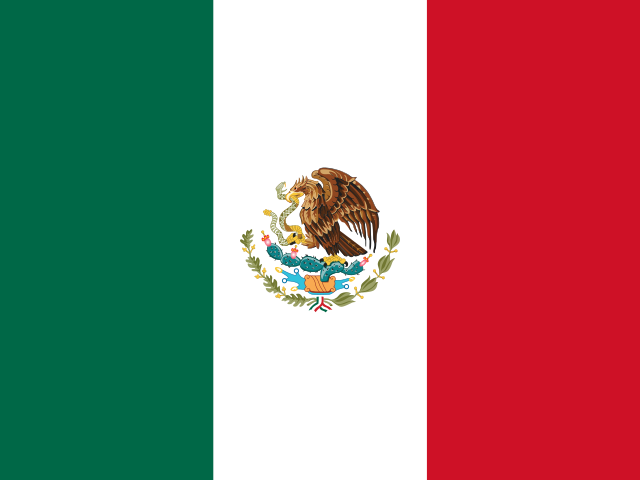
The Flag of Mexico
North America · Adopted 16 September 1968 (current proportions and emblem); tricolor pattern dates to 1821
Mexico's green-white-red vertical tricolor traces to the Army of the Three Guarantees, the coalition led by Agustín de Iturbide that secured Mexican independence from Spain in 1821 after an eleven-year war. The three colors were assigned specific political meanings at that moment: green stood for independence itself, white for the purity of the Catholic faith the new state guaranteed, and red for the union between Mexican-born criollos and Spanish-born peninsulares — a set of meanings tied directly to the specific political compromise, known as the Plan of Iguala, that ended the war, rather than being abstract virtues chosen after the fact.
The emblem at the center — an eagle perched on a prickly pear cactus (nopal), grasping a snake in its beak and talon — long predates 1821 entirely. It comes from the Aztec founding legend of Tenochtitlan, the city that became Mexico City: according to the story, the wandering Mexica people were told by their god Huitzilopochtli to build their capital at the exact spot where they saw an eagle perched on a cactus devouring a serpent, and they found that sign on a small island in Lake Texcoco around 1325. The symbol had already appeared on Mexican flags and seals through the colonial and early independence periods before being formally standardized as the national emblem.
The specific pose and detailing of the eagle-and-cactus emblem has been redrawn multiple times since 1821, reflecting changing artistic and political tastes — 19th-century versions show a more heraldic, European-influenced eagle, while 20th-century official versions moved toward a more naturalistic, Mexican-muralist-influenced style. The version in use today was fixed by a 1968 law that standardized the emblem's exact proportions and artistic rendering ahead of the Mexico City Olympics that year, ending decades of inconsistency between different official and unofficial renderings of the coat of arms used on government buildings, currency, and the flag itself.
Whether the eagle is devouring a snake at all has actually been a point of genuine dispute among historians of the legend: some pre-Columbian and early colonial sources describe the eagle simply perched with a serpent, not necessarily eating it, and the now-standard "eagle devouring a serpent" reading is thought by some scholars to reflect a later, more triumphalist interpretation layered onto the original founding story. Mexico's modern official artwork resolves the ambiguity by depicting the snake clearly in the eagle's beak and talon, but the underlying legend itself carries this documented uncertainty.
Mexico's flag proportions and exact color shades were also codified by the 1968 law, along with strict rules about the flag's use, display, and the criminal penalties for its desecration — part of a broader mid-20th-century Mexican push, alongside neighboring states, to legally formalize national symbols that had previously varied in practice across regions and decades.
Because the green-white-red vertical tricolor pattern is shared with Italy's flag, the two are sometimes mixed up by people unfamiliar with either — but Mexico's flag is readily distinguished by its central coat of arms, which Italy's plain tricolor entirely lacks, and by slightly different, though not dramatically different, official shades of green and red between the two countries.
The eagle-and-cactus emblem is one of the most recognizable national symbols in the Americas and appears not only on the flag but on Mexican currency, passports, and government seals; it is also central to the country's official name, Estados Unidos Mexicanos, and to civic ceremonies including the annual Grito de Dolores reenactment on Independence Day, 16 September, when the flag and emblem are displayed nationwide alongside recitations of Miguel Hidalgo's 1810 call to revolt.
Before the current tricolor stabilized, Mexico briefly experimented with other national banners during its turbulent early independence decades: the short-lived First Mexican Empire under Agustín de Iturbide (1821–1823) flew a version with an imperial crown atop the eagle, which was removed once the empire collapsed and Mexico became a republic, and subsequent 19th-century governments adjusted the coat of arms' exact artistic style repeatedly to match the political character of whichever regime was in power, from conservative to liberal to, briefly, the French-imposed Second Mexican Empire of Maximilian I in the 1860s, which restored an imperial crown a second time before its own defeat and the definitive return to the republican eagle.
The nopal cactus itself carries agricultural and culinary significance well beyond the flag's symbolism — it remains a staple food crop across much of Mexico, and its continued everyday presence in Mexican markets and cuisine is sometimes noted by Mexican commentators as giving the national emblem an unusually literal, lived-in connection to ordinary life, in contrast with national symbols drawn from more purely historical or abstract references.
Mexico's Flag Day, observed annually on 24 February, is marked nationwide with formal ceremonies at schools and government buildings, distinct from the more widely known Independence Day celebrations on 16 September; the separate observance underscores that Mexican civic culture treats the flag itself, apart from the independence anniversary, as worthy of its own dedicated day of commemoration, a distinction not every nation on this list draws as sharply.
An eagle that faces one way
- Double-sided flag — The bird is drawn in profile facing the hoist, so a single-layer flag shows it facing the fly from behind, which on an emblem this recognisable is immediately obvious.
As an Amazon Associate we earn from qualifying purchases made through these links, at no extra cost to you.
Often confused with
- Italy — shares the identical green-white-red vertical tricolor arrangement, but Mexico's flag adds the central eagle-and-cactus coat of arms that Italy's plain tricolor never carries. Compare side by side →
Mexico at a glance
- Capital
- Mexico City
- Population
- 130.9 million (2024)
- Currency
- Mexican Peso (MXN)
- Language(s)
- Spanish (official at federal level); 68 Indigenous languages hold co-official status regionally
Population figure as of 2024, source: UN World Population Prospects (2024 revision). See methodology for how facts are sourced and kept current.