Chisinau — Capital of Moldova
Chisinau's name appears in documents as early as 1436, when it was a small village on the Bâc River under the medieval Principality of Moldavia, and it stayed a modest market town for the next three and a half centuries — nothing close to a capital in the making. Its transformation began after 1812, when the Russian Empire annexed Bessarabia (the eastern half of the old Principality of Moldavia, including Chisinau) from the Ottomans following the Russo-Turkish War, and chose the town as the administrative seat of the new Bessarabia Governorate rather than the larger, more established city of Iași, which remained on the Moldavian/Romanian side of the new border.
Russian administrators rebuilt Chisinau's center in the early 19th century along wide, Petersburg-style boulevards, giving the city a European-administrative core that still anchors its downtown today, distinct from the older, denser lanes of the original market town nearby. The city changed hands repeatedly across the 20th century — part of Greater Romania after 1918, occupied by the Soviet Union in 1940, held by Romania again during 1941–1944 under wartime alliance with Nazi Germany, then annexed a second time by the USSR in 1944, which made it the capital of the Moldavian SSR.
Much of Chisinau had to be rebuilt after 1944, since the city suffered heavy destruction during the Second World War and a major 1940 earthquake before that; the Soviet reconstruction that followed replaced large sections of the historic center with the wide avenues, parks, and standardized apartment blocks typical of postwar Soviet urban planning, which is why the city today reads architecturally as considerably newer than its documented 15th-century origins would suggest.
When Moldova declared independence from the USSR in 1991, Chisinau simply continued as the seat of national government with no relocation debate, unlike some post-Soviet states that considered moving their capitals; it still concentrates most of Moldova's government, commerce and university life in a single city several times the size of any other in the country.
The city is frequently noted for its unusually high proportion of green space relative to its size, a legacy of Soviet-era park planning combined with the Bâc River valley running through the center, and it hosts Moldova's main university, national theaters, and the government buildings clustered around Great National Assembly Square, the site of the country's largest public gatherings during both the Soviet collapse and later political protests.
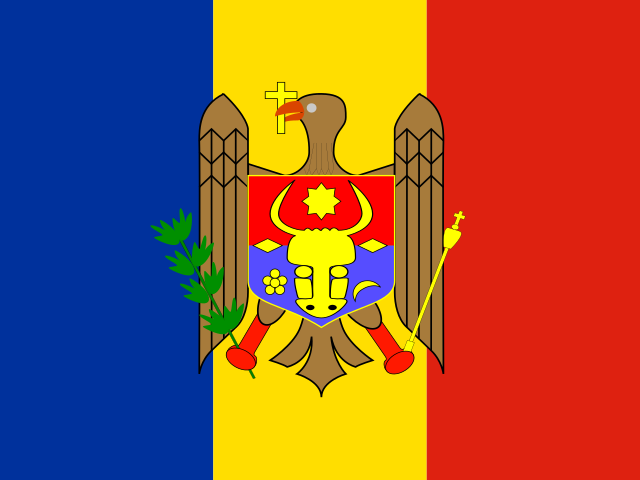
Chisinau's population is ethnically and linguistically layered in ways that reflect the wider country's contested identity, with Romanian-speaking Moldovans forming the majority alongside significant Russian-speaking and Ukrainian communities, a mix shaped directly by the successive waves of Russian imperial, Romanian, and Soviet administration the city passed through over two centuries — the same layered history that produced Moldova's flag dispute with Romania plays out, in miniature, in the everyday linguistic landscape of its capital.
The city's Triumphal Arch, built in 1840 to commemorate a Russian military victory over the Ottoman Empire, still stands in the central square facing the seat of national government, a rare surviving piece of pre-Soviet civic architecture that predates both the 1940 Soviet annexation and the wartime destruction that reshaped so much of the rest of the city center.
Quick facts
- Chisinau's metropolitan population is roughly 800,000, making it by far Moldova's largest city and several times the size of any other Moldovan urban center.
- The city's first documented mention dates to a 1436 charter, though archaeological finds suggest settlement in the area predates that record.
- Chisinau became the administrative capital of Bessarabia under Russian imperial rule starting in 1812, the point at which it began growing beyond a market town.
- Roughly a third of the historic center's buildings were destroyed or badly damaged during the Second World War, prompting the large-scale Soviet-era reconstruction visible today.
- The city sits on the Bâc River, a tributary of the Dniester, and its name is thought to derive from a Cuman or Turkic phrase referring to a spring or water source.