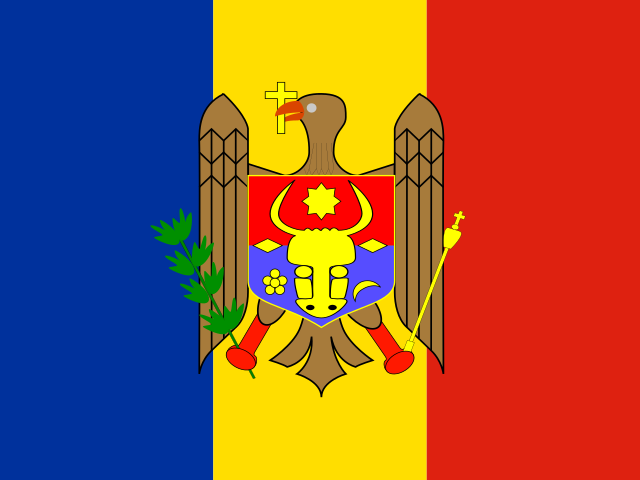
The Flag of Moldova
Europe · Adopted 12 May 1990 (refined 2010)
Moldova's tricolor of blue, yellow, and red — read left to right in vertical bands — was adopted on 12 May 1990, while the country was still the Moldavian Soviet Socialist Republic and the USSR was in the process of collapsing around it. It replaced the Soviet-era Moldavian SSR flag, a red field with a green horizontal stripe near the bottom and a hammer-and-sickle-and-star emblem in the canton, a design that had nothing culturally Moldovan about it beyond the green stripe and was swept away as soon as the republic's parliament could legislate a change. Independence from the USSR followed a year later, in August 1991.
The choice of blue-yellow-red was not invented in 1990; it revived a design already used briefly by the short-lived Moldavian Democratic Republic in 1917–1918 and, more pointedly, it is essentially the same tricolor Romania uses. That is not a coincidence the Moldovan government has ever tried to hide. Most of what is now Moldova was the Romanian region of Bessarabia until the Soviet Union annexed it in 1940, and the shared flag design was a deliberate 1990 statement of linguistic and cultural kinship with Romania at a moment when many Moldovans hoped for eventual reunification — a hope that faded politically through the 1990s and 2000s even as the flag itself stayed unchanged.
What visually separates the two flags is the coat of arms Moldova centers on its yellow stripe: an eagle grasping an olive branch in one talon and a scepter in the other, a cross in its beak, with a shield on its breast showing an aurochs head flanked by a star, a rose, and a crescent moon. The aurochs head traces back to the medieval Principality of Moldavia, founded in the 14th century, and is tied to a founding legend in which Prince Dragoș supposedly hunted an aurochs — a now-extinct wild ox — while pursuing it from Maramureș, and named the new principality's river Moldova after his hunting dog, which drowned in the chase. Romania's own tricolor carries no such central emblem, which is the main thing distinguishing the two flags at a glance.
Moldova is also one of the few national flags in the world with genuinely different obverse and reverse sides: the coat of arms is only printed or embroidered on one face of the fabric, so a flag seen from behind shows a plain, unbroken tricolor with no emblem at all. This is a practical consequence of how the eagle-and-shield design is applied rather than a symbolic choice, but it does mean two people looking at the same flag from opposite sides can see two visibly different objects.
The exact rendering of the coat of arms and the precise shades of blue, yellow, and red were only fully standardized by law in 2010, two decades after the flag's original adoption, tightening details that earlier versions had left somewhat inconsistent across official reproductions. That 2010 law is the version now in force.
Because the flag predates Moldova's current borders having ever been fully settled — Transnistria, the breakaway strip of territory along the Ukrainian border, has used its own Soviet-nostalgic red-green flag since a 1990 declaration of independence that no UN member state recognizes — the blue-yellow-red tricolor is flown only in the government-controlled majority of the country, a division that maps directly onto the wider unresolved status of Transnistria itself.
The Romania resemblance remains the flag's single most commonly noted feature outside Moldova, to the point that international vexillology references routinely list the two side by side; inside Moldova, opinion is genuinely split between those who see the shared tricolor as an honest statement of Romanian-Moldovan kinship and those, particularly among Moldova's Russian-speaking and Gagauz minorities, who view the flag as tilted toward one strand of the country's history over others.
Moldova marks its own Flag Day on 27 April, distinct from the 12 May date most sources cite for the original 1990 legislative adoption — 27 April instead commemorates the day in 1990 when the tricolor was first hoisted over the parliament building in Chisinau, a symbolic first-raising the country treats as the more emotionally significant anniversary even though the formal law came a couple of weeks later.
The autonomous region of Gagauzia, home to Moldova's Turkic-speaking, mostly Orthodox Christian Gagauz minority in the country's south, is permitted under Moldovan law to fly its own regional flag alongside the national tricolor on public buildings within its territory — a formal accommodation that Transnistria, by contrast, has never accepted, since Transnistria rejects Moldovan sovereignty outright rather than negotiating a flag-sharing arrangement within it.
Moldova's 2023 accession to European Union candidate status renewed public debate over the flag's Romanian-tricolor resemblance in a new context: pro-EU politicians have periodically pointed to the shared design with Romania, already an EU member, as a symbolic head start toward European integration, while critics of closer Romanian ties argue the flag should be read as a Moldovan symbol in its own right rather than as evidence of an implied path toward eventual union with a neighboring state.
One face, deliberately
- Single-sided flag — This is the rare flag where a double-sided version is the wrong buy: the page says the arms belong on one face only, and the back is meant to show a plain tricolour with no emblem at all.
As an Amazon Associate we earn from qualifying purchases made through these links, at no extra cost to you.
Often confused with
- Romania — uses the identical blue-yellow-red tricolor arrangement and proportions, sharing the same 19th-century unionist color tradition; only Moldova's gold eagle-and-shield badge across the center marks the two apart. Compare side by side →
- Chad — shares Romania's near-identical blue-yellow-red palette by coincidence rather than any historical link, and by extension is often grouped in the same 'which tricolor is which' confusion Moldova gets pulled into via its resemblance to Romania. Compare side by side →
Moldova at a glance
- Capital
- Chisinau
- Population
- 3.2 million (2024)
- Currency
- Moldovan Leu (MDL)
- Language(s)
- Romanian (official)
Population figure as of 2024, source: UN World Population Prospects (2024 revision); figure excludes the Transnistria region. See methodology for how facts are sourced and kept current.