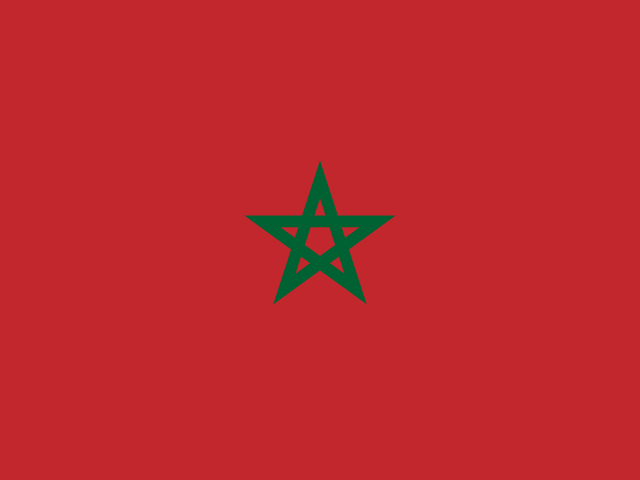
Rabat — Capital of Morocco
Rabat's history as a fortified settlement stretches back to the 12th century, when the Almohad dynasty built a ribat — a fortified monastery-garrison, the word the city's name derives from — on the south bank of the Bou Regreg river, later expanding it into a full imperial capital under Sultan Yaqub al-Mansur, who also began the enormous Hassan Tower minaret around 1195 as part of a planned mosque that was meant to be one of the largest in the world. The mosque was never finished after al-Mansur's death, and the truncated tower and its forest of stone columns still stand today as one of Rabat's defining monuments.
For centuries afterward Rabat's fortunes lagged behind Fez, Marrakesh, and Meknes, the traditional imperial capitals where successive dynasties actually governed. Rabat's real importance in the early modern period came instead from its twin city across the river, Salé, and from the Kasbah of the Udayas overlooking the river mouth, which in the 17th century became the base of the so-called Republic of Salé (or Republic of Bou Regreg) — a semi-independent corsair state whose privateers, many of them Andalusi Muslims expelled from Spain, raided European shipping in the Atlantic for decades before the settlement was folded back under sultanic authority.
Rabat only became Morocco's political capital in the modern sense in 1912, when the French Protectorate administration, established that year under the Treaty of Fez, moved the seat of government there from Fez. The choice was practical rather than sentimental: Rabat's coastal position made it easier to defend and supply than the inland imperial cities, and it was a smaller, more manageable base for a new colonial administration than the dense, politically volatile old capital of Fez. When Morocco regained independence in 1956, the newly restored monarchy kept Rabat as the seat of government rather than reverting to an older imperial capital.
The Kasbah of the Udayas, with its whitewashed and blue-painted lanes overlooking the Atlantic where the Bou Regreg meets the sea, remains one of the best-preserved historic quarters in Morocco. UNESCO recognized it in 2012 together with the rest of Rabat's old and new towns, citing the rare coherence of an early-20th-century colonial planned capital layered directly onto a much older Almohad and Andalusi urban core.
Mohammed V, the sultan (later king) who led Morocco to independence in 1956, is buried in Rabat in a mausoleum built directly beside the unfinished Hassan Tower, completed in 1971 under his son Hassan II — a deliberate pairing of the modern nation's founding monarch with the unfinished 12th-century imperial project, both now among the most visited sites in the city.
Rabat today functions as Morocco's administrative and diplomatic capital, hosting the royal palace, parliament, and most foreign embassies, while Casablanca — roughly an hour's drive south — remains the country's larger commercial and economic center, a division of roles that means many visitors are more familiar with Casablanca despite Rabat holding the actual seat of government.
The city's Chellah necropolis, just south of the modern center, adds yet another historical layer: built on the ruins of the Roman settlement of Sala Colonia, it was later converted into a fortified Merinid necropolis in the 14th century, where several Merinid sultans are buried, and today its ruins — overgrown with fig trees and home to a large colony of storks that nest on the old minaret — are one of Rabat's most atmospheric historic sites, spanning Roman, Islamic, and modern layers within a single walled compound.
Quick facts
- Rabat's metro area holds around 1.9 million residents by 2024 estimates — modest by Moroccan standards, ranking only seventh nationally and dwarfed by nearby Casablanca despite housing the seat of government.
- The Hassan Tower, begun around 1195, was intended to be part of the largest mosque in the western Islamic world; only the base and the roughly 44-meter-tall minaret shaft were completed before construction stopped.
- Rabat and its twin city Salé face each other across the mouth of the Bou Regreg river, connected today by several bridges and a tram line completed in 2011.
- The Kasbah of the Udayas occupies the site of the original 12th-century Almohad ribat fortress, and its walled quarter has remained inhabited without a break ever since, making it the oldest surviving district within modern Rabat.
- UNESCO's 2012 designation covers a wide span of the city — old medina, imperial quarters, and French-built Ville Nouvelle alike — under the title 'Rabat, Modern Capital and Historic City: a Shared Heritage.'