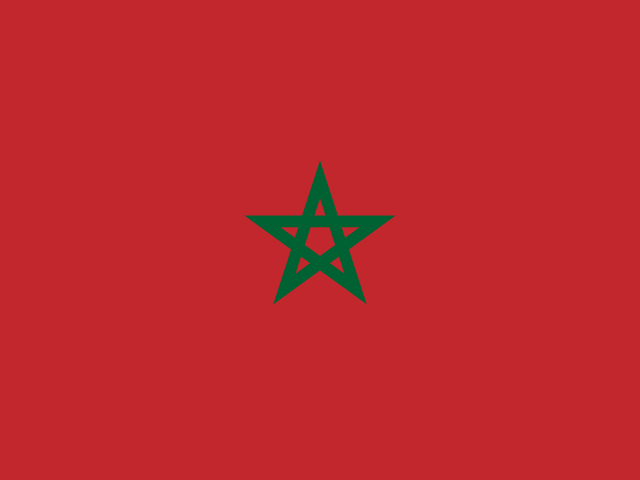
The Flag of Morocco
Africa · Adopted 17 November 1915
Morocco's plain red field is one of the oldest continuously used national colors in Africa, tracing back to the banners flown by the Alaouite dynasty, which has ruled Morocco since the 1600s. Red alone, without any charge, was the flag flown by Moroccan ships and forts for generations, but by the early 20th century that plain red was causing a real, practical problem: the Ottoman Empire's ships also flew plain red ensigns, and Moroccan vessels were repeatedly mistaken for Ottoman ones at a time when Morocco, newly under French and Spanish protectorate rule after the 1912 Treaty of Fez, needed its ships clearly identified as Moroccan under international maritime convention.
Sultan Yusef resolved the confusion on 17 November 1915 by decreeing that a green pentagram — a five-pointed star formed by five interlacing lines, popularly known outside Morocco as the Seal of Solomon — be added to the center of the red field. The mark was chosen deliberately: it had no attachment to either colonial power occupying the country, it was distinctly Moroccan and Islamic rather than borrowed from a European heraldic tradition, and it gave ships and diplomats an unambiguous way to tell a Moroccan flag from an Ottoman one at a glance.
The pentagram carries a double reading that Moroccans themselves invoke depending on context. As the Seal of Solomon, it connects to a shared Islamic and pre-Islamic Mediterranean symbolic tradition associated with wisdom and protective power, used across North Africa and the Middle East. As a five-pointed geometric figure, it is also read locally as representing the five pillars of Islam, echoing a symbolism found on other Muslim-majority nations' flags even though Morocco arrived at it through its own 1915 maritime-identification problem rather than copying anyone else's design.
Green itself is significant beyond just being the star's color: it is closely tied to Islam across the Muslim world and, in the Moroccan context, is also associated with the country's Sharifian monarchy, which traces the royal family's descent to the Prophet Muhammad. Red, meanwhile, predates the 1915 addition by centuries as the color of Alaouite authority and is popularly linked to the blood and sacrifice of the Moroccan people defending their sovereignty, particularly during the resistance to French and Spanish colonization in the early 20th century.
Unusually for a flag formalized under colonial rule, Morocco's design survived the protectorate period essentially unchanged. France administered most of the country and Spain a smaller northern and southern zone from 1912 to 1956, but the red-and-green flag continued to be recognized as the sultanate's own national emblem throughout, distinct from the French and Spanish flags flown alongside it at official buildings. When Morocco regained full independence on 2 March 1956, no new flag was needed — the 1915 design simply became, without alteration, the flag of a fully sovereign state.
Morocco's 1962 constitution and subsequent constitutional revisions (most recently in 2011) each preserved the flag exactly as decreed in 1915, giving it more than a century of continuous use through the protectorate era, the return of King Mohammed V from exile in 1955, the reigns of Hassan II and Mohammed VI, and the annexation and long-running territorial dispute over Western Sahara, where the same red-and-green flag is flown by Moroccan administration over territory whose sovereignty remains contested at the United Nations.
Because a green star or crescent on a colored field recurs across several North African and Middle Eastern flags, Morocco's flag is occasionally confused by casual observers with Saudi Arabia's, though the two share almost nothing beyond both nations' use of Islamic script or symbolism — Saudi Arabia's flag is green with white Arabic script and a sword, not red with a star. A closer resemblance, ironically, comes from Ethiopia's Rastafari-associated unofficial flags in some diaspora contexts, which occasionally borrow a green star, though the design lineage is unrelated.
A separate, short-lived flag flew in parts of northern Morocco during the 1921–1926 Republic of the Rif, the Berber-led resistance state led by Abd el-Krim that famously defeated Spanish colonial forces at the Battle of Annual in 1921 before its eventual defeat by a combined French and Spanish military campaign in 1926. Its flag — red with a white border and a green crescent and star — was a distinct wartime symbol tied to that specific uprising and never displaced the sultanate's own red-and-pentagram flag elsewhere in the country; it survives today mainly as a historical footnote of the Rif War rather than as a rival national design.
Today the flag is flown above every government building and school in the kingdom and is a fixture of Throne Day celebrations each 30 July, marking the king's accession, as well as Independence Day on 18 November. Its persistence through more than a century of political change — protectorate rule, independence, multiple royal successions, and a still-unresolved territorial dispute — makes it one of the more visually stable national symbols on the African continent.
Five interlacing lines, not a solid star
- Outline-accurate flag — The green figure is drawn as five crossing lines with open spaces between them, not a filled star, and a coarse print closes those gaps and produces a different symbol entirely.
As an Amazon Associate we earn from qualifying purchases made through these links, at no extra cost to you.
Often confused with
- Tunisia — also uses red as its dominant field color and a white disc with a crescent and star, but the layout, the central white circle, and the crescent-and-star motif rather than a pentagram make the two flags easy to tell apart on close look, even though both read as 'red field, central emblem' at a distance. Compare side by side →
Morocco at a glance
- Capital
- Rabat
- Population
- 38 million (2024)
- Currency
- Moroccan Dirham (MAD)
- Language(s)
- Arabic and Tamazight (official); French widely used in government, business, and education
Population figure as of 2024, source: UN World Population Prospects (2024 revision). See methodology for how facts are sourced and kept current.