Yaren — Capital of Nauru
Nauru is one of only a small handful of countries in the world with no officially designated capital city at all — Yaren functions as the de facto seat of government simply because it is the district that hosts Parliament House and most national government offices, a status set by administrative convenience rather than any formal declaration in law.
The reason Nauru never designated a formal capital comes down to scale: the entire country is a single island of about 21 square kilometers, organized into fourteen administrative districts that ring the coast around a central plateau once dominated by phosphate mining. With the whole nation effectively a single small town by the standards of most countries, the practical need to formally distinguish one district as 'the capital' the way larger countries do never really applied in the same way.
Yaren sits on Nauru's southern coast and is home to Nauru's small international airport as well as Parliament House, giving it a functional claim to capital status even without the formal designation. The absence of an official capital is often listed alongside Nauru's status as the world's smallest island nation by population and one of the smallest by land area as part of the same broader story of a country operating at a scale most national institutions were never designed for.
Like the rest of Nauru, Yaren's modern layout was shaped heavily by the phosphate mining economy that dominated the island through most of the 20th century — infrastructure, roads, and government buildings were built alongside and often directly funded by phosphate export revenue during Nauru's peak wealth years in the 1960s and 1970s, when Nauru briefly had one of the highest per-capita incomes in the world.
Since phosphate reserves were largely exhausted by the 1990s, Yaren and the rest of Nauru have depended heavily on external financial arrangements, most visibly Australian government payments tied to hosting an offshore immigration processing and detention center on the island since 2001 — an arrangement that remains a significant, if controversial, part of the district's and the country's economy today.
Nauru's path to independence was itself unusual and touched Yaren directly: the island was administered first as a German protectorate, then, after the First World War, as a League of Nations mandate jointly held by Australia, Britain, and New Zealand, and later as a United Nations Trust Territory under Australian administration, before becoming fully independent in 1968 as one of the few small Pacific states to move straight from trusteeship to sovereignty without an intervening period as a formal colony of a single power.
During the Second World War, Japanese forces occupied Nauru from 1942 to 1945, deporting more than a thousand Nauruans to forced labor in the Chuuk Islands — over a third of the island's population at the time, many of whom died before the survivors were repatriated after the war — and the Japanese garrison left behind coastal gun emplacements and tunnels on Command Ridge, the island's highest point, that remain visible near Yaren today as physical reminders of that occupation.
In the years after independence, phosphate wealth briefly gave Nauru one of the highest per-capita incomes in the world, and the government invested some of that income overseas, most notably in Nauru House, a high-rise office tower purchased in Melbourne, Australia, in the 1970s — an investment intended to secure long-term income once the phosphate ran out, though a string of similar overseas investments in later decades performed poorly and left the country in a considerably weaker financial position than the 1970s boom years had suggested it would face.
Quick facts
- Yaren's population is only about 750 people, among the smallest populations of any national capital district in the world.
- Yaren's district also contains Linkbelt Oval, home ground for Nauru's Australian rules football competition — the country's most popular sport, a legacy of decades of contract labor and administrative ties to Australia.
- Nauru's fourteen districts are small enough that most residents can reach any point on the island within about a thirty-minute drive along the single ring road circling the coastline.
- Nauru's small airline, once called Air Nauru and now Nauru Airlines, has at various points operated the country's only scheduled links to Australia, Fiji, and other Pacific neighbors out of the airstrip beside Yaren.
- Nauru has never issued its own currency; the Australian dollar has served as legal tender since independence, reflecting how closely the country's finances remain tied to Australia even decades after phosphate wealth peaked.
- Nauru's path to sovereignty passed through four different administering arrangements in roughly seventy years — German rule, then a joint Australian-British-New Zealand League of Nations mandate, then an Australian-run UN trusteeship — before independence arrived in 1968.
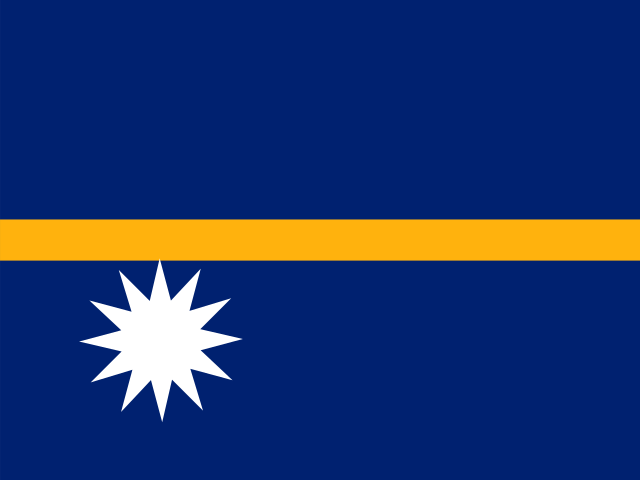
- Nauru's flag, adopted in 1968, pairs a gold horizontal stripe representing the equator with a single white 12-pointed star, its points standing for the island's twelve traditional tribes.