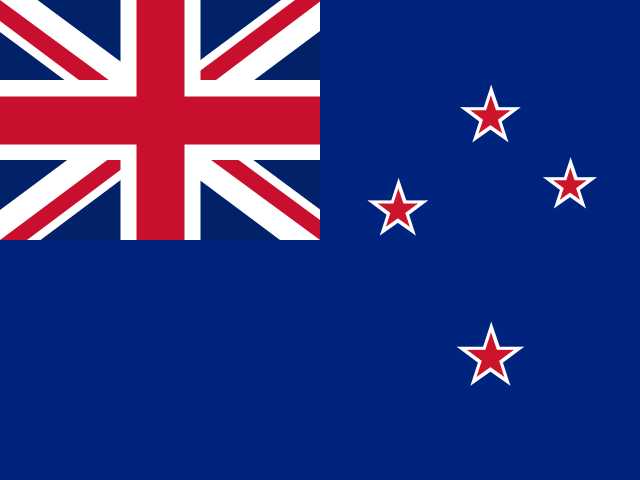
Wellington — Capital of New Zealand
Wellington was not New Zealand's first capital — that was Old Russell (Okiato) in the Bay of Islands, briefly, followed by Auckland from 1841. Wellington took over as capital in 1865, chosen largely for its central location at the southern tip of the North Island, close to the Cook Strait crossing to the South Island, which made it a more practical seat of government for a colony whose population and political interests were splitting between both islands as South Island gold rushes drew settlers south through the 1860s.
The city had already been established since 1840 as one of the New Zealand Company's first planned settlements, founded by British colonists on land at the harbor that Māori had occupied and named Te Whanganui-a-Tara long before European arrival; the English name honors Arthur Wellesley, the Duke of Wellington, following a pattern the New Zealand Company used across several of its early settlements.
Wellington's harbor sits directly on the boundary of the Australian and Pacific tectonic plates, making the city one of the most seismically active capitals in the world; the 1855 Wairarapa earthquake, one of the largest in New Zealand's recorded history, permanently uplifted parts of the harbor floor, and building codes in the city remain shaped by earthquake risk to this day, most visibly after the 2016 Kaikōura earthquake damaged buildings in the CBD despite its epicenter being over 60 kilometers away.
The city is known locally and internationally for its wind, a product of its position squarely in the Cook Strait — the narrow, funnel-shaped gap between New Zealand's two main islands — which channels weather systems through at high speed and has earned Wellington the nickname 'Windy Wellington' in everyday use.
As the seat of Parliament, Wellington is home to the Beehive, the distinctive round Executive Wing of Parliament Buildings completed in 1979, alongside the country's High Court, national archives, and — since the 1990s — a significant film and creative-industries sector centered on Wētā Workshop and Wētā FX, the special-effects studios behind the Lord of the Rings and Hobbit film trilogies, which has led some local tourism material to informally brand the city 'Wellywood.'
The city's steep, hillside residential suburbs, connected in places by a historic cable car running since 1902 between the central city and the Botanic Garden, give Wellington a compact, vertical character quite different from the flatter sprawl typical of Auckland, New Zealand's larger and more populous city — a layout shaped directly by the narrow strip of buildable land squeezed between the harbor and the surrounding hills.
Wellington's Te Papa Tongarewa, the national museum opened in 1998 on the harbor waterfront, was built with a bicultural mandate written directly into its founding legislation, presenting Māori and Pākehā (European New Zealander) history and taonga (treasures) as genuinely co-equal strands of the museum's core exhibitions rather than treating one as a supplement to the other, a model frequently cited internationally as distinctive among national museums.
Zealandia, a fully fenced 225-hectare ecosanctuary in the hills only minutes from the central city, has spent the years since its 1999 opening trying to undo two centuries of introduced-predator damage by excluding rats, stoats, and possums from a single valley and reintroducing native species that had vanished from the mainland entirely, including tuatara, little spotted kiwi, and saddleback. The project's most visible payoff has been the kākā parrots that now regularly fly out over the fence to visit gardens and inner-city parks across greater Wellington, a sound and sight unheard of anywhere near the capital for generations before the sanctuary was built.
The city has marketed itself for years with the slogan 'the coolest little capital in the world,' a claim that leans partly on an unusually deep café culture: Dalmatian and Italian immigrants who settled in Wellington through the 20th century helped establish an espresso tradition well before it spread through the rest of New Zealand, and Wellington baristas are often credited, alongside counterparts across the Tasman in Australia, with helping popularize the flat white in the 1980s, a coffee style that later spread internationally. Cuba Street, a pedestrian strip of Victorian-era shopfronts near the harbor, anchors much of that café, bar, and live-music scene today, sitting within the same earthquake-prone building stock that shapes so much of central Wellington's planning rules.
Quick facts
- Wellington's metropolitan population is roughly 215,000 in the city proper and around 440,000 across the wider Wellington region as of 2024 estimates, making it New Zealand's second-largest metro area after Auckland.
- Wellington became New Zealand's capital in 1865, replacing Auckland, largely for its central position near the Cook Strait.
- The city's Māori name, Te Whanganui-a-Tara, refers to the great harbour of Tara, a reference to an ancestral figure associated with the area's original settlement.
- Wellington is often cited as the world's southernmost capital of its size, built directly across the boundary between the Australian and Pacific tectonic plates that keeps earthquake risk central to city planning.
- Parliament's Executive Wing, known as the Beehive for its distinctive shape, was completed in 1979 and remains the seat of the New Zealand Cabinet.
- Zealandia's predator-proof fence, completed in 1999, was among the first urban ecosanctuary projects of its kind anywhere in the world and has since been used as a model for similar reintroduction projects elsewhere in New Zealand.