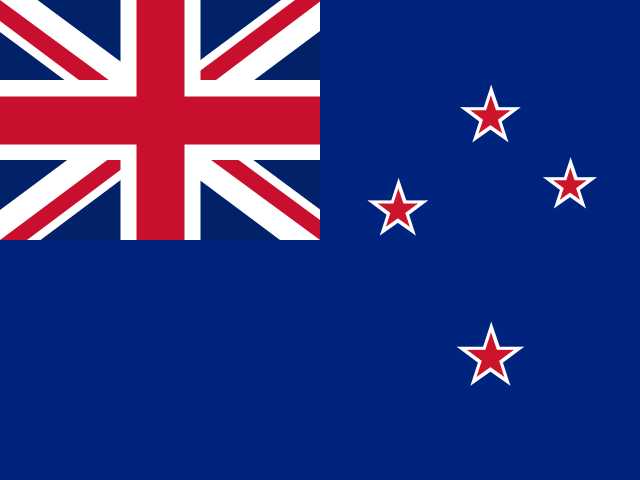
The Flag of New Zealand
Oceania · Adopted 12 June 1902 (New Zealand Ensign Act 1901 took effect)
New Zealand's flag was already flying informally as a colonial marine ensign for decades before it became law. British regulations required colonial vessels to fly a Blue Ensign defaced with a local badge, and New Zealand's badge — four red stars on white discs marking the Southern Cross — had settled into common use by the 1870s. The New Zealand Ensign Act 1901 formalized that existing custom as the country's national flag, and it took effect on 12 June 1902, making the flag older than New Zealand's own 1907 elevation to Dominion status within the British Empire.
New Zealand actually had an earlier, quite different flag first, chosen not by colonists but by Māori chiefs. In 1834, British Resident James Busby convened a gathering of northern Māori rangatira who selected a flag for the United Tribes of New Zealand, a red-white-and-blue design with a St George's cross and stars, needed so that New Zealand-built trading ships would be recognized under an internationally acknowledged flag rather than sailing unrecognized and vulnerable to seizure. That flag was formally superseded after the 1840 Treaty of Waitangi brought New Zealand under British sovereignty, but it is still occasionally flown today at commemorative events tied to Waitangi and pre-colonial Māori political history.
Unlike Australia's flag, New Zealand's carries no separate Commonwealth or Federation star — just the Union Jack in the canton and the four-star Southern Cross on the fly, each red star outlined in white so it reads clearly against the blue field. The four stars correspond to the four brightest stars of the Crux constellation, visible year-round from New Zealand's latitude and a navigational reference point used by Polynesian voyagers long before European contact.
The flag has been the subject of the most extensive formal reconsideration of any Pacific nation's flag: a two-stage, government-run referendum held in 2015 and 2016. The first referendum asked voters to choose an alternative design from a shortlist, and the 'Silver Fern (Black, White and Blue)' design — a black-and-blue field with a white silver fern — won that round. The second referendum then asked New Zealanders to choose directly between the silver fern alternative and the existing flag; voters kept the existing flag by 56.6% to 43.4% in March 2016, on turnout of just over two-thirds of enrolled voters.
Supporters of changing the flag argued the Union Jack canton no longer reflected an independent, increasingly bicultural nation and that the flag is easily confused with Australia's at a distance; supporters of keeping it argued the flag carries the memory of New Zealanders who served and died under it in both World Wars, particularly at Gallipoli in 1915, an argument that featured heavily in the 2016 campaign.
A separate flag carries real cultural weight without holding official national status: the Tino Rangatiratanga flag, designed in 1990 for the 150th anniversary of the Treaty of Waitangi, in black, red, and white with a stylized koru spiral, representing Māori sovereignty. It flies alongside the national flag on Waitangi Day and at many public buildings by government policy adopted in 2010, without replacing the ensign as the country's legal flag.
New Zealand recognizes three official languages by statute — English by widespread convention, Māori made official under the Māori Language Act 1987, and New Zealand Sign Language made official in 2006 — a detail the flag itself does not reflect directly but that runs through nearly every other piece of national symbolism and government signage in the country today.
The 2015-2016 referendum process was itself expensive and closely scrutinized, costing the New Zealand government an estimated NZ$26 million across both rounds of voting and a public consultation and design-submission phase that drew more than 10,000 proposed designs — a number frequently cited by opponents of holding another referendum any time soon, given the size of the financial and political cost relative to the result changing nothing.
Because the 2016 referendum result was framed by its own government as final for a generation, no further redesign process has been proposed since, and the pre-2016 flag remains the one flown over Parliament, on Waitangi Day, ANZAC Day, and at New Zealand's diplomatic missions worldwide.
New Zealand's flag takes the 1:2 shape Britain uses for its own ensigns, with the government's official specifications defining the exact royal blue field and the precise diameter and placement of each of the four red, white-fimbriated stars — details inherited largely unchanged from the 19th-century Blue Ensign warrant rather than rewritten when the 1902 Act formalized the design.
The flag was flown at half-mast nationwide on more than one occasion of national mourning in the 21st century, most notably after the February 2011 Christchurch earthquake, which killed 185 people and devastated the country's second-largest city, and again after the March 2019 Christchurch mosque shootings, in which a gunman killed 51 worshippers at two mosques — an attack that also prompted the government to fly the Tino Rangatiratanga and other community flags alongside the national ensign at public buildings as a gesture of solidarity distinct from the flag's usual ceremonial role.
New Zealand's Antarctic territorial claim, the Ross Dependency, established in 1923 and administered from Scott Base since the 1950s, flies the same national ensign over its research facilities year-round, making New Zealand's flag one of a relatively small number of national flags with a permanent, continuously staffed presence on the Antarctic continent alongside those of the small group of other claimant and research-station nations operating there under the Antarctic Treaty System.
Four stars, four sizes
- Geometry-accurate flag — Each of the four stars has its own specified diameter and position rather than all being alike, and a version with four identical stars evenly spaced is a redraw.
As an Amazon Associate we earn from qualifying purchases made through these links, at no extra cost to you.
Often confused with
- Australia — the reverse of New Zealand's own mix-up — Australia's Blue Ensign adds a large seven-pointed Commonwealth Star beneath the Union Jack and uses stars of mixed point-counts (mostly seven-pointed) for its Southern Cross, versus New Zealand's plain four-star, all-red, white-bordered Cross and no Commonwealth Star at all. Compare side by side →
New Zealand at a glance
- Capital
- Wellington
- Population
- 5.2 million (2024)
- Currency
- New Zealand Dollar (NZD)
- Language(s)
- English, Māori, and New Zealand Sign Language (all three official)
Population figure as of 2024, source: UN World Population Prospects (2024 revision). See methodology for how facts are sourced and kept current.