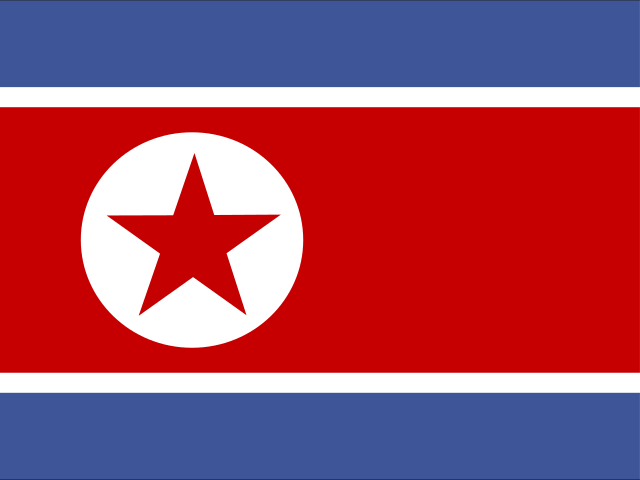
Pyongyang — Capital of North Korea
Pyongyang's political history on the Korean peninsula reaches back further than almost any other city's: tradition and early records place it as a capital of Gojoseon, among the earliest Korean kingdoms, and it later served as capital of Goguryeo, one of the Three Kingdoms that dominated Korean history for centuries before the peninsula was unified under Silla and, much later, Joseon rule.
Almost none of that ancient city survives above ground today, because Pyongyang was almost completely destroyed during the Korean War. United States bombing campaigns, particularly an intense firebombing effort in 1952, leveled the overwhelming majority of the city's structures, leaving North Korea's postwar leadership with what amounted to a blank slate for reconstruction rather than an old city to restore.
That blank slate became a deliberate showcase project. Pyongyang was rebuilt from the mid-1950s onward according to Soviet-influenced socialist urban planning principles, producing wide monumental boulevards, large public squares, and imposing state architecture designed explicitly to project the achievements and permanence of the new communist government — a stark contrast to the largely organic, centuries-layered growth typical of most old East Asian capitals.
The result is a cityscape built around a handful of monumental set pieces: Kim Il Sung Square, the vast plaza used for military parades and mass rallies; the Juche Tower, a 170-meter granite obelisk built in 1982 to mark Kim Il Sung's 70th birthday and honor his Juche ('self-reliance') ideology; and the unfinished 105-story pyramid-shaped Ryugyong Hotel, under intermittent construction since 1987 and, for years, one of the tallest uncompleted structures in the world.
As North Korea's political, cultural, and economic center, Pyongyang enjoys a standard of living and infrastructure investment well above the national average, and residency in the city is itself tightly controlled by the government, reflecting its status as the showcase capital of a state that presents Pyongyang internationally as proof of its own development while access for both foreign visitors and even most North Korean citizens from outside the city remains heavily restricted.
The Pyongyang Metro, opened in 1973, runs unusually deep underground — reportedly among the deepest metro systems in the world — a design widely understood to double the network as a bomb shelter in the event of war, and several of its stations are decorated with elaborate socialist-realist murals and chandeliers intended to showcase the achievements of the state to the relatively small number of foreign visitors permitted to ride it.
Foreign tourism to Pyongyang, on the rare occasions it has been permitted at all, has historically been restricted to guided group tours with fixed itineraries and government-assigned minders, a level of control over visitor movement that is itself frequently cited by outside observers as characteristic of how tightly the capital's public image is managed for both domestic and international audiences.
The city's skyline is dominated by a handful of other Soviet-scale monuments beyond the Juche Tower: the Arch of Triumph, completed in 1982 to commemorate Kim Il Sung's role in resisting Japanese occupation, stands taller than the Parisian arch it was modeled on, and the Mansudae Grand Monument holds two enormous bronze statues of Kim Il Sung and Kim Jong Il, a site where visiting foreign delegations and North Korean citizens alike are expected to bow. Rungrado 1st of May Stadium, on an island in the Taedong River that runs through the city center, has an official capacity of around 114,000, making it among the largest stadiums in the world, and it hosts the Arirang Mass Games, a highly choreographed gymnastics and card-stunt performance involving tens of thousands of performers that the government has periodically revived as a showcase event for foreign visitors.
Despite the scale of its public monuments, ordinary residential life in Pyongyang is concentrated in high-rise apartment blocks built in successive waves since the 1970s, many later renovated with brighter paint schemes and LED lighting under Kim Jong Un as part of a further push to present the capital as a modern, livable city to both domestic and international audiences.
Quick facts
- Pyongyang served as an early capital of the ancient kingdom of Gojoseon and later of Goguryeo, one of Korea's Three Kingdoms.
- Pyongyang's name literally translates to 'flat land' in Korean, a plain geographic description tied to its position on the Taedong River's flood plain rather than to any dynasty or monument.
- Kim Il Sung University, founded in 1946 as North Korea's first modern university, sits in central Pyongyang and has historically drawn its student body disproportionately from families connected to the political elite.
- The Ryugyong Hotel, a 105-story pyramid-shaped structure, has been under intermittent construction since 1987 and remains one of the world's most famous unfinished skyscrapers.
- Residency in Pyongyang is subject to government approval, and the city receives disproportionate infrastructure investment compared to the rest of the country.