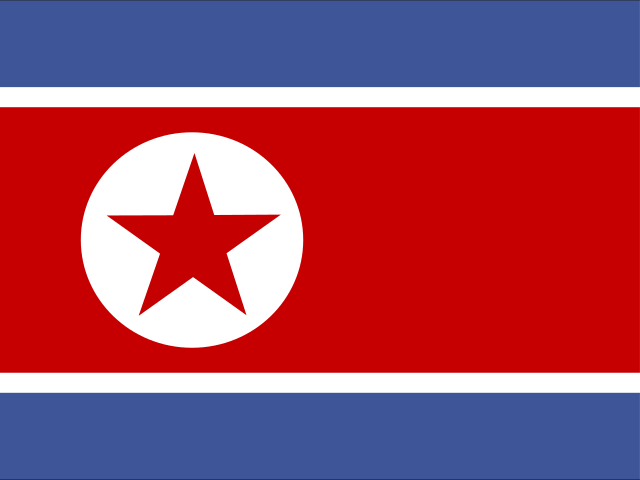
The Flag of North Korea
Asia · Adopted 8 September 1948
North Korea's flag became official on 8 September 1948, days before the formal proclamation of the Democratic People's Republic of Korea, and its adoption marked a deliberate break from the Taegukgi — the red-and-blue yin-yang flag with black trigrams that had represented Korea, undivided, since the late 19th century and that continues to serve as South Korea's national flag today.
That break was contentious even within the new North Korean leadership. Some accounts describe internal debate over whether to keep the historic Taegukgi, which many Koreans on both sides of the emerging division still associated with resistance to Japanese colonial rule (1910–1945), or to adopt an entirely new symbol untainted by association with the more conservative, Confucian-inflected old order the new communist state wanted to distance itself from; Kim Il Sung's government ultimately chose the latter, finalizing the new design by decree of the Supreme People's Assembly.
The current flag is a horizontal design: a wide red stripe through the center, bordered above and below by narrow white stripes, then wider blue stripes at the top and bottom edges. A white disc near the hoist end of the red stripe holds a red five-pointed star. Red represents the country's revolutionary and communist tradition; blue represents sovereignty, peace, and friendship (in some official framings, solidarity with other socialist and anti-imperialist states); and white, positioned between the red and blue, is described as symbolizing the purity of the Korean people and their martial spirit.
The five-pointed star inside the white disc is a standard socialist symbol also seen on the flags of Vietnam and China, though in each case set within an otherwise distinct national design — North Korea did not simply copy a Soviet template but built its own color and stripe arrangement around the shared star motif common to mid-20th-century communist states.
Unlike its neighbor and rival to the south, North Korea has not altered its flag design since 1948, giving the DPRK flag more than seven decades of continuous use through the Korean War, the long Kim family succession from Kim Il Sung to Kim Jong Il to Kim Jong Un, and the country's shift from a Soviet-aligned command economy to its current more isolated and heavily militarized state.
The Taegukgi that North Korea's flag replaced remains a politically loaded image inside the country: because it is South Korea's national flag, its display or reproduction within North Korea is treated as a serious political matter rather than a neutral historical artifact, reflecting how completely the 1948 flag change was meant to symbolize the division of the peninsula rather than simply update an old design.
North Korean law and state media treat the flag with a formality typical of the country's broader political culture: flag ceremonies are prominent at major state occasions including the anniversaries of the DPRK's founding and of the ruling party, and the flag features heavily in the elaborate mass displays — including the large-scale card-stunt and gymnastics performances the country has periodically staged — that are among its most internationally recognized public spectacles.
Because its red-white-blue horizontal stripe arrangement is broadly similar in color palette, though not in exact layout, to a number of unrelated flags worldwide, North Korea's flag is occasionally mistaken at a glance for other socialist-era or Southeast Asian flags, though its distinctive centered white disc and star make it straightforward to identify once seen up close.
The flag has also become a literal object of competition along the inter-Korean border. In the demilitarized zone's Panmunjom area, North Korea built a flagpole roughly 160 meters tall at the propaganda village of Kijong-dong, widely reported to be among the tallest flagpoles in the world, after South Korea had earlier raised a large flagpole of its own at Daeseong-dong nearby — an episode informally nicknamed the 'flagpole war,' in which each side kept raising taller poles to fly larger versions of their respective national flags as a visible show of prestige across one of the most heavily fortified borders on Earth.
North Korean flag protocol also governs the design's use on military and civilian vessels, where a slightly different naval ensign incorporating the flag is flown, and state media coverage of major national anniversaries routinely features mass displays built around the flag's red, white, and blue color scheme, reinforcing its role as one of the most consistently reproduced state symbols in North Korean public life.
A formal flag law passed by the Supreme People's Assembly in 2011 further standardized the exact proportions, colors, and permitted display contexts for the national flag, part of a broader pattern in which North Korea has periodically revisited and tightened the legal specification of its state symbols even while leaving the visual design itself untouched since 1948.
The national flag is distinct from North Korea's state emblem, a separate device used on official seals, currency, and government letterhead rather than on the flag itself: it depicts the Sup'ung hydroelectric dam beneath the sacred peak of Mount Paektu, ringed by ears of rice and bound by a red ribbon reading 'Democratic People's Republic of Korea,' with a red five-pointed star at the top — imagery tied to industrial self-reliance and to Mount Paektu's status in state mythology as the birthplace of the Kim family's revolutionary legacy, entirely separate visual territory from the plain star-in-a-disc design carried on the flag.
The giant flag North Korea raised at Kijong-dong is reported to weigh roughly 270 kilograms and to require a strong wind before it can fully unfurl from its 160-meter pole, a scale built specifically to outsize the South Korean flag flying across the border at Daeseong-dong rather than for any practical signaling purpose. North Korean vessels fly a separate naval ensign that incorporates the national flag's star-and-disc alongside additional military markings, distinguishing state and merchant shipping from ordinary civilian use of the plain national flag on land.
North Korea at a glance
- Capital
- Pyongyang
- Population
- 26.2 million (2024)
- Currency
- North Korean Won (KPW)
- Language(s)
- Korean (official)
Population figure as of 2024, source: UN World Population Prospects (2024 revision). See methodology for how facts are sourced and kept current.