Skopje — Capital of North Macedonia
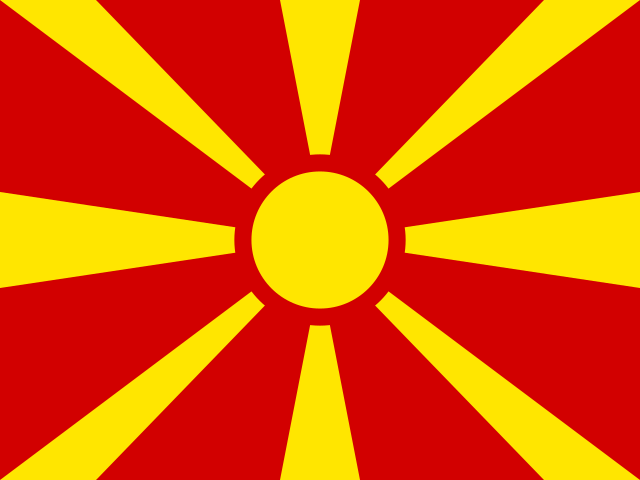
See the flag of North Macedonia →
Skopje's history as a city runs back to the Roman-era settlement of Scupi, established in the 1st century BC near the site of the modern city and destroyed by a major earthquake in 518 AD, after which the settlement shifted to roughly its current location. Across the following centuries it passed through Byzantine, Slavic, Serbian medieval, and Ottoman rule — the Ottomans held the city from 1392 until the Balkan Wars of 1912–1913, longer than any other single period in its documented history, and left a lasting architectural layer still visible in the Old Bazaar (Čaršija) district and the Stone Bridge across the Vardar River.
The single event that shaped Skopje's modern layout more than any other was the earthquake of 26 July 1963, which killed over a thousand people and destroyed roughly 80 percent of the city's buildings. The reconstruction that followed became an unusual international collaboration: the United Nations coordinated a rebuilding effort, and Japanese architect Kenzo Tange was selected to design a new master plan for the city center, producing the brutalist civic architecture — the railway station, several government buildings — that still defines much of central Skopje's postwar look.
Skopje became capital of the People's Republic of Macedonia within socialist Yugoslavia after the Second World War, continuing that role when the country declared independence in 1991, without ever facing a serious competing claim from another city for capital status.
In the 2010s the city underwent a second, far more controversial architectural transformation known as 'Skopje 2014,' a state-funded project that added dozens of neoclassical government buildings, museums, bridges, and statues to the city center, including a large equestrian statue widely understood to depict Alexander the Great, though officially titled simply 'Warrior on a Horse' to avoid explicitly reopening the same Vergina-Sun-era dispute with Greece over claims to ancient Macedonian heritage. The project drew heavy domestic criticism over its cost and its perceived kitsch aesthetic, alongside the renewed friction it caused with Greece.
Today Skopje dominates North Macedonia's national life by a wide margin, housing the country's parliament and its leading university, with a population far outstripping any rival city — a concentration typical of small Balkan states where a single capital carries most of the country's institutions.
Skopje Fortress (Kale), overlooking the Vardar from a hilltop above the Old Bazaar, has been continuously occupied and rebuilt in some form since at least the 6th century, surviving Byzantine, Slavic, and Ottoman control in succession and giving archaeologists a rare layered record of the city's changing rulers within a single fortified site.
The city's substantial ethnic Albanian population, concentrated mainly in northern districts across the Vardar, gives parts of Skopje a genuinely bilingual civic character, with Albanian-language signage, media, and institutions operating alongside Macedonian-language ones — a visible, everyday layer of the country's ethnic makeup that the national flag and its 1995 redesign, focused entirely on resolving the dispute with Greece, never directly addressed.
Skopje is also known internationally as the birthplace of Mother Teresa, born Anjezë Gonxhe Bojaxhiu in the city in 1910 to an ethnic Albanian Catholic family; a memorial house and museum dedicated to her now stands near the site of the church where she was baptized, drawing visitors independent of the city's other, more contested Skopje 2014-era monuments. The Millennium Cross, a large illuminated cross erected on Vodno mountain overlooking the city in 2008 to mark 2,000 years of Christianity in the region, is visible from much of central Skopje and reachable by a cable car built specifically to serve it, adding another large-scale, recently built symbolic structure to a skyline already reshaped by the Skopje 2014 project.
The city's Old Railway Station, badly damaged in the 1963 earthquake, was deliberately left with its clock frozen at the exact time the quake struck, and the building now houses the City Museum of Skopje, functioning as one of the clearest physical reminders of the disaster that reshaped the rest of the capital.
Quick facts
- Skopje's metropolitan population is roughly 600,000, making it by far North Macedonia's largest city.
- The 1963 earthquake left an estimated 200,000 of Skopje's residents homeless overnight, and dozens of countries sent aid or pledged reconstruction assistance as part of the UN-led rebuilding drive.
- Kenzo Tange's 1965 master plan envisioned an unbroken 'City Wall' of interconnected residential blocks ringing the center; only portions of that ambitious design were ultimately built as funding and priorities shifted in the following decades.
- The Archaeological Museum of Macedonia, opened in Skopje in 2014 as part of the broader Skopje 2014 building program, houses artifacts spanning the region's Neolithic, Roman, and medieval periods in a riverside building near the Vardar.
- The Skopje 2014 project is widely reported to have cost several hundred million euros in public funds, a price tag that became one of the most contentious domestic political issues of the 2010s in North Macedonia.