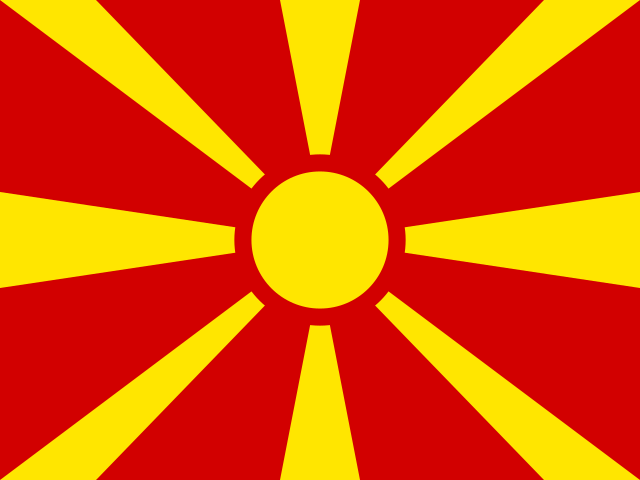
The Flag of North Macedonia
Europe · Adopted 5 October 1995
The flag North Macedonia flies today is its second since independence, and the reason for the change is one of the more direct international disputes in modern flag history. When the country declared independence from Yugoslavia in 1991 as the Republic of Macedonia, its first flag, adopted in 1992, placed the Vergina Sun — a golden, sixteen-rayed sunburst — on a red field. The symbol was drawn from an artifact found in 1977 in a royal tomb at Vergina, in Greek Macedonia, believed by many archaeologists to belong to the family of Philip II, father of Alexander the Great.
Greece objected immediately and forcefully. From Athens' perspective, a neighboring state built partly on Slavic and Ottoman-era heritage adopting an ancient Hellenic royal emblem looked like an appropriation of Greek history and, combined with the new country's chosen name, an implicit claim on the Greek region also called Macedonia. Greece imposed a trade embargo on its northern neighbor between 1994 and 1995 and blocked its entry into international organizations under the name 'Macedonia,' pressure that eventually forced negotiation.
The 1995 Interim Accord between the two countries resolved the immediate flag dispute (the deeper naming dispute over 'Macedonia' itself would drag on for another two decades, until the 2018 Prespa Agreement renamed the country North Macedonia). As part of the 1995 accord, the government replaced the Vergina Sun with a different, more abstract sun symbol: eight broad golden-yellow rays radiating outward from a small circle, extending all the way to the flag's edges, adopted by law on 5 October 1995. The new sun deliberately avoided any direct match to the Vergina artifact, satisfying Greek objections that the design was appropriating a specific piece of ancient Hellenic iconography.
The colors themselves — red field, golden-yellow sun — carry a more general set of associations than the specific 1992 symbol did: red is tied to the country's Slavic and Balkan heritage broadly and to the socialist-era Macedonian flag that preceded independence (a red flag bearing a gold-bordered red star, following the standard template used across the constituent republics of socialist Yugoslavia), while yellow represents the sun and, by extension, freedom and a new beginning after Yugoslavia's breakup.
Ethnic Albanians make up a substantial minority of the country's population, concentrated mainly in the west and northwest, and while the national flag itself has not been a major flashpoint for that community the way the Macedonia naming dispute was for Greek relations, the Albanian community's own flag — the black double-headed eagle on red, shared with Albania — is flown widely in Albanian-majority areas alongside the state flag, a visible marker of the country's ethnic composition that the national flag alone doesn't capture.
The 2018 Prespa Agreement, which resolved the broader name dispute by renaming the country from the Republic of Macedonia to the Republic of North Macedonia, did not require any further change to the flag itself — the 1995 sun design, having already been negotiated specifically to satisfy Greek objections, remained acceptable and unchanged even as the country's official name changed around it.
The flag is flown at government buildings nationwide and is prominently displayed around Independence Day on 8 September, marking the 1991 referendum, a date that predates the flag's own final 1995 form by four years — a reminder that the country's independence and its settled national symbol arrived through two separate, years-apart processes rather than a single clean founding moment.
Even the pre-independence socialist-era flag had already broken from the standard Yugoslav republican template earlier than most of its sister republics: the Socialist Republic of Macedonia adopted its own red flag bearing a small gold-bordered star well before the wider Yugoslav federation began fraying in the late 1980s, following the same general red-star pattern used across Tito's Yugoslavia but with symbolism the republic treated as distinctly Macedonian rather than purely federal.
The 1995 sun's eight rays extending fully to the flag's edges is itself a specific, legally defined choice — earlier proposed replacement designs floated during the 1994–1995 negotiations with Greece included versions with the sun contained within the field rather than touching its borders, and the eventual bordered-to-edge version was selected partly because its abstraction from any specific archaeological artifact was considered the clearest way to distinguish it from the disputed Vergina Sun.
The 2018 Prespa Agreement that finally settled the country's name also included provisions addressing how each side could use disputed historical symbols going forward, an agreement package broader than the flag dispute alone but directly building on the precedent the 1995 Interim Accord had already set when it forced the original flag change — meaning North Macedonia's national symbols have now been shaped by two separate rounds of formal negotiation with Greece across more than two decades.
The 1992 Vergina Sun flag survives today mainly outside the country's own borders: large Macedonian diaspora communities in Australia, Canada, and the United States — many of whom emigrated well before the 1995 change and maintain strong feelings about the original design — continue to fly the sixteen-ray Vergina Sun banner at community festivals and cultural associations, an informal continuation Greek authorities have periodically protested when it appears at diplomatic or sporting events involving diaspora organizations, keeping a version of the pre-1995 dispute alive in miniature decades after the state itself moved on. Domestic flag protocol requires the state flag to be flown at every government building, school, and diplomatic mission, and mandates specific dimensions and manufacturing standards for officially produced flags, with the Ministry of Defence responsible for certifying compliant flag production — a level of regulatory detail added gradually through the 1990s and 2000s as the country built out the administrative apparatus of full statehood after 1991.
Rays that reach the edge
- Geometry-accurate flag — The eight rays are specified to run all the way out to the flag's edges rather than stopping in open field, and a sun drawn as a self-contained disc with short rays is the wrong design.
As an Amazon Associate we earn from qualifying purchases made through these links, at no extra cost to you.
Often confused with
- Kyrgyzstan — also centers a golden sun-like emblem on a differently colored field, but Kyrgyzstan's sun has forty rays around a tunduk (yurt roof) motif on red, an unrelated design tradition from Central Asia rather than the Balkans. Compare side by side →
North Macedonia at a glance
- Capital
- Skopje
- Population
- 1.83 million (2024)
- Currency
- Macedonian Denar (MKD)
- Language(s)
- Macedonian (official); Albanian co-official nationwide since 2019
Population figure as of 2024, source: UN World Population Prospects (2024 revision). See methodology for how facts are sourced and kept current.