Oslo — Capital of Norway
Oslo's founding is usually dated to around 1040, based on medieval saga accounts crediting King Harald Hardrada, though archaeological excavations suggest some settlement in the area predates that traditional founding date. For roughly the next six centuries the city grew slowly at the head of the Oslofjord as a regional trading and church center, never a dominant force in Scandinavian politics the way Copenhagen or Stockholm became.
A devastating fire swept through Oslo in 1624, destroying most of the wooden medieval city. King Christian IV of the joint Denmark–Norway kingdom used the disaster as an opportunity to rebuild entirely, relocating the city to a new site closer to the Akershus Fortress and laying it out on a more fire-resistant grid plan of brick and stone buildings — and renaming it Christiania after himself in the process. That name stuck, officially, for exactly three centuries.
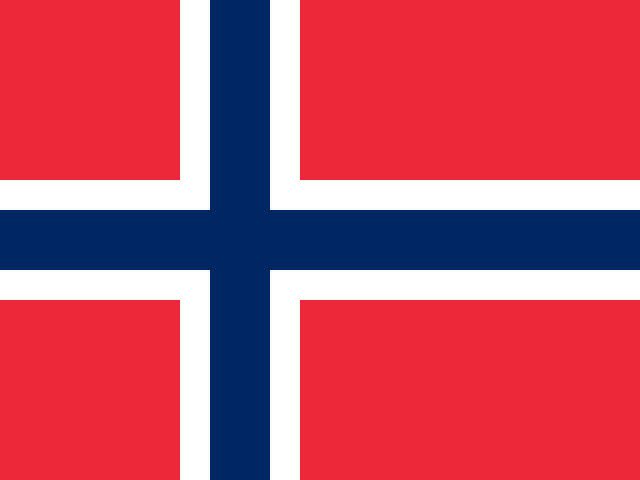
The renaming back to Oslo did not happen until 1925, well after Norway had already regained full independence from Sweden in 1905 — a genuinely delayed piece of national symbolism, since a country that had spent the late 19th century campaigning to remove Swedish union markings from its own flag nonetheless kept a Danish king's name on its own capital city for two more decades after full sovereignty returned. The 1925 change was part of a broader early-20th-century push to restore older Norwegian place names that had been altered or replaced during the centuries of Danish and Swedish rule.
Oslo's political importance grew steadily through the 19th century as the seat of the Storting (parliament) established under the 1814 constitution and, after 1905, as the capital of a fully independent Norway, home to the Royal Palace built for the new Norwegian royal line and to the University of Oslo, founded in 1811 as the country's first university, established specifically because Norway had none of its own throughout the centuries of Danish rule.
The city today is known internationally for hosting the Nobel Peace Prize ceremony each December — a role assigned by Alfred Nobel's 1895 will specifically to Norway (while the other four Nobel Prizes are awarded in Stockholm), a distinction rooted in Norway and Sweden's shared-crown union at the time the will was written, even though the two countries separated a decade later, and Oslo has continued hosting the peace prize ceremony ever since.
Oslo endured its own occupation during the Second World War, seized by German forces on the first day of the April 1940 invasion of Norway despite Norwegian resistance; King Haakon VII and the government fled the city and eventually the country, running a government-in-exile from London for the rest of the war rather than accept German-imposed rule, a period of occupation and exile that ended only with Germany's surrender in May 1945, after which the king's return to Oslo was met with mass public celebration.
Modern Oslo has expanded well beyond its historic center into a metropolitan region ringed by forest and fjord, and its Vigeland sculpture park, containing over 200 bronze, granite, and wrought-iron figures by sculptor Gustav Vigeland, remains one of the largest works by a single artist anywhere in the world, occupying a substantial section of the city's Frogner Park.
Quick facts
- Oslo's metropolitan population is roughly 1.1 million, out of Norway's total national population of around 5.5 million.
- The city was known officially as Christiania, after King Christian IV, from 1624 until 1925, when it reverted to its older name, Oslo.
- The Oslo Opera House, opened in 2008 on the harbor at Bjørvika, is designed with a sloping marble-and-granite roof that visitors can walk up to the summit, and it has become one of the most recognizable pieces of contemporary Scandinavian architecture.
- The Nobel Peace Prize has been awarded in Oslo every year since 1901, a role assigned specifically to Norway under Alfred Nobel's 1895 will, distinct from the other four Nobel Prizes awarded in Stockholm.
- The Akershus Fortress, begun around 1299 to defend the city and later expanded into a renaissance castle, still stands overlooking Oslo's harbor and remains in active military and ceremonial use.