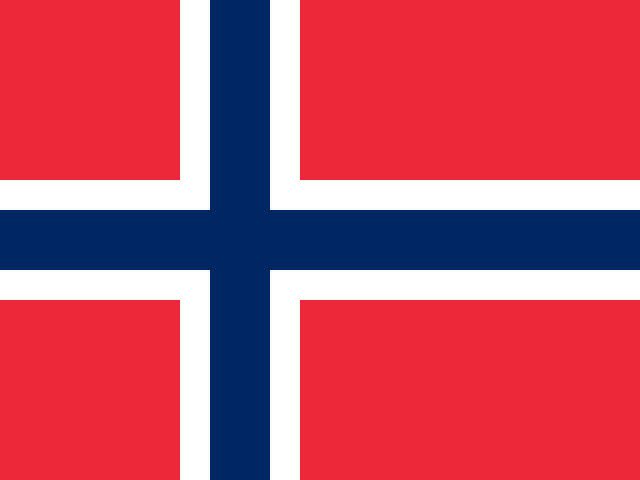
The Flag of Norway
Europe · Adopted 13 July 1821
Norway's flag — a blue Scandinavian cross fimbriated in white on a red field — was designed by Fredrik Meltzer, a member of the Norwegian parliament (Storting), and adopted by law on 13 July 1821. Meltzer built it deliberately on top of the Danish Dannebrog, a plain white cross on red that had been Norway's flag under nearly 450 years of union with Denmark, which ended only in 1814. Rather than discard the Danish-era cross pattern entirely, Meltzer layered a narrower blue cross inside the white one, keeping the familiar Nordic cross shape while making the design unmistakably Norwegian rather than a leftover Danish flag flown out of habit.
The choice of blue, white, and red together was not incidental. Norway's 1814 constitution, drafted at Eidsvoll in the months after the Danish union collapsed, was explicitly influenced by the American and French revolutionary constitutions of the preceding decades, and blue-white-red was understood at the time as a color combination associated with liberty and constitutional government more broadly across Europe and the Atlantic world — the same three colors, in different arrangements, appear in the flags of France, the United States, and several other constitutionally minded states of the era. Meltzer's design was meant to signal that political lineage as much as any specific Norwegian symbolism.
Adoption in 1821 did not mean the flag flew freely. Norway had entered a new union in 1814, this time with Sweden, under which Norway kept its own constitution and institutions but shared a king with Sweden and had to negotiate the terms under which its flag could be flown, particularly at sea. From 1844, Norwegian and Swedish merchant ships were required to carry a combined union symbol — a red-white-blue-yellow badge in the canton, sometimes nicknamed the 'herring salad' (sildesalaten) for its jumbled appearance — signaling the union rather than Norway alone.
The campaign to remove that union mark and fly a 'pure flag' (rent flagg) became a genuine, sustained political movement through the second half of the 19th century, tied closely to broader Norwegian agitation for equal standing within the union and eventually for full independence. The Storting passed the law removing the union badge from Norway's flag in 1898, over the Swedish king's initial objections, seven years before the union itself was finally dissolved by mutual agreement in 1905 — meaning Norway's flag became fully 'pure' before the country regained full sovereignty, not the other way around.
Oslo itself carries an unrelated but genuinely surprising naming footnote connected to this same period of shifting national identity: the city that is now Norway's capital was renamed Christiania after a 1624 fire, honoring King Christian IV of the Denmark-Norway union, and was not officially renamed back to its older name, Oslo, until 1925 — meaning for over three centuries the flag flew above a capital city that did not carry its original, and current, name.
No redesign has occurred since the 1898 removal of the union badge. Norway's flag has now flown in its current unmodified form for well over a century, through full independence in 1905, the Nazi occupation of 1940–1945 (during which the flag was banned from public display and became an underground symbol of resistance), and the country's continued status as a constitutional monarchy today.
Because several Nordic countries share the same basic off-center Scandinavian cross layout — a design lineage all tracing back to the Dannebrog — Norway's flag is sometimes casually mixed up at a glance with Iceland's, which uses the same blue-white-red combination in a different arrangement (Iceland's cross is red fimbriated in white on blue, the reverse color emphasis of Norway's red field with a blue-and-white cross).
Norway actually uses two distinct versions of its flag depending on context, a detail most casual observers never notice. The familiar rectangular flag serves as the civil flag, flown by ordinary citizens and businesses, while an official 'splitflagg' — the same red field and blue-white cross but with a distinctive swallow-tailed fork cut into the fly end — is reserved by law for state institutions, the navy, and government buildings, a two-tier system with roots in older Scandinavian naval flag traditions that distinguished state and civilian vessels.
Svalbard, the Arctic archipelago under Norwegian sovereignty since the 1920 Svalbard Treaty, flies the same Norwegian flag as the mainland despite the treaty granting citizens of signatory countries unusually broad rights to live and work there without a visa — an arrangement that makes Svalbard one of the more unusual territories flying a fully standard national flag over a population with such internationally open residency rules.
Norway's royal family, restored to a genuinely Norwegian line only in 1905 when Prince Carl of Denmark accepted the Norwegian throne and took the name Haakon VII, uses a separate royal standard distinct from the state flag — a golden lion rampant bearing an axe on a red field, drawn from the medieval Norwegian royal coat of arms, flown specifically to mark the monarch's presence rather than as a everyday national symbol.
Which colour is the field
- Colour-order accurate flag — This flag and Iceland's use the same three colours in swapped roles, so the check is which colour fills the field and which is the cross: red field, white border, blue cross, in that order outward.
As an Amazon Associate we earn from qualifying purchases made through these links, at no extra cost to you.
Often confused with
- Iceland — uses the same three colors in the same Scandinavian-cross layout but reverses which color dominates — Iceland's flag is blue with a red cross fimbriated in white, while Norway's is red with a blue cross fimbriated in white. Compare side by side →
Norway at a glance
- Capital
- Oslo
- Population
- 5.5 million (2024)
- Currency
- Norwegian Krone (NOK)
- Language(s)
- Norwegian, in two official written forms — Bokmål and Nynorsk
Population figure as of 2024, source: UN World Population Prospects (2024 revision). See methodology for how facts are sourced and kept current.