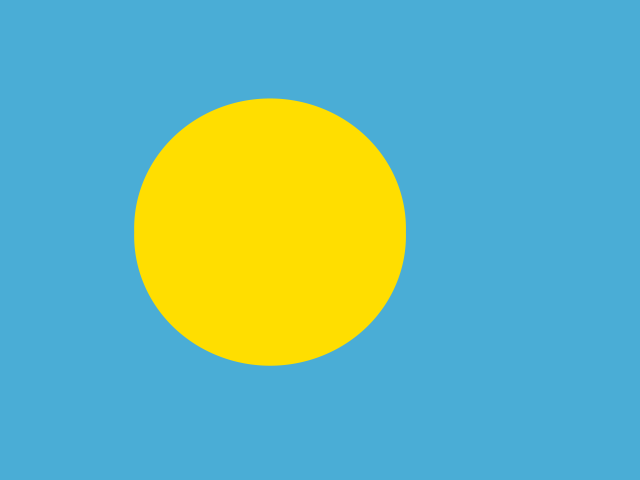
Ngerulmud — Capital of Palau
Ngerulmud is one of the newest and smallest national capitals in the world, formally taking over from Koror as Palau's seat of government only in 2006, more than a decade after Palau became fully independent in 1994 — making Palau one of the last countries in the world to complete its post-independence capital relocation.
Koror, on the island of the same name, had served as the country's administrative and commercial center through the Japanese colonial administration of the early-to-mid 20th century and continued in that role through American trusteeship and into independence, largely because it was the most developed and populous part of the country and hosted the main port and airport infrastructure built up over decades.
The decision to build a new capital came from Palau's constitution itself, which called for the capital to be moved to Babeldaob, Palau's largest island, rather than remain on the smaller island of Koror — partly to spread development away from an already-crowded Koror and partly to place the seat of government on customary land in Melekeok State, reflecting the historical importance of the Melekeok area's traditional chiefly leadership within Palauan society.
Construction of Ngerulmud's Capitol building, modeled loosely on the United States Capitol with its own dome, took years and was funded substantially through US assistance tied to the Compact of Free Association, and the capital's move was formally completed in 2006, transferring Palau's National Congress, president's office, and Supreme Court there from Koror.
Because Ngerulmud remains sparsely populated and has little independent commercial life of its own, most Palauans still live and work in and around Koror, meaning that — much like Micronesia's Palikir — Palau's political capital and its actual population and economic center are two separate places connected by a causeway and a relatively short drive across Babeldaob, rather than being the same city.
The name Ngerulmud is generally translated as referring to a place of achievement or accomplishment, and Melekeok State's selection was not incidental: it is the traditional seat of the Reklai, one of Palau's two paramount chiefly titles (the other being the Ibedul of Koror), and locating the national government there was in part a deliberate nod to a customary power center that predates any colonial administration on the islands. Melekeok village itself retains one of Palau's restored traditional bai, an ornately carved and painted community meeting house of the kind that once stood in every Palauan village and that UNESCO has recognized as an important element of Palauan cultural heritage.
Palau's National Congress, formally named the Olbiil Era Kelulau — often rendered in English as the 'House of Whispered Decisions,' a name drawn from the traditional practice of Palauan chiefs conferring quietly before announcing consensus decisions publicly — sits inside the domed Capitol at Ngerulmud alongside the offices of the president and the country's Supreme Court, so despite its tiny resident population the complex houses all three branches of national government under a single roof arrangement unusual even among small-state capitals.
Babeldaob's interior around Ngerulmud remains largely forested, and the capital sits close to the Ngermeskang River and patches of upland rainforest that stand in visible contrast to the dense, built-up harbor town of Koror just across the connecting causeway — a physical reminder that Ngerulmud was built into a rural landscape rather than grown out of an existing settlement.
Quick facts
- Ngerulmud's resident population is only a few hundred people, making it by some measures the least populous national capital in the world.
- A roughly 20-kilometer causeway and coastal road link Ngerulmud to Koror, a drive of under an hour that remains the main route officials use to commute between the political capital and the country's commercial hub.
- The Compact Road, a paved ring road around Babeldaob completed in 2007 with US funding, was built around the same time as Ngerulmud's Capitol and opened much of the island's forested interior to development for the first time.
- Ngerulmud's domed Capitol building was designed with separate wings for the presidency, the bicameral National Congress, and the judiciary, a layout meant to visually represent Palau's three branches of government despite the country's tiny population.
- Most of Palau's population and commercial activity remains centered in Koror, the former capital, rather than in Ngerulmud itself.
- Palau's National Congress is bicameral, combining a House of Delegates with one member per state and a Senate elected nationwide, an elaborate structure for a country of roughly 18,000 people.
- A Council of Chiefs, made up of the paramount chiefs of Palau's states, holds a formal constitutional advisory role alongside the elected government, blending customary and modern governance in a way unusual even among Pacific island states.