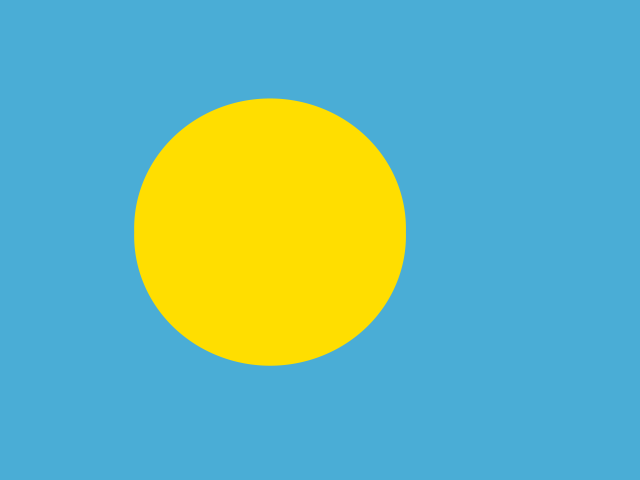
The Flag of Palau
Oceania · Adopted 1 January 1981
Palau adopted its flag on 1 January 1981, the day its constitution took effect and it became internally self-governing, more than a decade before Palauan voters finally approved the free-association terms with Washington that brought full statehood in 1994 — the last of the former Trust Territory districts to complete that transition, after seven separate plebiscites on the Compact spread across the 1980s failed to reach the required approval threshold. It was chosen through a design competition run during Palau's constitutional convention in 1979 and 1980, a process that produced a design deliberately distinct from the light-blue, star-based flags most of its Micronesian neighbors were adopting around the same time out of the former Trust Territory of the Pacific Islands.
The field is a rich medium blue representing the surrounding Pacific Ocean, but the central device is a single golden-yellow disc, offset toward the hoist rather than centered — a detail people unfamiliar with the flag frequently misread. It is not a rising or setting sun, the motif used on several other Pacific flags; it represents the full moon, which holds specific, practical cultural significance in Palau: traditionally, the timing of harvesting, planting, fishing, and important ceremonial and social activities was set according to the lunar calendar, and the full moon in particular was regarded as the point of greatest calm, unity, and peace, considered the optimal time for important community decisions and gatherings.
The disc's off-center placement toward the hoist is itself meaningful rather than decorative — it echoes traditional design conventions in Palauan and broader Pacific decorative art, where balance is often achieved asymmetrically rather than through strict central symmetry, and it also has the practical effect of making the disc read clearly even when the flag is hanging still rather than fully extended in wind.
Palau's constitutional convention deliberately avoided incorporating any colonial-era symbolism into the new flag, a notable choice given how many other Pacific nations built their independence flags directly on top of colonial coats of arms or administrative flags — Palau instead started from a blank field and chose a purely lunar, locally rooted symbol with no reference to Spanish, German, Japanese, or American administration, the four powers that had successively governed the islands since the late 19th century.
The moon symbol also carries a practical resonance tied to Palau's reputation today as a global center for marine conservation: Palau established one of the world's first shark sanctuaries in 2009 and later created the Palau National Marine Sanctuary in 2015, closing roughly 80% of its exclusive economic zone to commercial fishing, a set of policies frequently described by Palauan officials as a continuation of the same traditional resource-management thinking — attentiveness to natural cycles like the moon — that the flag's central symbol represents.
Palau's flag was designed under real time pressure: accounts from the constitutional convention describe the winning design being finalized only days before it needed to be sewn and flown for the first time, and the specific shade of blue was reportedly adjusted more than once after early versions were judged too close to the trust-territory flag's paler tone to read as a genuinely new national symbol.
The flag has not been redesigned since 1981, and it was formally carried forward unchanged as the flag of the fully sovereign Republic of Palau once statehood took effect on 1 October 1994, seven years after the winning 1987 Compact plebiscite finally cleared Palau's own constitutional supermajority requirement for approving nuclear-related agreements, a domestic legal hurdle that had blocked the earlier votes.
Constitution Day, 9 July, and Independence Day, 1 October, are Palau's two principal flag-ceremony occasions, reflecting the two-stage path — self-government in 1981, full sovereignty in 1994 — that the country took toward independence.
Palau's flag law sets the proportions at 5:8, notably closer to square than the 2:3 or 3:5 ratios common elsewhere, and specifies the golden disc's diameter and its offset from the hoist edge in exacting fractional terms rather than leaving proportions to the flagmaker's judgment — a level of precision the convention adopted specifically so the disc would read clearly as off-center by design rather than as a manufacturing error when flags were produced by different workshops.
Palau's admission to the United Nations on 15 December 1994, as the organization's 185th member, closed out the last active case before the UN Trusteeship Council: of the original eleven trust territories placed under UN oversight after 1945, Palau was the final one to complete the transition to full self-government, and the Council formally suspended its regular operations shortly afterward since it no longer had any territory left to administer — making Palau's flag, in a narrow but genuine sense, the last national flag raised to close out the post-WWII trusteeship system entirely.
Palau's capital was moved in 2006 from Koror, the country's commercial and population center, to purpose-built Ngerulmud on Babeldaob, the largest island — a relocation intended to spread development beyond crowded Koror, but one that left Palau with one of the least populous national capitals in the world, with a resident population routinely reported in the low hundreds even as the flag flies daily over its capitol building. Traditional Palauan bai, elaborately carved and painted communal meeting houses historically used by village councils, are frequently invoked alongside the flag's lunar symbolism as a shared reference point for how closely Palauan governance and design tradition still track pre-colonial custom.
Like the Marshall Islands and the Federated States of Micronesia, Palau uses the US dollar as its currency and negotiates its own Compact of Free Association funding directly with Washington; a fresh 15-year Compact review agreement between Palau and the United States was signed in 2024, continuing the direct financial-assistance and defense relationship that has run, with periodic renegotiation, since Palau's 1994 accession to full sovereignty.
An off-centre disc at 5:8
- Flag cut to 5:8 — The disc is deliberately set toward the hoist rather than centred, and its offset is specified against a 5:8 field, so a stock cut with a centred circle gets both facts wrong at once.
As an Amazon Associate we earn from qualifying purchases made through these links, at no extra cost to you.
Often confused with
- Bangladesh — the classic vexillological comparison for Palau — both use an off-center circular disc on a plain field, but the colors are reversed and unrelated in meaning: Bangladesh's flag is a green field with a red disc representing the sun and the blood of its 1971 independence struggle, while Palau's is a blue field with a golden disc representing the moon, with no connection between the two designs beyond the shared compositional idea. Compare side by side →
Palau at a glance
- Capital
- Ngerulmud
- Population
- 18,000 (2024)
- Currency
- United States Dollar (USD)
- Language(s)
- Palauan and English (official nationally); Sonsorolese and Tobian additionally official in their respective states, Japanese recognized in Angaur state
Population figure as of 2024, source: UN World Population Prospects (2024 revision). See methodology for how facts are sourced and kept current.